Nevermind album-cover phone case
The Sun is Also a StarThe Nevermind album-cover phone case is the object that connects Natasha Kingsley’s daily passage through a security checkpoint with Irene’s private struggle against loneliness. Natasha experiences it as a personal possession that Irene repeatedly handles while delaying her appointment; for Irene, the image becomes a focus for attention and a route to music that speaks to her despair. Its significance comes not from changing hands, but from being examined again and again by two people who understand those encounters very differently.
Design and Repeated Inspection
The case displays the cover art for Nirvana’s album Nevermind: a baby boy submerged in clear blue water, spread-eagled in a pose that suggests flying as much as swimming, with a dollar bill hanging from a fishhook in front of him. The image is striking enough to hold Irene’s attention each time Natasha submits her phone for screening. Irene feels an extra breath rise in her as she looks at the apparently underwater baby, an involuntary response that makes the image seem to draw her into the scene.
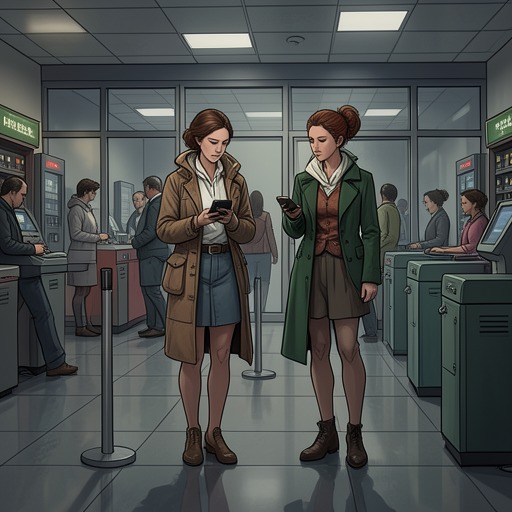
The case becomes part of a daily ritual. Natasha has been passing through the checkpoint every day that week, and Irene stops the gray bin before it reaches the conveyor belt, then turns over the phone and studies the image. Natasha notices the repeated handling. She dislikes Irene’s fingers lingering on the baby, but she does not speak up: she has an appointment she cannot miss and fears that making Irene angry could delay her further. The object is thus both visually conspicuous and practically vulnerable, exposed to the guard’s inspection while its owner waits for permission to continue.
Two Readings of the Object
For Natasha, the phone and its case belong to a private world she keeps close while moving through an unfamiliaring institutional routine. She watches the bin rather than Irene, as if reluctant to be separated even briefly from her phone and hot-pink headphones. She takes Irene’s inspection as evidence that the guard may dislike her or her work, and reads the delay through the pressure of her own appointment. Irene, meanwhile, sees Natasha as another applicant seeking something from America and does not recognize her as the same person who has appeared every day that week. The case is repeatedly present, but the people’s awareness of one another is unequal.
Irene’s attention to the case is also an attempt to make contact without openly asking for it. Her job supplies nearly all of her human interaction; she needs the applicants’ presence, even though most concentrate on their belongings and watch the bins pass through the machine. She wants to touch the objects people bring with them, but her gloves and the moving line keep that wish at a distance. Natasha’s phone gives her a particular image to return to, and the familiar act of looking becomes a small, repeated connection. Yet Irene does not greet Natasha aloud or explain why she keeps the bin from moving. The case holds the attention that neither woman can turn into a conversation.
From Album Cover to Music
The image leads Irene to the album behind it. During her lunch break, she downloads Nirvana’s music and listens to it three times in a row. In Kurt Cobain’s voice, she recognizes the loneliness and wanting she has associated with the image and with Natasha’s case. She looks up Cobain’s story and learns that it did not end happily. The case has therefore carried Irene’s attention beyond the checkpoint: it prompts her to seek out music, and that music intensifies thoughts she has been living with for years.
Irene has been considering suicide on and off for a long time, but she finds in Cobain’s lyrics words that seem to give form to her despair. She makes a plan to die that day and writes a note addressed to no one. The case itself neither speaks nor leaves Natasha’s possession; its role is indirect but consequential. The repeated sight of its cover prompts the search for the album, while the album’s voice becomes part of the chain leading Irene toward a life-threatening decision. An everyday object at the checkpoint thus participates in a crisis whose depth Natasha cannot see.
Narrative Significance
The case’s meaning depends on the contrast between its repeated physical handling and the unspoken lives attached to it. Natasha sees Irene’s scrutiny as an obstacle and worries about the time it costs her. Irene’s perspective reveals that the same encounter is a rare chance to feel connected to another person. The narrative first establishes the case as an object Natasha resents having touched, then shows how Irene’s attention to it belongs to her need for contact. That shift corrects Natasha’s assumption that Irene is simply an unhappy worker, without making the inspection itself less intrusive from Natasha’s point of view.
The case also links private distress across a divide neither character can readily cross. Natasha carries an image associated with a song and musician who have helped her endure a nightmare; Irene encounters the same image without knowing what it means to Natasha, then finds her own way to the music. The cover does not make their experiences identical, and their brief checkpoint encounters do not amount to an acknowledged relationship. Instead, it gives the narrative a material thread between them: an image seen daily, a phone held back from the conveyor belt, and a song that reaches Irene when her loneliness has become dangerous.