The 7 train conductor's sermon
The Sun is Also a StarThe 7 train conductor's sermon turns a routine subway delay into a brief, unruly collision between private faith and public life. The conductor tells trapped passengers that God has saved him and can save them too; many respond with disbelief or annoyance, and the train eventually empties at Times Square. Yet the speech does not end at the platform: its claim that life has purpose enters Daniel Jae Ho Bae's thoughts as he abandons his planned trip and follows what he takes to be a sign.
The Breakdown and the Announcement
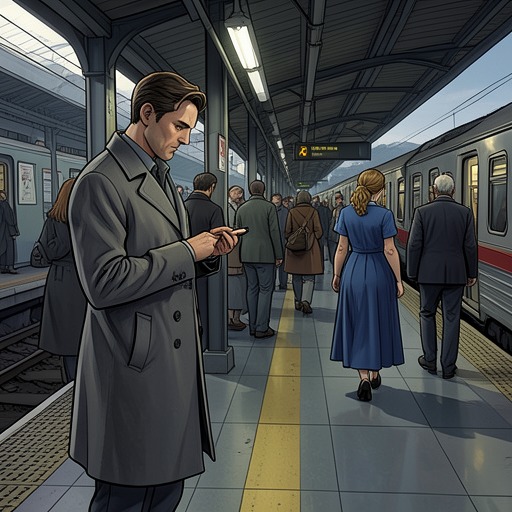
Daniel is traveling toward Manhattan, where he plans to visit his favorite barber, and has taken out his notebook to work on a poem. After roughly fifty minutes and three poorly written lines, the train is close to his stop when it moves only about twenty feet into a tunnel and halts. The lights go out. Five minutes pass before the conductor speaks over the system, turning an expected service update into a personal testimony.
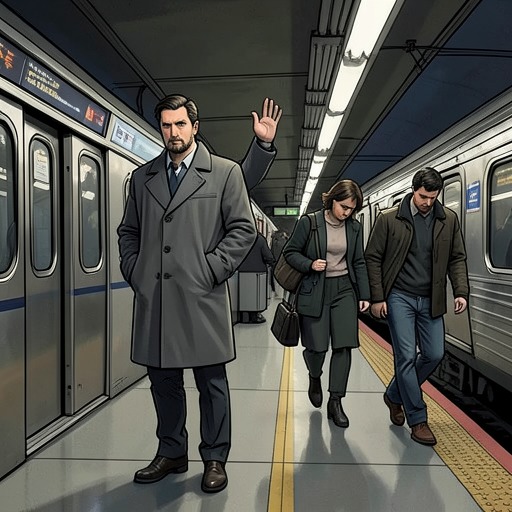
The conductor announces, “Up until yesterday I was just like you. I was on a train going NOwhere, just like you.” The words recast the literal stoppage as an opening for a religious message. Rather than simply tell riders what has happened to the train, he makes the stalled journey a metaphor for spiritual direction, placing himself among the passengers before declaring that something has changed him.
The Conductor's Conversion
The story later supplies the experience behind the announcement. One night, while following his usual ritual of watching television, the conductor sees a program he has never watched before: a man at a lectern, projected on an enormous screen, weeping before an audience. Some audience members are crying too, though the conductor recognizes that their tears are not sad ones. He stays awake through the night, unmutes the program, and watches until morning.
The next day he researches Evangelical Christianity and finds a framework that answers a need he did not know how to name. Its four principal commitments, as he understands them, are being born again, believing wholly in the Bible, accepting that Christ died so people may be forgiven, and actively spreading the gospel. The promise of being made new matters especially to him: he welcomes the idea of being free of sin and worthy of love and salvation. His later announcement is therefore not merely an eccentric interruption of subway etiquette; it is the outward act of a newly adopted faith.
The account also identifies the emotional force beneath his proselytizing. The conductor experiences belief as joy, and as certainty that life has purpose, that hardship is not the whole story, and that a better future awaits. He has come to interpret even bad events as happening for a reason. His appeal to passengers follows from that conviction: if faith has given his own life meaning, he feels compelled to share it with fellow travelers. The train's physical delay becomes the occasion for announcing a different destination, one beyond the route map.
A Sermon Met with Resistance
The conductor's delivery is emphatic: he overpronounces the beginnings of words and sounds as though he is smiling while he evangelizes. He tells the passengers, “God HIMself came down from HEAven and he saved me,” then urges them, “HE will save you too, but you have to ACcept him into your hearts. ACcept him now before you reach your final DEStination.” The emphasized syllables make the speech sound unlike the ordinary announcements riders expect, heightening the gap between the conductor's certainty and the passengers' impatience.
Their reactions are varied but not receptive. Some roll their eyes or smack their foreheads. A man in a suit tells the conductor to stop talking and drive the train; a mother covers her little girl's ears and objects to the man's profanity. For a moment Daniel imagines the passengers turning on one another, a comic but uneasy prospect in the darkened car. The conductor falls silent, and the train moves again after another minute. His authority over the loudspeakers gives his message an audience, but it cannot compel agreement.
At Times Square, the doors still do not open at once. The speakers crackle back to life, and the conductor declares, “This train is now out of SERvice. Do yourself a FAvor. Get out of here. You will find God if you look for him.” The instruction combines an actual service notice with one last appeal. The passengers leave somewhere between relief and anger, each with somewhere else to be. Daniel's observation that finding God is not on anyone's schedule captures the practical indifference that the sermon has failed to overcome.
Aftermath and Narrative Consequence
For Daniel, however, the speech does not remain only an awkward subway episode. He has already decided to let the universe dictate his choices on this last day of childhood, and the conductor's invitation to find God follows him onto the street. Times Square seems an unlikely place for divine discovery to him, but the message has altered how he reads what happens next: he is alert to the possibility that an ordinary encounter might carry meaning.
A woman on the sidewalk briefly loses herself in whatever she is listening to, then opens her eyes, hunches her shoulders, and hurries away. Daniel watches her go and notices the large white words DEUS EX MACHINA on the back of her leather jacket: God from the machine. The phrase makes the conductor's voice return to his mind, and Daniel wonders whether the coincidence is a sign. When she enters Second Coming Records, the shop's name seems to strengthen that impression. Daniel decides not to wait for another train to take him to Thirty-Fourth Street; keeping what he regards as a noncreepy half-block distance, he follows her instead.
The sermon thus has consequences beyond its immediate audience. Most passengers leave the train irritated or relieved, and the conductor's words do not change the route or persuade the crowd. But for Daniel, the language of providence turns the day's chance details into a pattern worth pursuing. The scene holds the same event in two registers: an interruption that passengers want to end, and a possible invitation that Daniel carries forward.