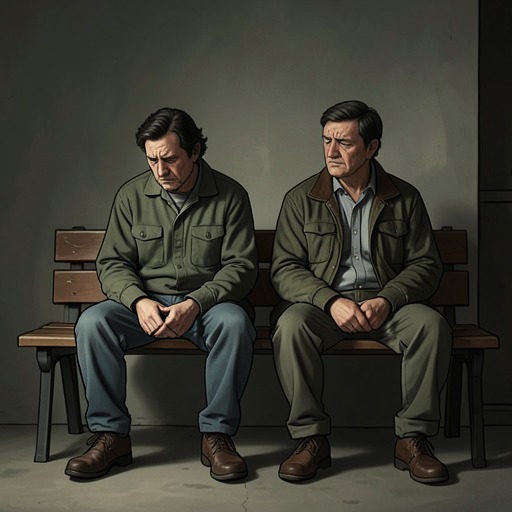
The marriage of Samuel Kingsley and Patricia Kingsley amid their move to pursue his acting dream
The Sun is Also a StarThe marriage of Samuel Kingsley and Patricia Kingsley begins under the pressure of a shared plan: Samuel will go ahead to the United States and pursue acting, then his wife and daughter will join him. That plan separates the family for two years and brings them together again in New York City, but reunion does not resolve the tension between Samuel’s ambition and the obligations of family life. As the years pass, the acting dream that helped motivate their move becomes a source of exhaustion and resentment, while the family’s migration leaves Patricia and their daughter carrying the consequences alongside him.
A migration organized around a dream
Samuel Kingsley moved to the United States two years before Patricia Kingsley and their young daughter, Natasha Kingsley. At first, the separation was meant to last only a year. Samuel hoped to establish himself as a Broadway actor, and believed that going alone would leave him free to audition at short notice and make connections in New York City without the demands of caring for a wife and child. A cousin in New York City had promised help, and the prospect of opportunity made the move seem possible even though Samuel had been poor all his life.
The plan lasted longer than Patricia was willing to accept. One year became two, and might have become three, but Patricia could not and would not wait any longer. Her decision to bring the family to the United States was therefore not simply the completion of Samuel’s original plan: it was also a limit placed on how long the marriage could remain divided across countries. Their migration depended on the promise that they would live together again, but the move also brought Patricia and Natasha into a country where the family had to adapt without knowing whether the stories of safety and prosperity would prove true.
For Natasha, the separation survives as a childhood memory of telephone calls. When she was six, she could recognize that a call was coming from the United States because her mother had to dial extra numbers. At first, Samuel sounded happy and familiar. After about a year, his voice seemed to change: his accent acquired a lilt and twang, and he sounded less happy. Natasha could not hear his side of the conversations, but she understood enough from Patricia’s questions to sense what the distance was doing to the family. Patricia asked how much longer they were expected to wait and said that they were no longer a family in the same way while Samuel was there and they were elsewhere.
Reunion and the work of making a life
When Patricia and Natasha finally left Jamaica, Natasha expected that she might see the family and friends she was leaving again at Christmas. She did not understand that the family’s undocumented status could make returning home impossible. Her memories of departure combine that uncomprehending childhood expectation with anxiety about the journey and about whether Samuel would recognize her after so long. At the airport, he did recognize her and held her and Patricia close. He told them how much he had missed them, and in that moment he sounded as he had before, his Jamaican patois unchanged. The reunion restores an intimacy that the long separation had made uncertain, even as the move makes their former home harder to reach.
The practical arrangement that followed required Samuel to change the way he pursued his ambitions. During his two years alone in the United States, he had lived with an old family friend of his mother and used savings to meet his limited expenses. With Patricia and Natasha there, he took a security-guard job in a Wall Street building and found a one-bedroom apartment in Flatbush, Brooklyn. He chose the graveyard shift so that he could audition during the day, telling Patricia, “Me can make this work.” The promise expresses an effort to hold both parts of his life together: earning money for the household while continuing to seek acting work.
That arrangement imposed a cost. Samuel was tired during the day, and no acting parts came his way. His accent did not disappear despite his attempts to change it, and Patricia and Natasha continued to speak with full Jamaican accents even as he tried to teach them what he considered proper American pronunciation. The family’s different relationships to speech expose the unevenness of adaptation: Samuel treats American pronunciation as an aid to his professional hopes, while the voices Patricia and Natasha bring with them remain part of their family life. The evidence does not present the accent as a simple obstacle that could be solved through effort; it persists alongside the repeated rejection that Samuel must face.
The strain between family duty and artistic ambition
Rejection wears Samuel down. Acting, in theory, calls for a thick skin, but his is not thick enough to withstand the continual disappointments. The narration likens rejection to sandpaper, wearing his skin away, until he is unsure whether he or his dreams will last longer. This image makes the marriage’s central pressure more complex than a choice between a good husband and an impractical dream. Samuel has taken work and arranged his hours around auditions, yet the dream remains vivid enough to measure his life against what he has not achieved.
That frustration later breaks into an accusation against the family itself. In an angry outburst, Samuel says he is tired of hearing about Patricia’s dreams and complains that, without her and the children, he would have everything he wanted and could use the talent God gave him. He regrets having entered the store and says his life would have been better if his family had not stood between him and the work he believes he was meant to do. His words recast the family’s shared migration as a burden on his ambitions, despite the fact that Patricia and Natasha crossed countries to join him and that his own plan had been premised on their eventual reunion.
The accusation does not erase the earlier evidence of affection or effort. Samuel had missed Patricia and Natasha, held them close when they arrived, and tried to make a working life in Brooklyn while continuing to audition. The contradiction is the point: he can love his family and still experience their needs as the loss of the artistic future he imagined. His anger reveals how far the promise of making things work has moved from the practical arrangement he once proposed. What began as a plan to establish himself for the family has become, in his own account, a reason he cannot have the life he wants.
Family consequences and the limits of the record
The marriage unfolds within the family’s precarious immigration circumstances. Years later, Samuel’s drunk-driving arrest is followed by a Notice to Appear from the Department of Homeland Security, bringing the family’s status into the legal process. Natasha asks why she should have to pay for her father’s mistake, separating his responsibility for the arrest from the consequences that threaten the family. Her question makes visible how an individual action can place a whole household at risk, though it does not by itself establish how Patricia responds to Samuel or how the couple resolves their conflict.
Natasha does not tell the attorney about her father’s harshest words concerning Patricia and the children. Instead, she recounts the notice that arrived after his arrest. That omission is consequential: the lawyer receives the facts she chooses to give about the family’s case, not the full account of Samuel’s bitterness toward his wife and children. The marriage thus appears not only in direct exchanges between the spouses but through the daughter who remembers their separation, witnesses the family’s reunion, and carries knowledge of the conflict into a legal crisis.
The relationship’s significance lies in its unresolved collision of commitments. Patricia refuses to remain indefinitely apart from Samuel; Samuel welcomes his family and tries to accommodate them while pursuing acting; and the years of failure turn those obligations into material for resentment. Their migration creates a household together, but it does not guarantee that the dream around which the move was organized can survive the demands of making a life. The available account shows the cost of that tension without supplying a final reconciliation or a definitive end to the marriage.