
The Word as Historical Evidence
The Surgeon of CrowthorneThis thread traces how the book presents dictionary-making as the reconstruction of each word’s changing life from dated examples rather than the imposition of a timeless definition.
increasing Bearing strength in each event
 decreasing
Bearing strength in each eventdecreasingTrench’s Historical Proposal
A Dictionary as History
The Deficiencies of Existing Dictionaries
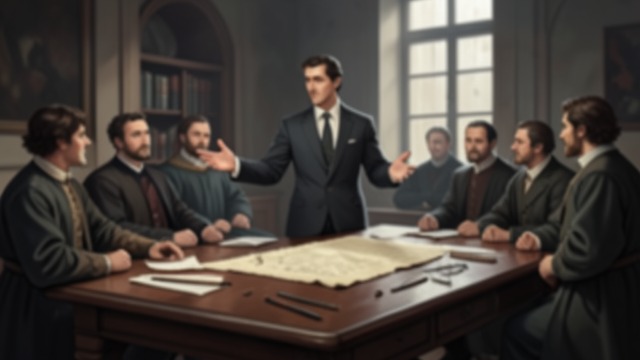
At a meeting of the London Library’s Philological Society, Richard Chenevix Trench argued that English dictionaries had failed to register the language fully. Their makers had too often selected supposedly worthy words and corrected usage according to personal standards, rather than recording what speakers and writers actually used.
Trench proposed a different responsibility: the lexicographer should act as a historian, not a critic. A dictionary, in this view, was an inventory of the language, obliged to include words with recognized lives whether they seemed elegant, obsolete, or socially disfavoured.
Words with Lives
The proposal also made chronology essential. Each word had a history that could be reconstructed from surviving written evidence: examples could show when a form appeared and how its senses shifted. The ideal dictionary would therefore preserve not only what a word meant, but the sequence of meanings through which it had travelled.
The project’s scale made the proposal daunting. To document English in this way required broad reading across centuries, far beyond the capacity of a lone editor. Trench’s historical principle thus led directly to a practical question: how could the evidence be gathered at all?
The Evidence-Gathering Network
Reading on a National Scale
A Collective Method
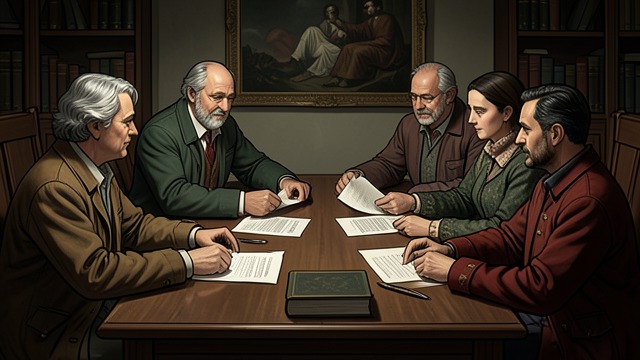
The Philological Society turned the historical ideal into a plan for organized reading. Volunteers would examine books from different periods, copy passages illustrating particular words, and send their slips to editors for sorting. The method made literary quotation the raw evidence from which definitions and word histories could be built.
Herbert Coleridge designed pigeonholes for the expected contributions and believed that an initial volume might appear quickly. The estimate proved radically optimistic: the quantity of material and the time needed to organize it were vastly greater than the early organizers had imagined.
Enthusiasm and Attrition
Frederick Furnivall tried to sustain the volunteer network, but the work was laborious and the requests difficult to keep alive. Readers returned books, stopped sending slips, or misunderstood what counted as useful evidence. The project’s ambition threatened to overwhelm the very system intended to make it possible.
The early failures revealed an important truth about historical lexicography: collecting examples was not a preliminary chore that could be rushed past. It was the foundation of the whole enterprise, and its scale would determine the pace and form of every later editorial decision.
Murray’s Editorial Workshop
From Slips to a Dictionary
A New Editor and a New System
After the project stalled, Frederick Furnivall helped persuade James Murray to take on the editorship. Murray developed a detailed workflow: incoming slips were checked, alphabetized, separated by part of speech, arranged chronologically, and grouped by shades of meaning before he supplied etymology, pronunciation, selected quotations, and definitions.
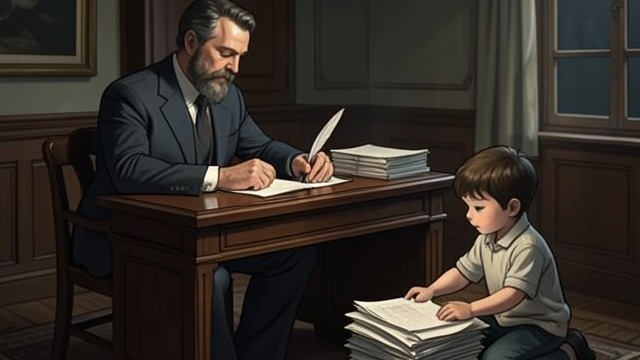
The labor took place first at Mill Hill and then in Oxford, where a purpose-built Scriptorium handled an expanding flood of paper. Assistants and even Murray’s children helped process the evidence. The editor’s system transformed volunteer reading into an organized editorial operation, but it could not make the work quick.
A First Public Result
The first fascicle appeared in January 1884, covering the alphabet from A to ant. Its dense succession of forms, senses, and quotations made visible the historical method’s intricacy. The modest-looking installment represented years of collecting, checking, and editorial reconstruction.
Murray expected the Dictionary to be completed within a relatively short period, but the first installment already suggested how much evidence each word might demand. The work’s authority would rest on the accumulation and arrangement of examples, not on a single editor’s confidence or taste.
Minor’s Indexed Archive
Reading Before the Request
A Private Indexing Method
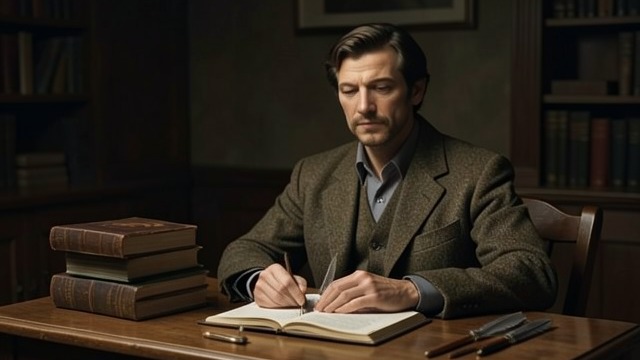
William Chester Minor responded to James Murray’s appeal by reading rare and historical books in his Broadmoor rooms. Rather than immediately sending every interesting quotation, he made extensive, alphabetized word-lists in small quires, carefully recording where each candidate appeared in its source.
This private index let him work in advance of the editors. When the Dictionary office later requested a word, Minor could search his own lists, return to the precise passage, and select a quotation suited to the editorial need. His method converted solitary reading into a ready store of evidence.
The Value of Exactness
The approach differed from that of most volunteers, who generally sent quotations as they encountered them. Minor’s lists allowed the editors to request material for words they were actively preparing, making his contribution unusually timely as well as meticulous.
His first substantial response concerned art, a word that had troubled Murray’s team with its many senses. Minor supplied a large group of examples, including a dated passage that entered the Dictionary. The episode shows the historical method at work on a small scale: a difficult abstract word became more intelligible through the sequence and context of its recorded uses.
The Monument in Print
A Language Recorded
Completion and Scale
The completed New English Dictionary appeared in 1928 after decades of work by editors, readers, and printers. Its twelve volumes contained hundreds of thousands of defined words and more than a million illustrative quotations, making the accumulated evidence itself part of the book’s achievement.
The finished work did not present English as a frozen system. Its historical entries registered old forms, changing senses, and new evidence gathered during the project. Later supplements incorporated material that had been missed or had emerged while the original volumes were being prepared.
An Unfinished History
The story’s account of the Dictionary emphasizes that even such a monumental reference work could not claim absolute finality. Researchers could find earlier examples than the editors had located, and the record of English continued to grow beyond the book’s first publication.
Its authority therefore came not from ending linguistic change but from documenting it with unusual patience and precision. The Dictionary stands as a historical monument precisely because its quotations preserve a language in motion, rather than pretending that one generation’s usage can settle it for all time.
November 1857
1858 through the early 1870s
1878–1884
Early 1880s through 1885
1928 and the 1933 supplement
