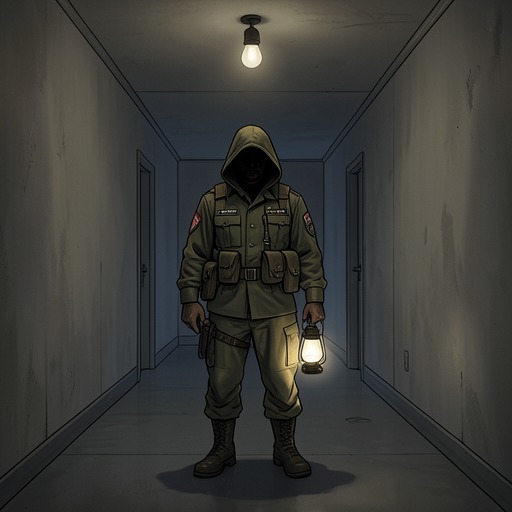
Branding of the Irish deserter
The Surgeon of CrowthorneThe Branding of the Irish deserter was a wartime punishment that placed William Chester Minor, then a young Union Army surgeon, in the role of carrying out a sentence against an Irish soldier. The episode mattered beyond the battlefield: it became one of the principal explanations offered for Minor’s later fear of Irishmen and his mental illness. The account connects a specific act of military discipline to the story Minor believed about his own danger, while making clear that the proposed connection was never established as the definitive cause of his illness.
Background and sentence
Branding was one of several punishments used to shame and discipline soldiers. Military regulations specified a letter D, one and a half inches high, and allowed it to be applied either with a hot iron or by cutting the mark and filling the wound with black powder. The book presents branding as a particularly severe combination of pain and public humiliation. In this case, the sentence was imposed on an Irish deserter captured during the Battle of the Wilderness.
The deserter had fought for the Union Army, but the narrative describes his loyalties as having shifted. After emancipation, he regarded the conflict as no longer serving the cause for which he had enlisted; he wanted to return to Ireland and oppose British rule there. Five soldiers from the Provost-Marshal’s unit found him hiding behind a barn on a farm in the foothills. A drumhead court martial followed quickly. It sentenced him to thirty lashes with a cat and to be branded on the face before the flogging.
The account places the deserter’s circumstances against the abruptness of military justice: capture, a swiftly convened court, and a severe sentence. It describes him as exhausted after trying to escape and as having served in battles in Pennsylvania and Maryland as well as Virginia. The punishment would carry different meanings in the two places he had in mind. In America, the mark would shame him as a deserter; in Ireland, the narrative suggests, it could identify him as a man with military experience who intended to fight the British.
Minor’s role
The officers required Minor, a newly assigned surgeon, to carry out the branding. They treated the order as a way to initiate the young doctor into the rigours of war. The deserter was brought to him with his arms restrained behind him. Minor took the branding iron from a basket of coals borrowed from the brigade farrier, but paused before carrying out the order. The book presents that hesitation as evidence of his reluctance and notes his brief concern about whether the punishment was compatible with his Hippocratic code.
The officers pressed him to proceed, and Minor applied the iron to the deserter’s cheek. Afterward, the prisoner was led away with an alcohol-soaked rag that Minor had given him. This account records the immediate aftermath without claiming to know how the wound healed. The mark itself, however, is presented as lasting: it would remain with the deserter and could shape how he was treated on his return to Ireland.
The episode also made Minor’s position unusually conflicted. He was a doctor, but the military command used him to administer a punishment that was not treatment. The account does not describe him as choosing the sentence; the court martial had imposed it and the officers directed him to carry it out. His hesitation, followed by compliance, is the consequential distinction in the scene: the order came from the officers, but the act of branding was performed by Minor.
The deserter and the meaning of the mark
The narrative gives the deserter a possible future beyond the punishment. He wanted to return to his family and to Ireland, where he hoped to use his soldiering experience against British authority. The branding threatened that future as well as his standing among soldiers. The account reasons that the mark could expose him to suspicion, harassment, or detention by British and Irish authorities, and thus make the intended return to revolutionary activity much more difficult.
It also suggests that the deserter might have held Minor responsible. In the book’s reconstruction, he could have seen the young surgeon as the man who had betrayed his medical calling by marking him. The deserter’s anger at that act may, the account proposes, have become a source of fear for Minor: Minor could imagine that the man would return to Ireland, tell Irish patriots what had happened, and encourage revenge against him. This is presented as what Minor almost certainly believed was in the deserter’s mind, not as a documented threat made by the prisoner.
Later explanation and limits
The branding episode acquired a second life in accounts of Minor’s illness. During Minor’s murder trial at Kingston Assizes in early April, witnesses described the extent of his fears. His landlady, Mrs Fisher, was reported to have connected his fear that Irishmen would abuse him with his having been ordered to brand an Irish soldier during the American Civil War. The story was repeated for decades as a leading possible explanation of his condition. In compressed form, it became the claim that the wartime punishment had driven him mad.
The book does not establish that claim as a medical conclusion. Some doctors had suggested exposure to battlefield conditions as a cause of Minor’s illness, and another account linked it to his having witnessed an execution; the available version of that story supplied neither a time nor a place. The branding explanation was influential, but it existed alongside other proposed causes. In 1915, when Minor was elderly and gave an interview to a journalist in Washington, DC, he told a different story. The evidence therefore supports the episode’s importance in the history of how his illness was explained, while leaving its actual causal role unresolved.