Collaborative volunteer lexicography
The Surgeon of CrowthorneCollaborative volunteer lexicography was the organizing method that made a historical English dictionary possible: instead of entrusting the reading of the language’s literature to one scholar or a small editorial office, it distributed that work among readers who gathered dated examples for editors to assess. Proposed by Richard Chenevix Trench for the New English Dictionary, the method joined a democratic ideal to a practical paper-and-post system. Its success depended not only on the number of readers it recruited, but on how carefully their dispersed reading could be turned into usable evidence.
A collective answer to an impossible task
The project required more than examples that illustrated what a word meant. Its ambition was to document the history of meaning: the changing life of each word as recorded across English literature, newspapers, magazines, and journals. Reading that material seemed too vast a task for any one person. Trench’s answer was to make the work the combined labor of a very large body of unpaid amateur readers.
The proposal surprised the Philological Society, but its collective character seemed to members to have a rough democratic appeal. The dictionary would be assembled not by an unaccountable authority imposing fixed rules on English, but through evidence gathered from individual readers and the language’s recorded uses. This method fitted Trench’s resistance to an autocratic model of linguistic authority: the enterprise’s form, as well as its subject, could express the freedom of people to use words without hard-and-fast rules. The volunteer plan was therefore both a labor strategy and an argument about who could participate in describing English.
That participation had a consequence beyond the immediate workforce. It eventually allowed William Chester Minor, a scholarly former United States Army assistant surgeon confined at Broadmoor, to contribute to the dictionary. The same open call that addressed a national-scale research problem could reach a reader living within a psychiatric institution, whose books and accumulated knowledge gave him an unusual capacity to help.
Readers, periods, and quotation slips
After the Philological Society formally adopted the plan for a wholly new dictionary on 7 January 1858, Frederick Furnivall issued a circular inviting volunteer readers to choose a period of English history. The available spans ran from 1250 to 1526, from 1526 to 1674, or from 1674 to the present day. These divisions reflected the editors’ view that different periods represented different developments in the language; recruiting readers by period could thus distribute attention across its history.
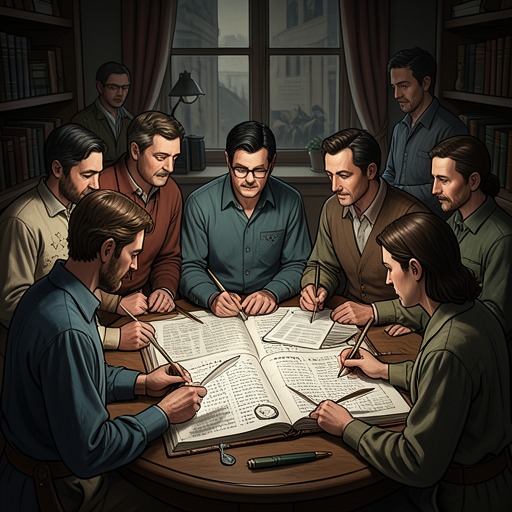
The routine was straightforward to describe but demanding to carry out. A volunteer offered to read particular books, made word-lists from that reading, and then searched more specifically for words the dictionary team wanted. For each example, the reader prepared a paper slip: the target word went at the top left, followed by the date, author, title, volume, and page of the source, and then the full sentence showing the word in use. That format preserved more than an isolated definition could: it connected a word to a dated occurrence and a recoverable passage. The quotation slip became a durable unit of the project’s collaborative method, one still used by lexicographers.
The system also depended on editorial work to make submissions consistent and retrievable. Later, at James Murray’s Scriptorium, incoming bundles passed through successive checks and sorts: readers checked that quotations were complete and correctly spelled; others arranged the words alphabetically, divided them by part of speech, and put their quotations in chronological order. Assistants then separated meanings into shades of sense and began drafting definitions. A volunteer’s contribution therefore entered a chain of handling and interpretation; the submitted sentence was evidence for editorial judgment, not a finished dictionary entry in itself.
Ambition, miscalculation, and scale
The first organizational plans badly underestimated what this work would produce. Herbert Coleridge, the first editor of the New English Dictionary on Historical Principles, designed a set of oak-board pigeon-holes nine wide and six high to hold an anticipated 60,000 to 100,000 slips. He expected the first volume within two years and attributed the prospect of delay to contributors’ slowness. In the event, volunteers supplied more than six million slips. The first saleable section took roughly ten times the expected time, and the project’s early progress was hindered by its organizers’ failure to grasp the scale of its labor, duration, and cost.
Coleridge’s death after only two years at work further slowed the undertaking. He was thirty-one and had not yet completed the examination of quotations for words beginning with A. Frederick Furnivall succeeded him, bringing energy to the work and introducing assistants between the volunteer readers and the editor. The dictionary’s collaborative structure was consequently not a simple direct exchange between amateur and editor: it required intermediaries and a growing means of managing the material readers produced.
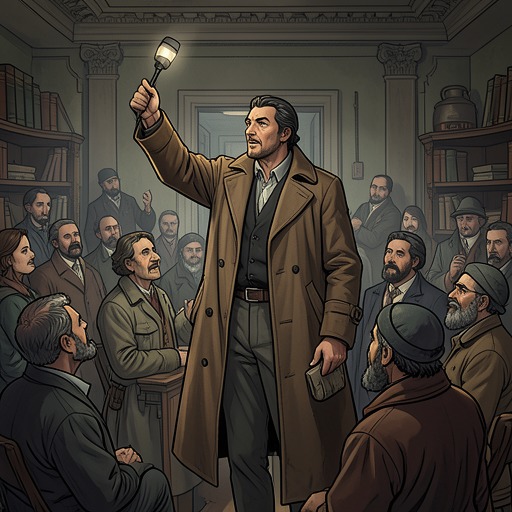
When Oxford University Press took the project forward and Murray was appointed editor, the call for readers was renewed. Within days of his agreement with the Delegates in 1879, he planned a corrugated-iron Scriptorium at Mill Hill School and prepared a four-page appeal to English-speaking and English-reading people. It sought readers in Great Britain, America, and the British colonies to extract material from books not yet examined. Newspapers and magazines printed parts of the appeal; bookshops and news-stands distributed it, and librarians used copies as bookmarks. Its movement through publications, shops, and libraries extended the project’s reach well beyond the Society’s own membership.
From a general appeal to targeted research
The appeal could also reach readers whose circumstances differed sharply from those of ordinary volunteers. In the early 1880s, a copy reached William Chester Minor in one of his cells at Broadmoor, where books lined a room from floor to ceiling. After eight years as an inmate, he was eager for useful intellectual work. The invitation led him to write to Murray and offer his services, making the dictionary’s open volunteer network consequential in a particularly unexpected setting.
Minor’s work showed how participation could become more targeted than simply reading an assigned book and sending in interesting sentences. He built indexes and word-lists from his own extensive reading, then asked the editors which words they needed. Once he received a request, he checked his indexed material, went back to the relevant book and page, transcribed a suitable sentence, and sent the quotation slip to the Scriptorium. Editors could therefore request evidence for a particular word rather than relying only on quotations that happened to surface in their own searches.
A request concerning art demonstrated the value of that arrangement. The editors had identified sixteen shades of meaning for the noun and sought earlier or additional evidence. Eighteen readers responded after an article in the Athenaeum drew attention to the request; Minor sent twenty-seven quotations, substantially more than the sentence or two supplied by other respondents. Many came from Joshua Reynolds’s Discourses, but the material was useful to the dictionary-makers, and one quotation became the first known example of Minor’s work to appear in the finished book. This exchange makes the method’s central principle concrete: a widely distributed invitation generated responses, while editorial requests and indexed reading helped convert one volunteer’s accumulated research into evidence needed at a particular moment.
A distributed dictionary
Collaborative volunteer lexicography was neither a crowd simply writing definitions nor a substitute for editorial expertise. Volunteers read, selected, dated, and documented examples; editors and assistants sorted the submissions, distinguished senses, and fashioned definitions from the historical record. The method relied on both sides of that relationship: readers multiplied the amount of literature that could be searched, while an organized editorial process made their evidence usable.
Its reach also made the work difficult to predict. A paper system devised for tens of thousands of slips had to accommodate millions, and the labor of collecting examples became inseparable from the labor of storing, sorting, checking, and interpreting them. Yet this material burden was evidence of the method’s achievement as well as its miscalculation. The dictionary’s historical record could be assembled because reading had been distributed among many people, and because their contributions could travel through slips and correspondence into an editorial center. The resulting work was collective in production, even where its definitions required concentrated editorial judgment.