Compilation of the Oxford English Dictionary
The Surgeon of CrowthorneThe Compilation of the Oxford English Dictionary turned an ambitious principle into a vast collaborative enterprise: instead of merely defining words, it would document their recorded histories through dated examples of use. Conceived in 1857 and completed in its first edition in 1928, the Dictionary depended on volunteer readers, editorial systems, purpose-built workspaces, and the painstaking conversion of paper slips into printed pages. Its scale and method made it both a reference work and a record of how English changed over time.
A historical dictionary on an unprecedented scale
The project arose from dissatisfaction with the limits of earlier dictionaries. In 1857, a formal proposal called for a work broader than the selections assembled by Samuel Johnson: it would attempt to include every word, nuance, spelling, pronunciation, etymology, and relevant literary citation. The ambition was not simply to give definitions, but to establish what could be known about each word from its recorded life in English.
The principle behind the plan was historical. For each word, editors sought evidence of its earliest known written use, followed by examples that could show changes in meaning and form. The quotations were not decorative illustrations added to a finished definition. They were the evidence from which the history of a word could be reconstructed, including the sequence and subtleties of its senses. The method promised a degree of precision that a dictionary compiled from definitions alone could not provide, but it required an immense amount of reading and made the project slow, costly, and difficult to keep current.
The scale of the completed work reflects that trade-off. The first edition, completed in 1928, comprised twelve large volumes and took more than seventy years to produce. When the first supplement appeared in 1933, the work became familiarly known as the Oxford English Dictionary. Five supplements followed; a later second edition integrated the original work and its supplements into twenty volumes. The second edition defines well over half a million words, while the opening pages of the first fascicle already reveal the accumulating reach of the project: its eventual extent would be 15,487 pages.
Volunteers, slips, and a growing editorial system
The project’s organizers concluded that no individual could read all the relevant English literature and periodicals. The necessary work, they proposed, would require the combined efforts of a large body of unpaid volunteers. Readers were to examine books, newspapers, magazines, and journals, recording examples of words that interested the editors. This proposal gave the enterprise a collective structure: the Dictionary’s evidence would be gathered across many readers and places, then coordinated by its editorial team.
Each quotation was recorded on a paper slip. The reader wrote the target word at the top, then identified the date, author, work, volume, and page, followed by the complete sentence illustrating the word. The system made an example traceable to its source and allowed evidence to be sorted and compared. Readers were encouraged to look for rare, obsolete, archaic, new, or unusually used words, but ordinary words could also matter when a sentence illuminated their meaning. In principle, every word in a book could become a catchword.
The early estimates proved radically inadequate. Herbert Coleridge planned pigeon-holes for between 60,000 and 100,000 slips and expected the first saleable section within two years. In the end, more than six million slips arrived, and the work of producing the first section took far longer than anticipated. Coleridge died after only two years as editor, having not reached halfway through the quotations for words beginning with A. Frederick Furnivall succeeded him, and the Dictionary’s early history continued to be marked by delays and organizational difficulties.
On 1 March 1879, James Murray was formally appointed editor of the New English Dictionary on Historical Principles, then projected at about 7,000 pages in four volumes and ten years of work. Within days, he decided to establish a Scriptorium and to issue a fresh appeal for volunteers across Britain, America, and the British colonies. The project had moved from a broad proposal to an organized undertaking, but its published estimates still understated the labor ahead.
The Scriptorium and the making of entries
Murray first established a Scriptorium at Mill Hill School, then continued the work after moving to Oxford in 1884. The Oxford building, known within the family as the Scrippy, was a corrugated-iron structure fifteen feet by fifty, sunk into a three-foot trench after a neighbour objected to its effect on the view. The alteration left the workplace damp and cold. Yet its cramped, makeshift character coexisted with a more effective system for handling the growing volume of evidence: by then, more than a thousand slips were arriving each day.
The Oxford Scriptorium began with 1,029 pigeon-holes, compared with the fifty-four devised for Coleridge’s original scheme, and added shelves as the slips accumulated. Workers checked that quotations were complete and correctly spelled, sorted them alphabetically, separated the parts of speech, and arranged examples chronologically. Assistants grouped the evidence into distinct senses and drafted definitions. Murray then reviewed and further divided the material, supplied etymologies and pronunciations, chose representative quotations, and prepared the final definition.
This sequence connected physical organization to scholarly judgment. A word’s quotations had to be grouped by sense and ordered so that readers could see how meanings developed over time. Ideally, the published evidence included at least one literary example for every century in which the word was used, with more examples where meanings were changing rapidly. Murray’s definitions and selected evidence were then sent to the Press, set in type, returned as galley proofs, and prepared for printing. A planned output of 600 finished pages a year sat uneasily beside the reality that a single word could occupy three-quarters of a day’s work.
Contributors, correction, and the printed legacy
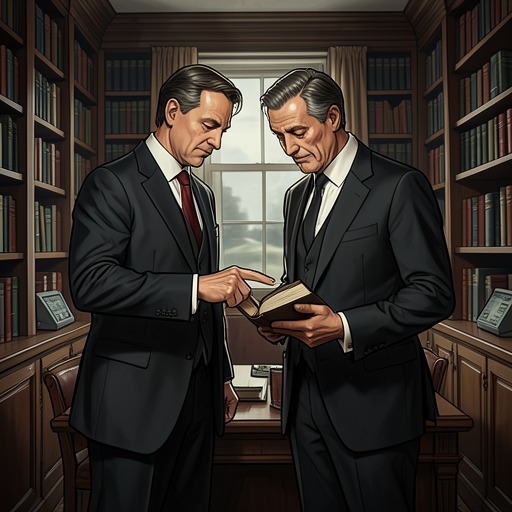
The volunteer system brought William Chester Minor into the Dictionary’s history. In the early 1880s, an appeal for readers reached his cell at Broadmoor, where books filled one of his two rooms. He became a dedicated contributor, following Murray’s instructions for recording catchwords and their documentary details. The collaboration also illustrates how the project’s distributed labor connected readers who worked in very different circumstances to the editorial center in Oxford.
The story of the two men’s first meeting later acquired a dramatic but unreliable form. Hayden Church’s 1915 magazine account portrayed Murray arriving at Broadmoor expecting to visit a fellow scholar and discovering that Minor was an inmate. The book’s account identifies this version as fiction. A letter Murray wrote to Francis Brown in 1902 instead indicates that his first contact with Minor came around 1880 or 1881, when he believed the frequent contributor was probably a retired medical man. Their actual meeting took place in January 1891, after Murray sought permission to visit. They then knew one another personally and met regularly for nearly twenty years, joined by respect and a shared commitment to words.
The Dictionary’s physical production eventually became part of its history too. Letterpress plates used for its printings were discarded as the Press adopted computer typesetting and photolithography. One plate was later cleaned and used to print proofs on handmade paper, one in Oxford Blue and another in China Red, then framed with the plate between them. The image of a surviving plate beside its proofs recalls the material chain behind the Dictionary: gathered sentences became slips, slips became edited columns, and columns became printed pages. The project’s defining achievement was not only the number of words it assembled, but the durable method by which it made their recorded histories visible.