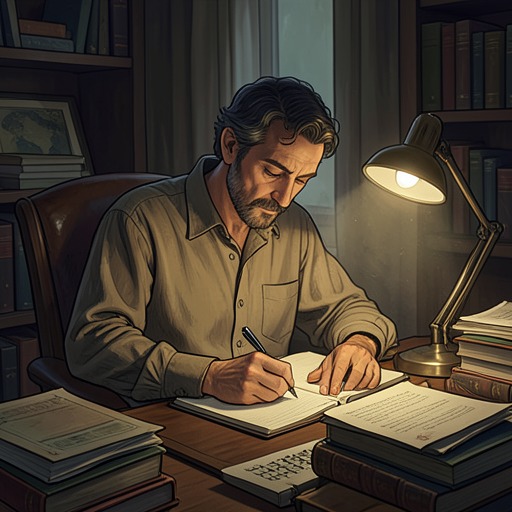
Dictionary-making as therapy
The Surgeon of CrowthorneDictionary-making as therapy is the account of how work on the Oxford English Dictionary gave William Chester Minor purpose, structure, and a measure of relief during his long confinement at Broadmoor Asylum. The project did not resolve his illness, and the evidence does not establish that it was a treatment in a clinical sense. Its significance lies instead in the sustained intellectual task it offered: a route back into scholarly life, a focus for his attention, and a fixed point that seemed to help him manage his distress.
Illness and the search for an explanation
Minor’s need for such a focus emerged amid a serious illness whose nature was initially described in period medical terms. In 1868, after severe headaches and vertigo, he was examined in New York. Surgeon Hammond’s report of 3 September classified his condition as monomania and described him as delusional, although it did not identify the subject of the supposed single-topic obsession. By November, doctors considered his condition serious enough to recommend institutional care; an examining doctor described the monomania as suicidal and homicidal. These records mark a progression from suspicion about his mental state to a formal recognition that he was gravely unwell.
Decades later, at St Elizabeths Hospital, psychiatrist Dr Davidian described Minor’s condition on 8 November 1918 as dementia praecox, of the paranoid form. The book presents that diagnosis in the changing language of psychiatry: dementia praecox had been named by Emil Kraepelin and was used for an illness understood to begin early in life, rather than the decline associated with old age. The change in terminology matters because it places Minor’s history between Victorian classifications such as monomania and a developing psychiatric framework. It does not, by itself, settle what caused his illness or establish a treatment that could have cured it.
The invitation into scholarly work
The Dictionary became important to Minor first as an invitation. When James Murray sent him two closely printed sheets of instructions for contributors, the value lay not only in the practical directions. Minor appears to have taken the correspondence as a sign of forgiveness and understanding, and the invitation as a form of membership in a society from which he had been estranged. Even while he remained confined in cells at Broadmoor Asylum, he could now imagine himself connected to the wider world of learning.
That connection seems to have affected his sense of self. After years of imprisonment and intellectual isolation, Minor’s confidence began to return, at least marginally. The surviving medical records, as described in the book, suggest that he became more contented while reading Murray’s letter and preparing to undertake the work. For a time, even the ward notes’ picture of a suspicious and brooding man gave way to signs of a change in temperament. Having something valuable to do mattered not as an abstract consolation but as a demanding task to which he could commit himself.
Routine, exacting work, and relief
Murray’s plan made the assignment more than a pleasurable trawl through books. The Dictionary depended on collecting quotations, and Minor understood that the scale of the project required close attention and careful selection. He had to search for material relevant to the editors’ needs and send the strongest examples. His cell-bound work therefore depended on method: reading with a specific purpose, judging evidence, and directing his discoveries toward a collaborative undertaking.
The scale and discipline of that undertaking also brought a difficulty into view. Minor recognized that the Dictionary’s potential importance to history and to English-speaking readers demanded that it be done properly, and wondered whether such work could be accomplished from an asylum cell. He nevertheless chose to contribute, both because it gave him worthwhile occupation and because he believed Murray’s approach was right. The task’s constraints did not make the work trivial; they made its rules and purpose especially consequential to him.
The account later describes the Dictionary slips as a kind of medication and therapy. Month after month, year after year, the quiet intellectual routine appears to have given Minor some release from paranoia. This is a qualified claim: the work offered relief and focus, not recovery from the underlying illness. The distinction is central to the idea of dictionary-making as therapy. A scholarly practice could shape the texture of his days and support his self-worth without removing his confinement or ending his delusions.
Limits, irony, and the loss of a lodestone
The narrative links Minor’s condition to several possible influences without presenting a settled cause. It asks whether his experiences of war, possible inherited vulnerability, temperament, or his confinement may have contributed to the course of his illness. It also notes the possibility that a more compassionate regime might have mitigated his distress. These remain possibilities rather than demonstrated explanations; the evidence does not show that any single event produced his illness or that the Dictionary work could substitute for medical care.
That uncertainty sharpens the book’s counterfactual irony. It suggests that treatments available in a later period might have reduced some of Minor’s symptoms, while also acknowledging that medication could have left him less inclined or able to perform the work for Murray. This is not an argument against treatment. Rather, it exposes the tragic contingency by which a contribution of lasting value became intertwined with a life marked by suffering and inadequate care.
The Dictionary’s importance as a focus also made its loss consequential. When the great book ceased to serve as Minor’s lodestone, the account says, his life began to decline. His later correspondence with Lady Murray, in November 1915, shows that a connection to the project remained: he offered the books sent from Broadmoor to the Scriptorium, hoping they would eventually go to the Bodleian Library. But the work could not protect him indefinitely. His eyesight failed, leaving him unable to read for a period, and he died in 1920. Dictionary-making had supplied a meaningful structure and a measure of psychological relief; it had never made him well, and it could not prevent the final narrowing of the world that reading had opened for him.