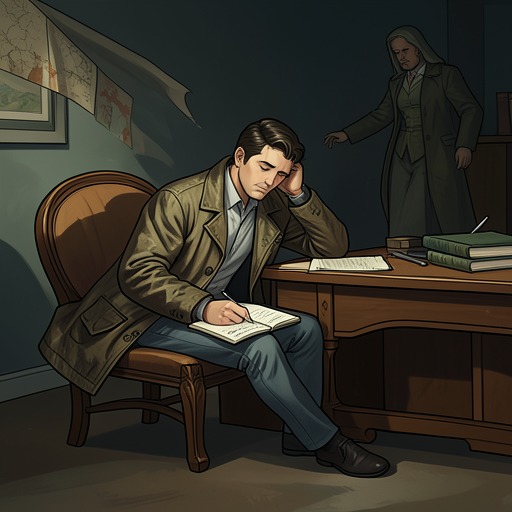
Dr Nicholson
The Surgeon of CrowthorneDr Nicholson was the Broadmoor Asylum for the Criminally Insane superintendent who welcomed James Murray to visit William Chester Minor in January 1891. By arranging the visit, treating Minor as a valued and cultivated person, and granting him unusual freedoms, Nicholson helped create the conditions for a relationship that joined institutional care with sustained intellectual companionship.
Role at Broadmoor
At the time of Murray’s visit, Dr Nicholson was the asylum’s governor; the account also identifies him as its superintendent. His importance to the story lies less in a detailed personal history, which the evidence does not provide, than in how he used his position. He could authorize visitors, arrange their reception, and shape the everyday conditions of Minor’s life at Broadmoor.
Nicholson warmly invited Murray after the editor wrote to request permission. When Murray arrived, Nicholson drove him to and from the railway station and included him at lunch, where Minor was also present. Murray then spent many hours with Minor in the latter’s room or cell, both before and after the meal. The visit was not a brief inspection: Nicholson’s hospitality allowed the two men to meet at length and begin a personal acquaintance.
Privileges and Regard for Minor
Nicholson held Minor in high regard and granted him privileges beyond the basic terms of confinement. He regularly brought distinguished visitors to Minor’s room to see him and his books. Minor could receive visitors freely, write uncensored letters, and order books from antiquarian dealers in London, New York, and Boston. He also employed a fellow inmate to assist him, one of the practical arrangements that made his daily intellectual work possible.
These freedoms did not mean that Minor was outside the institution’s authority; they show how Nicholson exercised that authority with particular trust and consideration. The account contrasts Nicholson’s special sympathy with that of his successor, who did not show the same regard. Nicholson’s approach gave Minor a measure of independence and recognition within the asylum, while keeping his life and work connected to visitors beyond it.
Aiding Murray and Minor’s Friendship
Nicholson’s support continued after the first meeting. He sometimes invited Murray and Minor to afternoon tea. On one or two occasions, Murray’s wife, Ada, also visited Broadmoor and stayed with Nicholson and his family in the superintendent’s comfortable home while the two men worked over books in Minor’s room or on the grounds. Nicholson’s household thus became part of the setting in which the collaboration developed, rather than merely a point of entry into the institution.
Murray and Minor met dozens of times over the following years and remained in contact for almost two decades. Nicholson helped make those meetings workable in practice: when Murray wanted to visit, he would telegraph Nicholson to ask about Minor’s condition. If Minor was low and angry, Murray would stay in Oxford; if he was low but likely to be comforted by a visit, he would travel. Nicholson’s knowledge of Minor’s changing moods helped Murray approach him with care, and the visits could be shaped around the patient rather than imposed on him.
Significance
Nicholson’s role links Broadmoor’s institutional arrangements to the intellectual partnership between Murray and Minor. Permission to visit, transport, shared meals, access to books, and the ability to receive correspondence were concrete forms of support; together they made repeated meetings and continued dictionary work possible. The story presents Nicholson not as the source of that partnership, but as the superintendent whose regard and discretion helped it take root and endure.