Historical lexicography
The Surgeon of CrowthorneHistorical lexicography is a method for describing the history of words through dated examples of their use. In James Murray’s work on the Oxford English Dictionary, a word’s record was built from quotations found across books and periods, then organized to show how its meanings developed. The dictionary was not simply a list of approved definitions: it was an editorial reconstruction from evidence, with the printed entry representing the endpoint of a long chain of reading, sorting, comparison, and selection.
The evidence: words in dated use
Murray’s instructions made every word a possible catchword. Readers were encouraged to look especially for words that seemed rare, obsolete, archaic, new, or used in an unusual way, but ordinary words also mattered when a sentence illustrated their use or meaning. The dates of examples could help establish when a word entered the language or when an older form became obsolete. Rather than beginning with a rule about how a word ought to be used, this approach began with instances of how it had been used.
The method depended on context as well as on the word itself. Murray asked for as many quotations as readers could conveniently supply, particularly when different contexts showed differences in meaning or subtle variations in usage. One isolated example might establish that a word occurred; a sequence of examples could make distinctions visible. The accumulated evidence therefore served both as a record of a word’s history and as the basis for dividing its senses.
From reading to quotation slips
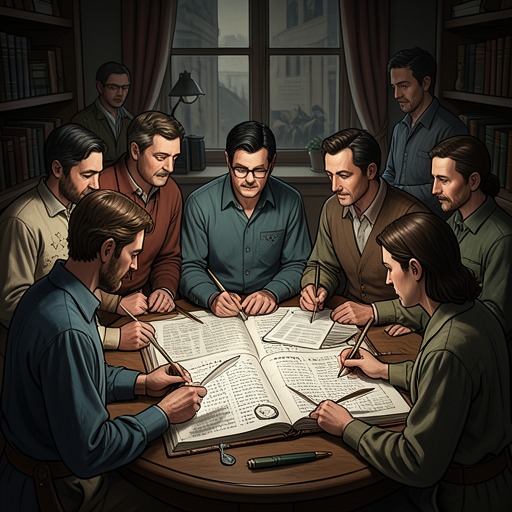
The evidence was gathered in a deliberately structured form. On a half-sheet of writing paper, the reader put the catchword at the upper left, followed by the quotation’s date, the author and cited book, its volume and page, and the full sentence containing the word. Readers assigned to important, frequently used books could request pre-printed slips; otherwise, they were to prepare their own. The completed slips were arranged alphabetically and sent to the Oxford University Press Scriptorium.
These instructions governed what counted as useful evidence. A reader was not asked merely to collect striking passages or to confirm a preferred definition. The sentence needed to illuminate the word, and the source details made it possible to place that sentence in time and identify where it came from. Murray’s invitation to gather examples for every word, including ordinary ones, made the method broad in scope; his request for multiple examples in differing contexts made it comparative.
Sorting, defining, and tracing change
At the Oxford University Press Scriptorium, the slips passed through successive stages of organization. Workers checked that quotations were complete and words correctly spelled, sorted slips alphabetically, separated a catchword into its parts of speech, and arranged the quotations chronologically. Editors then divided the material into shades of meaning and made an initial attempt at definition. Chronology did more than give an entry a sequence: it allowed the assembled examples to show how a word’s meanings had altered over its lifetime.
Definition was a separate craft, constrained by rules. A noun, for example, was first placed in its class, such as mammal or quadruped, and then distinguished from other members of that class. A definition should not use words more complicated or less familiar than the word being defined; it should state what something is rather than what it is not. Where a word had several meanings, those meanings needed to be stated, and the words in a definition had to be findable elsewhere in the dictionary. The editor had to satisfy these requirements while keeping the result concise and clear.
Murray then reviewed the grouped evidence, rearranging or further subdividing it where necessary. He added etymology and pronunciation, both of which could involve difficult editorial decisions, and selected the quotations for the finished entry. Ideally, the evidence included at least one literary sentence for every century in which the word was used; a rapidly changing word might need more examples to show the pace of change. The resulting entry was thus neither a raw transcript of the slips nor a definition detached from them, but an edited account whose claims were supported by selected historical examples.
The material process and its demands
The method required a substantial administrative and physical operation. Packages arrived at the Scriptorium, where separate workers checked, sorted, classified, and dated the slips before editors addressed meanings and definitions. Once Murray had prepared the finished columns, they went to the Press for typesetting and returned as galley proofs. The sequence connected scattered acts of reading to a printed reference work through repeated handling and editorial decisions.
The intended pace made the scale of the labor plain. The expressed hope was to publish two parts, amounting to 600 pages of finished dictionary, each year. Murray tried to complete thirty-three words a day, yet a single word such as Approve could take three-quarters of a day. The method’s thoroughness therefore had a cost: each entry might require a large body of evidence to be found, checked, distinguished, and compressed into a usable definition.
Evidence, record, and the finished dictionary
The book’s account of the dictionary also distinguishes documented history from a later, appealing story. Hayden Church’s romantic version of James Murray’s first meeting with William Chester Minor appeared in 1915; Henry Bradley later objected that its most romantic features were fiction. A letter Murray wrote to Francis Brown in 1902 gives a different chronology: Murray said that Minor began writing to him around 1880 or 1881, and that their correspondence concerned the dictionary and its materials. Murray’s account places their first meeting in January 1891. The contrast shows why the record behind a claim matters, even when a more dramatic version has become familiar.
The completed Oxford English Dictionary made the scale of this evidence-based undertaking visible. Its twelve volumes defined 414,825 words and used 1,827,306 illustrative quotations; William Chester Minor alone had contributed scores of thousands. Those totals express the method’s central achievement: a dictionary assembled not from a single authority’s intuition, but from many attestations arranged, evaluated, and shaped into a historical account of English.