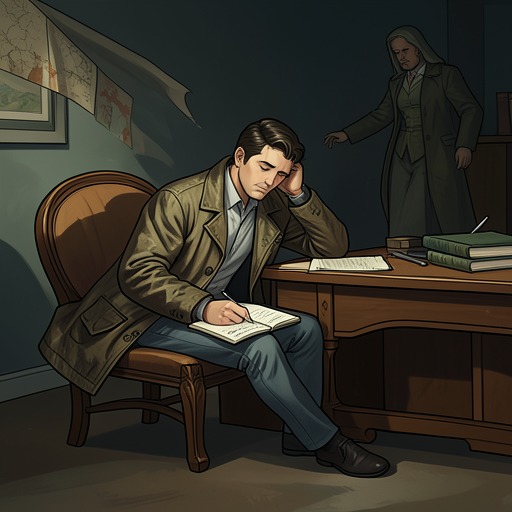
James Murray and William Chester Minor’s first meeting
The Surgeon of CrowthorneJames Murray and William Chester Minor’s first meeting took place at Broadmoor Asylum in January 1891, not in the dramatic circumstances later attached to it by popular retellings. The visit brought together two men who had already corresponded about dictionary work: it began a personal friendship that lasted almost twenty years, while revealing the distance between a documented encounter and a story made irresistible by its romance.
The legend and the record
For decades, accounts of the meeting repeated a striking scene: Murray supposedly set out to visit a fellow scholar and discovered, to his astonishment, that his destination was an asylum and that his correspondent was an imprisoned murderer. That version came from Hayden Church, an American journalist living in London. It appeared in the Strand in 1915, first in one form and then in a revised and expanded version; Church had also published it anonymously in the Washington Sunday Star that July. Its sensational presentation made the encounter feel like a revelation staged for an audience.
The account was not a reliable record of how the two men first met. The book identifies it as an amusing, romantic fiction, subsequently repeated by many writers. A fuller account emerged from a 1902 letter Murray wrote to Francis Brown, found in a wooden box among the possessions of one of Minor’s few living relatives. The letter appears complete, though the possibility that it was a fair copy rather than the original leaves a small qualification about its textual history. It places the visit in January 1891, six years earlier than the date associated with the legend.
From correspondence to a visit
Murray’s first contact with Minor had come soon after his dictionary work began, probably in 1880 or 1881. Minor wrote often and proved a valuable reader. Murray initially supposed that his correspondent was a retired medical man with time available for reading. When he learned that Minor’s address, Broadmoor, Crowthorne, belonged to a large asylum, he still imagined that Minor might be its medical officer.
The visit was prompted by an American who had recently seen Minor and reported that he was low in spirits. Murray had hesitated to go, unsure whether Minor knew that he knew anything about his personal circumstances. The visitor assured him that Minor understood and would welcome the kindness of a visit. Murray then wrote to Minor and to Dr Nicholson, the governor of Broadmoor Asylum. Nicholson warmly invited him and arranged to meet him at the railway station, drive him to and from the asylum, and include Minor at lunch.
Murray’s preparations were characteristically practical. In his letter to Nicholson, he expected to travel from Reading on the train Nicholson had named, but had not checked the timetable; he relied on his wife to work out the arrangements and tell him when to leave the Scriptorium. The detail places anticipation of the visit alongside the ordinary rhythms of work and travel, rather than in the theatrical atmosphere of Church’s story.
The encounter at Broadmoor
Murray spent many hours with Minor in his room or cell, both before and after lunch. He described finding a highly cultivated and scholarly man, with artistic tastes and what Murray regarded as fine Christian character. In Murray’s view, Minor seemed as sane as he was himself. He also appeared resigned to his confinement, and grieved chiefly over the limits it placed on his ability to be useful. This was Murray’s personal impression of the man he met, not a medical assessment or a denial of the circumstances that had brought Minor to Broadmoor.
The visit also made the consequences of Minor’s crime present in the relationship. Murray learned, apparently from Nicholson, that Minor regularly gave a large part of his income to support the widow of the man whose death he had caused, and that she visited him. Nicholson thought highly of Minor, granted him privileges, and took distinguished visitors to see him and his books. Such evidence complicates the neat contrast in the later legend between a free scholar and a hidden criminal: Murray encountered both a learned collaborator and an inmate whose life remained bound to the harm he had done.
The men were strikingly alike in appearance: both were tall, thin, bald, and wore long white beards and thick moustaches. Yet the lasting bond was not visual resemblance. Murray’s account makes their shared scholarship central, alongside wary mutual respect. The first meeting did not create their intellectual connection from nothing; it brought an established exchange of letters into personal contact.
A friendship behind the story
Murray’s 1902 letter makes clear that he and Minor knew each other personally and met regularly for almost twenty years after the January 1891 visit. Their first encounter over lunch thus began a durable friendship, sustained by a passionate shared interest in words. Minor’s contribution to the dictionary mattered to Murray, and Murray’s visit answered a human need as well as acknowledging a scholarly one: Minor was distressed by the restrictions that kept him from being useful, while the visit showed that his work and company were valued.
The contrast between the recorded meeting and the celebrated invention is part of the event’s significance. Church’s version compressed a long correspondence and a complicated relationship into a single astonished discovery. The letter instead preserves the slower sequence: an uncertain first contact, years of scholarly exchange, a carefully arranged visit, and an enduring friendship formed inside the reality of confinement. The actual meeting was less sensational than the legend, but it was not less consequential.