James Murray’s visit to Broadmoor
The Surgeon of CrowthorneJames Murray’s visit to Broadmoor brought the Oxford English Dictionary’s editor face to face with William Chester Minor, the elusive contributor whose work had enriched the Dictionary for years. The meeting took place in January 1891, after Murray sought permission from the institution’s superintendent, Dr Nicholson. It began a friendship that endured alongside their shared work, but its quieter reality was later displaced by a celebrated and largely invented story of a mistaken visit and a startling revelation.
Correspondence and the decision to visit
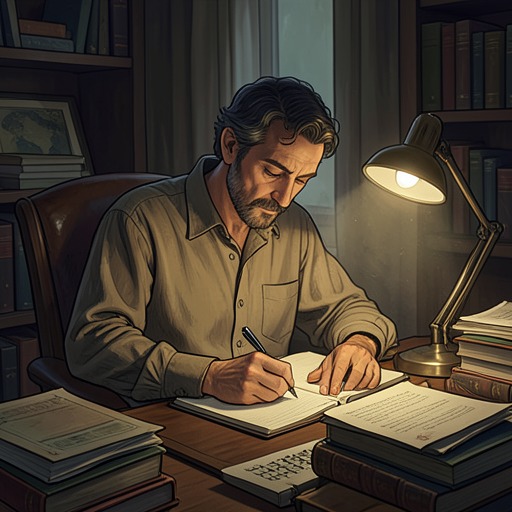
Murray and Minor had been corresponding about English words and lexicography for years before they met. Murray’s first contact with Minor probably came in 1880 or 1881, soon after he began work on the Dictionary. At first, he understood him to be a retired medical man with abundant time for reading. When Minor’s address at Broadmoor, Crowthorne, drew his attention to the asylum, Murray supposed that Minor might be its medical officer. The correspondence had thus preceded any clear personal knowledge of the circumstances in which Minor lived.
By the late 1880s, Murray had particular reason to seek him out. The Dictionary was approaching the midpoint of its enormous undertaking, its makers were receiving public honours, and Murray wanted its contributors, including those who seemed shy or remote, to receive recognition for their work. He had long wished to thank Minor in person. His own duties at the Oxford Scriptorium kept him heavily occupied, but he nevertheless arranged the journey and wrote to Dr Nicholson for permission to meet the contributor whose labours, he said, had done so much for the Dictionary.
The surviving account of that arrangement gives the visit an ordinary, practical beginning rather than a theatrical one. Murray expected to travel by a train from Reading, and in his letter he joked that he relied on his wife to manage such details as timetables and to remind him when to leave the Scriptorium. The letter conveys his keen anticipation, but it also places the proposed meeting within the routines of work and travel. The visit was not a sudden discovery staged by an accidental arrival: Murray asked to see Minor, and the institution’s superintendent enabled the meeting.
The meeting behind the legend
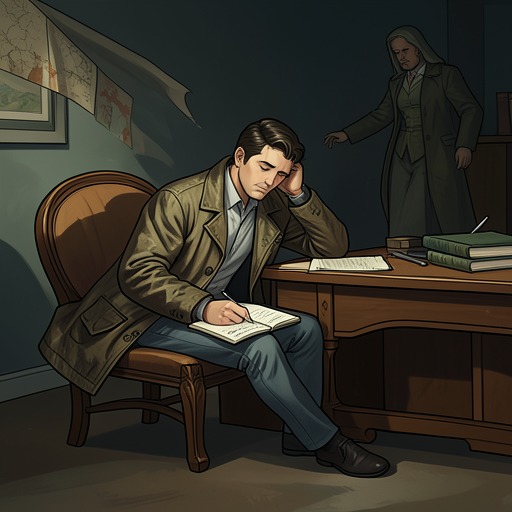
The familiar story places the encounter in the autumn of 1896. In that version, Murray telegraphs ahead, arrives at Crowthorne station, and is carried to an imposing house, where he mistakes a senior official for his correspondent. The official then reveals that Minor is not the master of the house but an inmate of Broadmoor Asylum. The scene turns the discrepancy between Minor’s scholarly standing and his confinement into a polished dramatic reversal.
That account is not the date or course of the real visit. The meeting occurred in January 1891, six years earlier than the version repeated by romantically minded tellers. Murray’s correspondence with Dr Nicholson and his retrospective account to Dr Francis Brown support a different sequence: he requested permission, travelled to meet Minor, and encountered a man he already knew through years of letters. The first meeting included lunch and opened into a long personal acquaintance. It was surprising in its circumstances, but not because Murray had arrived believing he was entering the home of a free and wealthy scholar.
The disparity matters because the 1896 story makes ignorance the engine of the scene. In the documented account, Murray had already noticed that Minor’s address was an asylum and had formed assumptions about his possible role there; the meeting was arranged through the superintendent. The actual encounter’s force therefore lies less in a single shock than in the joining of two relationships that had until then been mediated by correspondence: an editor seeking to acknowledge a valued reader, and a contributor whose life at Broadmoor was not visible in the work he sent.
How the fictional encounter became familiar
The best-known version was created by Hayden Church, an American journalist living in London for much of the first half of the twentieth century. He published it anonymously in the Washington Sunday Star in July 1915, then presented revised and expanded versions in the Strand magazine in September 1915 and six months later. Its sensational framing joined an American murderer, an English dictionary, a wealthy surgeon, and an asylum in one headline-grabbing narrative. The facts that made the story arresting were real in broad outline—Minor was an American, had committed murder while mentally ill, was confined at Broadmoor, and contributed extensively to the Dictionary—but the dramatic visit was a fabrication.
The story spread because it offered an unusually neat collision of scholarship and confinement. In the middle of the First World War, newspapers and readers embraced it as a romance of learning set against grim contemporary events. Later accounts repeated Church’s version, including K. M. Elisabeth Murray’s biography of her grandfather and Jonathon Green’s 1996 history of lexicography. Elizabeth Knowles, an Oxford University Press editor who investigated the story in the early 1990s, was more cautious, particularly because no definitive account of the first meeting had been found. Repetition gave the legend the appearance of settled history even while the documentary basis remained uncertain.
A letter Murray wrote to Dr Francis Brown in 1902 helped correct that record. It was found in a wooden box in the attic of one of Minor’s few living relatives, in Riverside, Connecticut. The surviving letter appears full and complete, though the account notes the general possibility that letter-writers sometimes prepared fair copies and edited them. Murray’s recollection identifies his early correspondence with Minor, describes how he interpreted the Broadmoor address, and supplies the basis for dating their meeting to January 1891. A separate letter to Dr Nicholson records Murray’s arrangements and anticipation. Together these documents replace the legend’s staged revelation with a more credible account built from correspondence and recollection.
Friendship, confinement, and the visit’s significance
The meeting was not an isolated courtesy call. Murray’s account says that he and Minor saw one another regularly for almost twenty years after their first encounter. Their relationship rested on mutual respect and, most decisively, a shared devotion to words. Murray’s wish to thank an industrious contributor became a personal friendship that persisted despite the unusual setting in which it began.
That setting was essential, but it should not be confused with the sensational mechanics later attached to the visit. Minor was an inmate at Broadmoor, and Murray’s record indicates that he came to understand more of the consequences of the death Minor had caused: a large part of Minor’s income supported the dead man’s widow, who visited him regularly. Dr Nicholson thought highly of Minor, granted him privileges, and sometimes showed visitors his room and books. These details give the encounter a human and institutional context absent from the simplified tale of an editor blundering into an asylum and discovering a secret.
The evidence also places the visit within a longer history of changing descriptions of Minor’s illness. In 1868, when he was thirty-four, a medical report classified him as delusional and described his condition as monomania, while leaving the subject of that supposed single-minded obsession unspecified. Much later, in 1918, his psychiatrist at St Elizabeths Hospital used the diagnosis dementia praecox, of the paranoid form. That later terminology cannot be treated as what Murray knew or as an explanation supplied by the 1891 meeting; it instead shows how accounts of Minor’s condition shifted across institutions and decades. The visit brought Murray into contact with a contributor whose life could not be reduced either to his dictionary work or to the period’s changing medical labels.
The visit’s afterlife reveals a second story: how documentary uncertainty can yield to a more satisfying public narrative. Church’s version sharpened the contrast between the celebrated dictionary and the imprisoned scholar by turning a planned meeting into a revelation. The surviving letters make the truth less theatrical but no less striking. Murray had valued Minor’s work before he knew him personally, sought permission to meet him, and continued the relationship for years. The correction does not dissolve the romance of the encounter; it locates its force in the friendship and shared intellectual labour that followed, rather than in a fictional surprise.