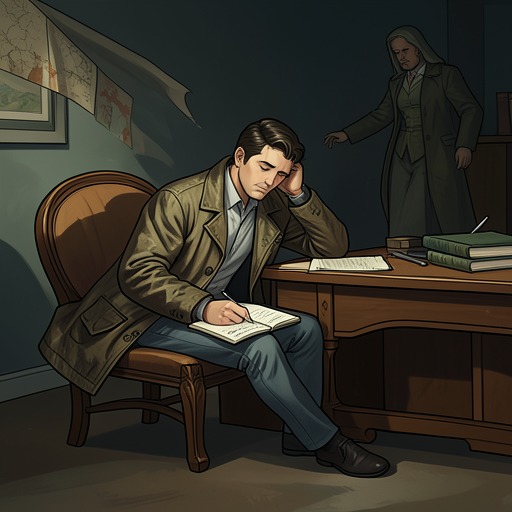
Justin Winsor
The Surgeon of CrowthorneJustin Winsor was the Harvard College librarian whose conversation with James Murray exposed the life behind William Chester Minor’s letters to the Oxford English Dictionary. By telling Murray that Minor’s circumstances were painful, Winsor transformed an apparently ordinary scholarly correspondence into a story of illness, confinement, and murder—while also transmitting details that later proved inaccurate.
Identity and Position
Winsor appears in Murray’s account as a distinguished American librarian and historian. The book describes him as one of the foremost figures in nineteenth-century American librarianship and a formidable historian. His institutional standing gave weight to the news he brought, but his importance in this episode lies especially in his role as the person who connected Murray’s unknown correspondent with a life beyond dictionary work.
The Disclosure to Murray
Murray’s first contact with Minor had come soon after he began work on the Dictionary, probably in 1880 or 1881. Minor wrote often and proved to be an exceptionally good reader. Murray assumed he was a retired medical man with ample time, and even after noticing that Minor’s address was Broadmoor, he supposed that he might be the asylum’s medical officer. Their correspondence, Murray later recalled, remained limited to the Dictionary and its materials.
Between 1887 and 1890, Winsor was sitting with Murray in the Scriptorium when the conversation turned to Murray’s preface and its mention of Minor. Winsor told him that Americans had been moved by the reference and that Minor’s was a painful case. Murray was astonished and asked what Winsor meant. Winsor, in turn, was surprised that Murray had corresponded with Minor for years without learning or suspecting anything about his situation. He then related the story of Minor’s illness and confinement, giving Murray knowledge that Minor had never disclosed in their letters.
A Story, and Its Errors
Winsor’s disclosure was consequential, but it was not wholly reliable in its details. As Murray retold the story, he said that Winsor had incorrectly placed Minor at Harvard, although Minor had attended Yale. Winsor also repeated a probably apocryphal account that witnessing the execution of two men after a court martial had driven Minor mad. The shooting that led to Minor’s confinement was likewise misplaced: Murray’s retelling put it in the Strand, whereas it had occurred in Lambeth.
These errors did not erase the central revelation. Winsor conveyed, in essence, that Murray’s valued correspondent was not simply a retired doctor with a taste for old books: Minor was an American held in an asylum after a murder committed while he was mentally ill. The contrast between the wrongly remembered particulars and the broadly correct account shows how a story passed between people can preserve its essential outline while acquiring distortions.
Consequences for the Correspondence
Murray wrote that Winsor’s account affected him deeply. Because Minor had never referred to his personal circumstances, Murray did not confront him with what he had learned. Instead, he wrote more respectfully and kindly than before, taking care not to reveal the disclosure for fear of changing their relationship. Winsor’s intervention therefore altered Murray’s understanding without immediately altering the terms of their correspondence: the Dictionary remained their shared subject, but Murray now understood that the man supplying its evidence lived under very different circumstances than he had imagined.