Lambeth Tragedy (George Merrett murder)
The Surgeon of CrowthorneThe Lambeth Tragedy was the fatal shooting of George Merrett on a cold Saturday morning in 1872, an exceptionally unusual gun crime in Victorian London. Its immediate sequence was brief: shots in the night, a policeman’s alarm, a pursuit, and an arrest at the scene. Its significance grew through the trial, which exposed the extent of William Chester Minor’s illness, and through the later history of the crime and its retelling.
Setting and background
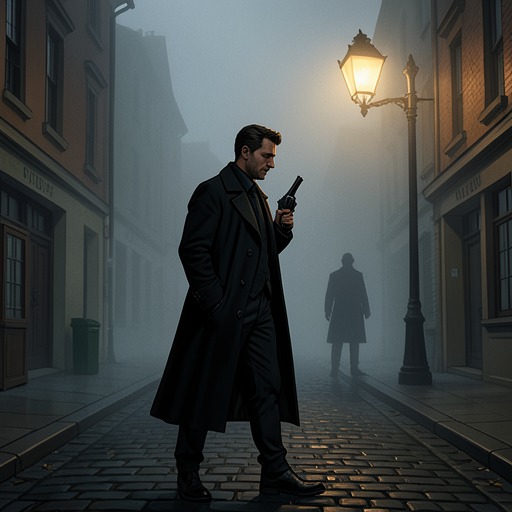
Shortly after two o’clock on 17 February, a series of revolver shots broke the night in Lambeth Marsh. The account gives the number as three, while allowing that there may have been four. The sound was startling not simply because the district was violent, but because firearms were rarely used in crimes in London. They were costly, cumbersome, difficult to conceal, and associated in public discussion with a kind of violence regarded as foreign to Britain. A Lambeth newspaper had recently boasted that the country had no experience of the shooting attacks common in the United States.
The setting sharpened the contrast. Lambeth Marsh was a poor, crime-ridden district of crowded lanes, but gunfire was not an expected feature of its street violence. The shots therefore carried beyond their immediate effect: they announced an exceptional crime in a place already burdened by a formidable reputation. The event would be named by the press the Lambeth Tragedy, a title that made the district itself part of the story.
The attack and arrest
George Merrett was walking to his early shift at the Red Lion Brewery, where he worked shovelling coal. He had made the same journey on the previous twenty nights. His wife had watched him leave beneath a gas lamp, with no reason to think this ordinary departure would be his last. Near the entrance to Tenison Street, a man began shouting and chasing him. Merrett ran over the frost-slick cobbles. The pursuer stopped, raised a gun, and fired; the first shot missed. Merrett continued to flee and call for help, but another shot, followed by a final one, struck him.
The gunfire reached Constable Henry Tarrant as he was on the graveyard shift near the viaduct arches beside London Waterloo Station. He blew his whistle to alert nearby colleagues and ran towards Belvedere Road, where he believed the shots had come from. Henry Burton and William Ward heard the whistle and hurried after him. When Burton arrived, Tarrant was already holding a man. Tarrant sent the two officers towards the road, where they found Merrett lying motionless. Burton and Ward knelt beside him; Ward summoned a hansom cab, and the policemen took Merrett to St Thomas’s Hospital.
The journey could not save him. Doctors tried to treat his wounds, but Merrett died. Meanwhile, Tarrant had secured the shooter. The man was tall and well dressed, with what Tarrant described as a military appearance; he held a smoking revolver and did not try to escape. When asked who had fired, he acknowledged that he had. His arrest at the scene gave the police an immediate suspect, but the circumstances behind his act would become clear only later.
Trial and the revelation of illness
The trial in early April at Kingston Assizes brought the extent of Minor’s illness into public view. Scotland Yard testified that Minor had previously complained of men entering his room at night to poison him. He believed the supposed intruders were members of the Irish Republican Brotherhood and feared that they intended to murder him and make his death appear to be suicide. He had raised these fears repeatedly with the police, including in a letter shortly before Christmas and in a further communication dated 12 January.
The evidence placed the shooting within a longer history of fear and suspicion, without making the victim’s death any less real or the crime any less consequential. Minor had lived in the neighbourhood with intense anxieties about Irish people and repeatedly sought reassurance about whether Irish servants or visitors were present. At trial, witnesses described a troubled man whose fears had already come to police attention. The account identifies the trial as the point when the full extent of his illness became starkly apparent; it does not reduce the murder to a single explanation.
Aftermath and the story’s retelling
The shooting initiated a chain of consequences that the book describes as unprecedented. Minor was found to be insane and became a long-term inmate of Broadmoor Asylum for the Criminally Insane. He also became known as a contributor to the Oxford English Dictionary, a connection that later helped transform the murder and its aftermath into a story about crime, confinement, and scholarship.
One famous version of that story claimed that James Murray first encountered Minor while visiting Broadmoor in 1896. The account was created by journalist Hayden Church and published in 1915; it was sensationally framed as the discovery that an American murderer had helped write the Oxford dictionary. A letter Murray wrote in 1902 instead establishes that their first meeting took place in January 1891, six years earlier than the romantic legend claimed. Murray had already been corresponding with Minor, and the meeting began a friendship that continued for almost twenty years. The correction does not erase the murder’s consequences; it shows how the event’s later meaning was reshaped by stories that made its unlikely conjunction of violence and scholarship irresistible to readers.