London
The Surgeon of CrowthorneLondon binds together the book’s two central histories: the arrest of William Chester Minor after a rare shooting in Lambeth, and the making of the Oxford English Dictionary, set in motion at a lecture in the city fifteen years earlier. The city is not a single backdrop. Its districts carry different social meanings, while its streets, institutions, and routes connect a crime, a scholarly enterprise, and the later stories told about them.
Districts of contrast
Victorian London appears first through the contrast between Lambeth Marsh and the more respectable parts of the city. Lambeth Marsh, across the Thames from Westminster, is described as a crowded, disreputable district of slums and alleyways, associated with footpads, pickpockets, and an earlier outbreak of garrotting. Its Dickensian reputation made it a place respectable Londoners preferred not to enter. Yet the book stresses that violence there did not make gunfire ordinary: firearms were costly, cumbersome, difficult to conceal, and rarely used in London crime.
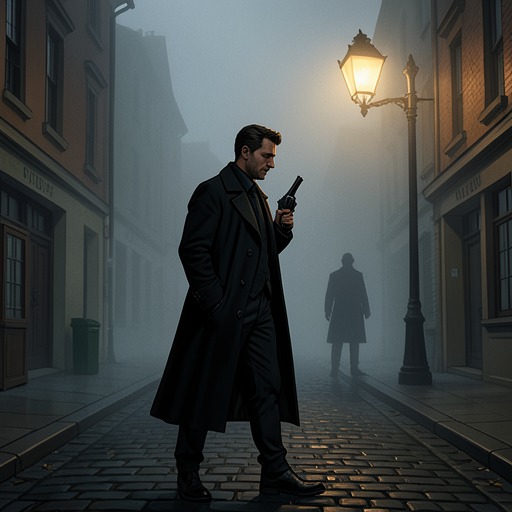
That distinction gives the shots of 17 February 1872 their force. Shortly after two in the morning, three revolver shots—perhaps four—were heard in the cold night. A constable on the graveyard shift, walking beneath the railway arches near Waterloo Railway Station, recognized the sound, blew his whistle, and ran through the narrow lanes toward Belvedere Road. The shooting was startling not simply because it took place in a rough neighborhood, but because an armed criminal was unusual even in a city with London’s scale and reputation for crime.
The location also shaped the response. Minor had taken rooms at 41 Tenison Street and lived alone, despite having considerable means. His landlady described him as an anxious tenant who sometimes demanded that the furniture be moved and feared that people might break in. He repeatedly asked whether Irish servants or visitors were in the house and wanted Irish employees dismissed. Lambeth’s population included many casual Irish laborers, making the presence he feared a real feature of the neighborhood, though the threat he imagined was not established by those circumstances.
Crime and the city’s institutions
After his arrest, Minor was taken to Horsemonger Lane Gaol and charged with murder. His identity changed the case’s reach: he was a surgeon, a former United States Army officer, and an American from New Haven, Connecticut. Because of his army commission, the Foreign Office notified the American minister in London that an American army surgeon was being held on a murder charge. A rare London shooting had become an international incident.
The later trial revealed that the police had encountered Minor before the killing. He had gone to Scotland Yard to complain that men were entering his room at night and trying to poison him. He attributed the danger to Fenians, members of the Irish Republican Brotherhood, and feared that they would break in and murder him. He had made similar claims repeatedly, enlisted the help of the police commissioner in New Haven, and wrote to a Scotland Yard detective in January 1872 saying that he had been drugged and feared murder disguised as suicide. The trial took place at Kingston Assizes, because the relevant jurisdiction was still Surrey’s, not London’s: the city’s police investigation and the court’s location did not coincide.
A city of work, illness, and learning
London also figures in James Murray’s private history. When his wife, Maggie, became gravely ill after the death of their infant daughter, the couple left Hawick for modest lodgings in Peckham. The cost of supporting them forced Murray to suspend his linguistic pursuits and take a clerk’s position at the Chartered Bank of India. The move placed him in a different kind of London life, among office routine and economic necessity, but it did not end his intellectual work. He studied languages on his commute, considered the accents of London policemen, and lectured at a Camberwell church. His attention to Maggie’s return to her childhood Scots dialect during delirium became one small observation that helped him through her subsequent death.
The city’s scholarly life is marked by a very different November evening. On 5 November 1857, at the London research library on St James’s Square, Richard Chenevix Trench delivered a lecture on deficiencies in English dictionaries. The surrounding square belonged to an elite London of town houses, clubs, bishops, peers, and politicians; within it, the library offered a substantial collection of books to the public. The book presents Trench’s lecture there as the beginning of the project that became the Oxford English Dictionary. The work would take seventy years, almost to the day, in contrast to the six years taken by Samuel Johnson and his team to produce their dictionary.
London as setting and as story
These episodes make London a meeting place for different kinds of history without making all their decisive encounters occur within the city. Minor arrived in London in a wintry November, but his first meeting with Murray took place at Broadmoor in January 1891. The later popular account of that meeting was written by Hayden Church, who lived in London for much of the first half of the twentieth century. The book identifies Church’s dramatic version as fiction: Murray’s first contact with Minor had probably come in 1880 or 1881, and he learned only by chance that Minor’s address was Broadmoor, assuming at first that he might be a medical officer there. The correction matters because it separates the documented relationship from the romance later attached to it.
London nevertheless remains central to how that relationship and the city’s criminal history are understood. A letter Murray wrote in 1902 to Francis Brown recounts the discovery and the eventual personal connection; the letter later surfaced among Minor’s relatives in Connecticut. Murray and Minor met in 1891 and continued to see one another regularly for almost twenty years. For the setting of Minor’s crime, the book turns to Roy Porter’s social history of London, using the city’s history to make the Lambeth episode legible without reducing the metropolis to a single neighborhood or reputation. London is thus both the place where the narrative’s violent and intellectual histories begin and the larger urban context that lets their very different worlds stand in relation.