London Library
The Surgeon of CrowthorneThe London Library’s rooms at St James’s Square were more than a prestigious address: they joined a public-minded book collection to the private clubs and scholarly circles of London’s elite, and became the setting for the speech that set the Oxford English Dictionary project in motion. On 5 November 1857, the Philological Society met upstairs in the library building; the place where its members gathered thus became part of the history of a work that would take seventy years to complete.
Setting in St James’s Square
The building stood at the north-west corner of St James’s Square, in a narrow terraced house amid one of London’s most fashionable quarters. The square was surrounded by grand town houses and private clubs, with bishops, peers, and Members of Parliament among its residents. Fine shops, churches, office apartments, and foreign embassies were close by. The account places the library within this concentrated landscape of wealth, influence, and institutions: its rooms were available for scholarship, but its immediate social surroundings were unmistakably aristocratic.
The address had acquired its literary purpose twelve years earlier, when the London Library moved there from cramped quarters on Pall Mall. The new building was tall and capacious. In 1857 it held only a few thousand volumes and had room to spare, a contrast with the more than a million books it would contain in the account’s present day. The move therefore altered more than the library’s location: it gave the institution space to expand its activities beyond housing books.
Collection and institutional life
The London Library was described as a publicly accessible collection that its admirers considered the finest private library in the world. That combination mattered. It was a private institution, situated among the residences and clubs of powerful men, yet its books were available to the public. The building’s intellectual standing rested not only on its collection but also on its role as a meeting place for organizations whose work shared, in the committee’s view, the library’s scholarly aims.
With space available, the committee decided to raise extra money by renting rooms. It limited the arrangement to societies whose members were thought likely to share the library’s lofty purposes and to mingle comfortably with its often snobbish membership. The Statistical Society and the Philological Society were selected. Renting rooms connected the library’s finances to its intellectual life: the spare capacity of the new building could support learned societies, while their meetings brought organized scholarship into the library itself.
The 1857 meeting and its legacy
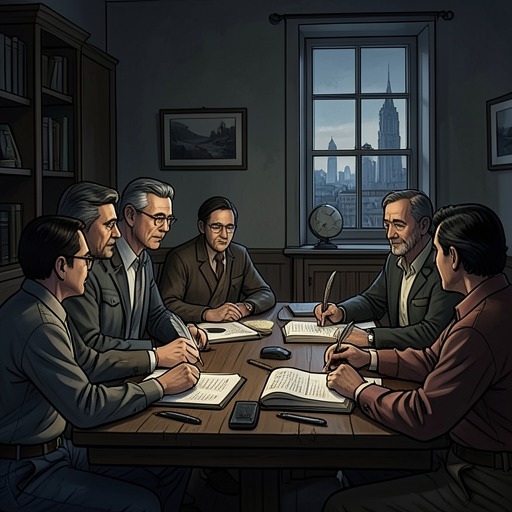
On a cold Thursday evening, shortly after six, the Philological Society held one of its fortnightly meetings in an upstairs room. The date was Guy Fawkes’ Day, 5 November 1857. The speaker, Richard Chenevix Trench, was Dean of Westminster and a leading figure in the society. His announced subject was deficiencies in English dictionaries. He argued that a dictionary should record the language rather than act as a judge of which words were good or bad: its maker should be a historian, not a critic.
The meeting’s significance outlasted the evening and the room. Trench’s speech at the London Library marked the beginning of the Big Dictionary project, later known as the Oxford English Dictionary. The library did not merely provide a dramatic backdrop: its rooms housed the society whose discussion helped launch the undertaking. The contrast between the modest collection of a few thousand books in 1857 and the dictionary project’s seventy-year span gives the address a particular historical scale. A building with space to spare became the site from which an effort to record the language began.