Madness
The Surgeon of CrowthorneMadness is presented not as a fixed diagnosis with a settled cause, but as a condition interpreted through the medical language available in each period. William Chester Minor’s history moves from Victorian uncertainty about monomania to a twentieth-century diagnosis of dementia praecox, while the book leaves open what precipitated his illness. Its account also asks how a life shaped by delusions and confinement could find a measure of steadiness in sustained intellectual work.
From Suspicion to Medical Recognition
Minor’s deterioration became unmistakable in the summer of 1868. After reportedly remaining too long in the Florida sun, he complained of severe headaches and vertigo. Nurses escorted him to New York City, where doctors examined him and assessed whether he could continue his military service. By September, his condition had moved from suspicion among those around him to formal medical concern.
On 3 September 1868, Surgeon Hammond recorded that Minor appeared to suffer from monomania, a contemporary term for an intense fixation on a single subject. Hammond did not identify the subject, but judged Minor delusional. Minor was thirty-four. The surviving medical language marked a serious change in his status without establishing a complete account of what he was experiencing.
As the medical reports accumulated, they repeatedly judged him unfit for duty and unable to travel. By November, army doctors recommended immediate institutional care under Dr Charles Nichols, superintendent of the Government Hospital for the Insane in Washington, DC. An examining doctor described the monomania as involving risk of suicide and homicide. Minor agreed to enter the asylum and hoped to do so without a guard. These records document how clinicians assessed danger and fitness; they do not, by themselves, explain the origins of his illness.
A New Diagnostic Vocabulary
At St Elizabeths Hospital, Minor’s case received a description that the book regards as recognizably modern. On 8 November 1918, his attending psychiatrist, Dr Davidian, recorded the diagnosis of dementia praecox, paranoid form, identifying Minor in the hospital register as Federal Patient Number 18487. This replaced the looser Victorian category of monomania and the simpler label of paranoia. The change was more than a new name: it placed the case within a different psychiatric framework, beyond the moral treatment tradition associated with Philippe Pinel.
Dementia praecox had been in use for two decades by the time Davidian applied it. The term described an early loss of contact with reality, distinguishing an illness that could emerge in youth or adulthood from senile dementia, which referred to decline associated with old age. Emil Kraepelin published the nomenclature in 1899. He used it in part to distinguish the condition from manic-depressive psychosis, which early alienists could confuse with it. In Kraepelin’s account, manic-depressive psychosis had identifiable physical causes and could be treated, whereas dementia praecox was endogenous, without an identifiable external cause. The book explains this historical distinction rather than treating it as an unchanging account of present-day psychiatry.
The diagnostic vocabulary continued to shift. Schizophrenia, a term derived from Greek words for split mind, appeared in 1912; the book notes that some have since proposed the name Kraepelin’s Syndrome to avoid the older term’s associations. This history shows how psychiatric classification can change even when the underlying case remains the same. A later diagnosis can make a condition more legible without resolving every question about the person’s experience or its cause.
Causes, Trauma, and Uncertainty
The book does not settle whether Minor’s illness was triggered by war, inherited vulnerability, temperament, or some combination. It asks whether the scenes he witnessed at the Battle of the Wilderness could have precipitated his later behaviour, and whether his branding of an Irish soldier might have contributed, directly or indirectly, to the crime committed eight years later. These are presented as questions, not established causal findings.
Several possibilities are considered. Two of Minor’s relatives had died by suicide, although the circumstances are uncertain. His temperament may also have mattered: he was a painter, flautist, and collector of old books, and the narrative wonders whether a gentle disposition left him especially vulnerable to the sights and shocks of battle. The book further suggests that confinement at Broadmoor Asylum may have failed to improve his condition, while a more compassionate regime might have eased his distress. None of these possibilities is offered as a proven explanation.
The discussion sets that uncertainty against changing ideas about schizophrenia and trauma. It notes that post-traumatic stress can follow extreme experiences, but argues that this framework alone cannot account for the persistence of Minor’s symptoms throughout his life. The book’s cautious conclusion is that the events in Virginia may have brought more destructive manifestations to the surface, while something more fundamental was also wrong. It leaves unresolved whether the illness had an identifiable trigger, an inherited or temperamental basis, or no cause that could be recognized. That restraint matters: retrospective diagnosis cannot turn speculation about a historical life into certainty.
Treatment, Work, and the Book’s Perspective
The history of Madness is also a history of how treatment changes. The book contrasts Victorian moral treatment with the sedatives available around the time of Minor’s final decline and with later antipsychotic drugs, which can manage symptoms but have not explained the illness’s elusive triggers. It argues that compassionate care and effective medication allow many people with schizophrenia to lead dignified lives, while emphasizing that such care was largely unavailable to Minor. The comparison is not a claim that modern treatment would have resolved every aspect of his case.
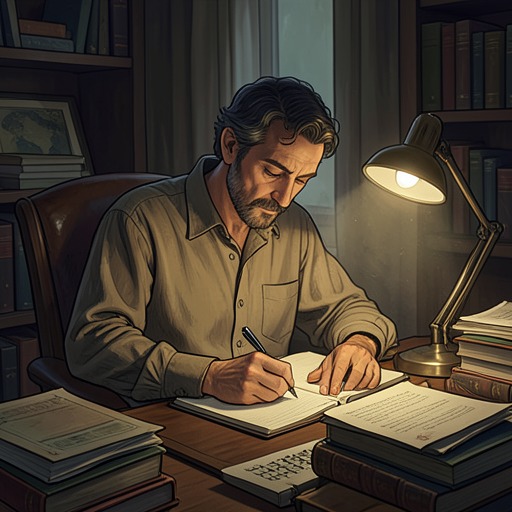
Minor’s dictionary work offers the account a particularly difficult irony. The quiet routine of preparing quotation slips and sustaining intellectual effort appears to have provided some release from paranoia. The work became a form of therapy: a recurring, focused activity that gave his mind a fixed point. When that stimulus ended, his condition worsened. The narrative therefore presents the dictionary neither as a cure nor as a substitute for care, but as a meaningful support whose loss had consequences.
The book’s own framework is informed by histories of psychiatry and illness, including Gordon Claridge’s study of possible origins of mental illness and Andrew Scull’s history of the earlier mad-doctoring trade. Roy Porter’s social history of London supplies context for the city in which Minor committed his murder. Together, these references place an individual case within changing medical language and social history. The result is an account that recognizes the force of diagnosis while resisting the idea that a label, whether Victorian or modern, can fully explain a life.