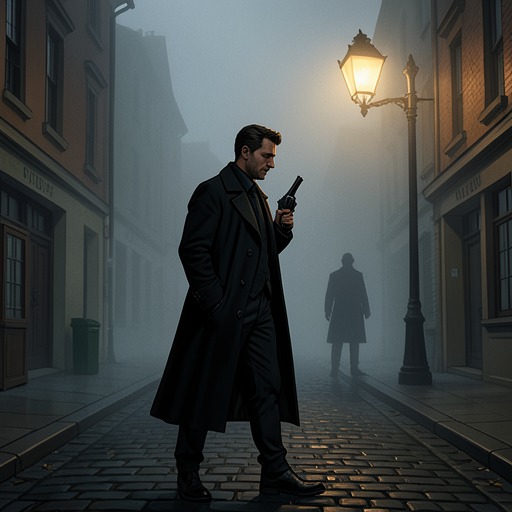
Minor's Colt Revolver
The Surgeon of CrowthorneMinor's Colt Revolver links William Chester Minor’s military past to the fatal shooting of George Merrett in London. The book presents it first as a weapon he carried against a danger he feared, then as the gun kept within reach while he slept, and finally as the smoking revolver in his hand when a constable took him into custody. Its recurrence connects Minor’s explanations of persecution to the consequences of his actions, without establishing that the intruders he described were real.
Military weapon and private precaution
In 1866, while serving on Governors Island after the cholera epidemic, Minor began carrying his Colt .38 service revolver when out of uniform. He did so illegally, according to the account. The weapon had a six-shot rotating magazine, but one chamber was permanently blocked with a blank under customary practice, leaving five chambers available for cartridges. The detail later corresponds to his reported practice of keeping five cartridges in the gun beneath his pillow.
Minor explained his decision by recalling that a fellow officer had been killed by muggers on his way back from a bar in lower Manhattan. He feared that ruffians might follow or attack him too. The account distinguishes this stated rationale from the wider pattern that was beginning to concern his colleagues: carrying the gun was presented as a response to a specific danger, while the narrative identifies it as an early sign of what, in retrospect, appeared to be paranoia. The revolver therefore enters the story as a practical military object made part of a private system of vigilance.
From American service to London
When Minor left Boston for London in October, he intended to spend time in Europe resting, reading, and painting. He carried books and art materials, and arrived in early November with his identification as an officer in the United States Army. The gun travelled with these belongings, secured in its japanned box. That circumstance gives the weapon a quiet but consequential place in the transition: Minor did not leave it behind with his military life, even as he imagined beginning a different one abroad.
The revolver’s movement from a service context into Minor’s lodging changes how it figures in the narrative. It is no longer described simply as something carried outside uniform because of a feared street attack. According to the police interrogation account, for months Minor had slept with it loaded beneath his pillow, ready for the unknown men he believed entered his room at night. The same five-cartridge capacity described in the account of the weapon’s military configuration thus becomes part of the circumstances in which he interprets a perceived threat at home.
The shooting and arrest
In Minor’s account of the night George Merrett was killed, he awoke believing that a man stood in the shadows at the foot of his bed. He reached beneath his pillow for the revolver and believed the figure fled down the stairs and out of the house. Minor said he pursued a man into Belvedere Road, mistook him for the intruder, and fired four times. The account records his belief that the man had been stopped and could no longer harm him; the person shot was Merrett, who had been walking to work.
The gun’s role is also established outside Minor’s explanation. A constable found him moments after the shooting holding a smoking revolver, and Minor acknowledged that he had fired it. The weapon thus joins two accounts that must be kept distinct: his description of a pursuit prompted by an imagined intruder, and the observable fact that he had shot Merrett. The landlady told the court that no one could have entered her house at night without a key, and that the household slept lightly; her evidence challenged the premise on which Minor said he had acted.
Narrative significance
The revolver recurs at the points where fear becomes action. First, it is carried in anticipation of possible attack; later, it is kept loaded beside Minor as he sleeps; finally, it is the instrument he uses after interpreting a fleeing stranger as the person he believed had entered his room. This sequence makes the object a concrete thread through the book’s account of his changing circumstances, rather than a detached detail of military equipment.
Its significance does not depend on attributing intention or independent agency to the weapon. The narrative instead traces how Minor’s access to it, his expectation of danger, and his interpretation of what he saw converged in a fatal act. Its final appearance in the constable’s custody confirms the material fact of the shooting, while the disputed intruder remains part of Minor’s account rather than an established presence. In this way, the revolver marks the difference between a threat as Minor experienced it and the harm suffered by George Merrett.