Murder of George Merrett
The Surgeon of CrowthorneThe Murder of George Merrett was the fatal shooting of an unarmed brewery worker by William Chester Minor in Lambeth on 17 February 1872. Its significance extends beyond the crime’s immediate shock: it exposed the consequences of Minor’s severe mental illness, devastated Merrett’s family, and ultimately formed the grim prehistory to Minor’s long confinement and substantial work for the Oxford English Dictionary. The later prominence of that work would make the imbalance in how the two men were remembered part of the event’s enduring meaning.
Setting and circumstances
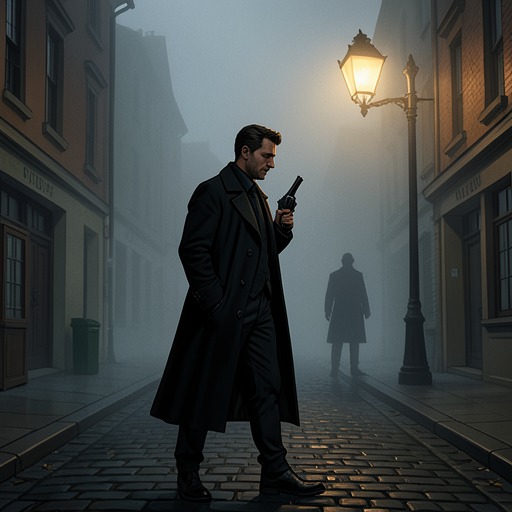
The shooting occurred in Lambeth Marsh, a crowded and violent district on the south bank of the Thames, but firearms were unusual even there. Guns were costly, cumbersome, and difficult to conceal, and contemporary Londoners regarded their use in crime as a rarity. Shortly after two o’clock on Saturday morning, three revolver shots rang out; the account allows that there may have been four. Their sound was recognized by Henry Tarrant, a constable on the graveyard shift near Waterloo Railway Station.
Tarrant ran through the lanes towards Belvedere Road after sounding his whistle. Henry Burton and William Ward, alerted by the whistle, followed. Burton found Tarrant holding a man and was told that someone had been shot. He and Ward hurried to the road, where they found Merrett gravely wounded. The policemen summoned a cab and took him to St Thomas’s Hospital, about 500 yards away, but he died despite the doctors’ efforts. The rapid response could not undo the fatal outcome.
Merrett had been on his way to the Red Lion Brewery, where he worked shovelling coal. His wife had no reason to expect danger: he was making the familiar journey to a dawn shift, as he had on the previous twenty nights. At the entrance to Tenison Street, a man began shouting and pursued him. Merrett tried to escape; the pursuer raised a gun and fired. The first shot missed, and further shots followed before one struck Merrett. The sequence turned an ordinary walk to work into a killing that startled a city unaccustomed to gun crime.
Arrest and identification
Tarrant detained the shooter at the scene. The man did not try to flee. He held a smoking revolver and acknowledged that he had fired it. When police searched him, he explained that an item they found was a surgical instrument, though he did not always carry it. The arrested man was identified as William Chester Minor, thirty-seven years old, a qualified surgeon and former United States Army officer.
Minor had lived in London for less than a year and rented a modest furnished room at 41 Tenison Street, near the place of the shooting. He was a man of considerable means, so his economical lodgings did not reflect financial necessity. The reason he had come to this part of Lambeth was not established in the early questioning. By dawn he had been taken to Horsemonger Lane Gaol and charged with murder.
His American identity gave the case an international dimension. The Foreign Office notified the United States Minister in London that an American army surgeon was being held on a murder charge. The shooting was already exceptional as a London firearm killing; the diplomatic notice made it an international incident as well.
Illness and consequences
Minor’s mental illness became starkly apparent at his trial in early April. Police testimony showed that he had previously gone to Scotland Yard to complain that men were entering his room at night and trying to poison him. He believed the supposed intruders were Fenians associated with the Irish Republican Brotherhood, and feared they would break into his lodgings or kill him. His anxieties were not confined to private complaints: before Christmas, he had arranged for the police commissioner in New Haven to write to Scotland Yard on his behalf. In January he wrote again, saying he believed he had been drugged and that men planned to murder him and make the death appear to be suicide.
Minor’s landlady had also described his recurring fear of Irish people. He repeatedly asked whether the house had Irish servants, visitors, or lodgers, and demanded that Irish servants be dismissed. These reports establish the persecutory pattern that the trial brought before the court; they do not make Merrett responsible for it. Merrett was an innocent worker on his way to his job. The crime’s consequences fell first on him and on the family left behind.
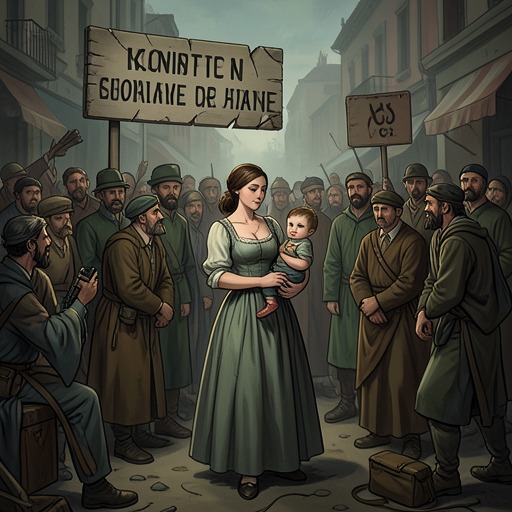
Merrett’s wife, Eliza, was pregnant and had six young children. The family was already living in poverty, far from the security suggested by the public attention soon directed towards the case. Money was collected to help them: American residents were asked to contribute through a diplomatic fund, Lambeth’s clergy organized collections, and amateur entertainments raised further funds. The scale of these efforts testified to public concern, but it could not restore the household that the killing had broken apart.
A case retold and a life of work
The murder later became inseparable from the story of Minor’s work on the Oxford English Dictionary. He was a long-staying inmate at Broadmoor, and, after beginning to correspond with James Murray around 1880 or 1881, became one of the Dictionary’s major contributors. Murray visited him in January 1891; the two men then knew one another personally and met regularly for almost twenty years. Minor gave a large part of his income to support Merrett’s widow, who visited him. His scholarly labour and acts of support belong to the aftermath, but they do not erase the murder that made that aftermath possible.
A popular account of Murray’s first visit claimed that he arrived expecting to meet a fellow scholar at home, only to discover that his correspondent was a murderer confined in an asylum. The book identifies this dramatic version as a fiction created by the journalist Hayden Church and first published in 1915. The documented meeting occurred in 1891, years earlier than the version attached to the Dictionary dinner, and began a friendship between men who had corresponded for years. Correcting the story matters: the legend’s romantic surprise can make the meeting the centre of the tale, displacing both the actual chronology and the victim whose death preceded Minor’s contribution.
Burial and remembrance
Merrett’s funeral gave the killing a public scale. A procession half a mile long travelled from Lambeth past the place where he had been shot and on towards Tooting Cemetery. The Foresters’ Band led it; brewery workers and thousands of members of the public followed. Eliza rode in the leading carriage with her youngest baby. The funeral’s length and attendance marked the grief surrounding the death, while the later condition of the grave records how little of that public remembrance endured.
Merrett’s grave has no marker now, only a small patch of settled, discoloured earth. Minor, by contrast, has a small gravestone in Evergreen Cemetery in New Haven, and his Dictionary contributions offer another form of remembrance. The completed work comprised twelve volumes, defined 414,825 words, and used 1,827,306 illustrative quotations; Minor alone supplied tens of thousands. Yet the book’s lasting distinction risks giving its contributor a memorial far more visible than that of the man he killed. The account presents the murder as both the beginning of Minor’s extraordinary scholarly aftermath and an irreparable loss whose least remembered figure was Merrett.