OED Quotation Slips
The Surgeon of CrowthorneOED Quotation Slips were the working units through which readers’ encounters with books became evidence for the Oxford English Dictionary. Each carried a word in context, with the bibliographic details and date needed to trace its recorded use. Collected, sorted and compared, the slips allowed James Murray’s team to describe how English words and their meanings changed over time; William Chester Minor’s contributions made this paper system both a vast scholarly resource and the basis of a long working relationship.
Format and Instructions
Murray specified a consistent format. A reader was to write the target word, or catchword, at the upper left of a half-sheet of writing paper, then put the date of the quoted passage beneath it. The slip also needed the author, title, volume and page, followed by the full sentence in which the word appeared. For some important, frequently used books, pre-printed slips could be requested from Mill Hill; otherwise, readers were to prepare their own, arrange them alphabetically and send them to the Oxford University Press Scriptorium.
The instructions made the slips a means of documenting usage, not merely a store of interesting excerpts. Readers were asked to look for every word in a book. Rare, obsolete, archaic, new or unusually used words deserved particular attention, but ordinary words mattered too when a sentence helped show their meaning or use. A quotation’s date could help establish when a form entered the language or when a particular sense was in circulation. Each slip therefore joined a word to a specific passage and source, making an individual example useful as evidence within a chronological account.
From Packets to Dictionary Entries
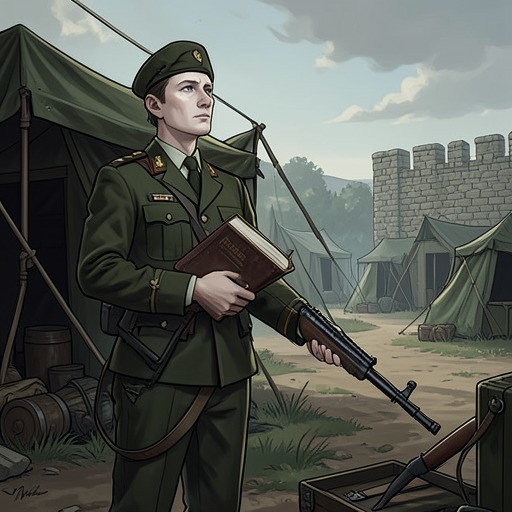
Minor’s surviving contribution began in a distinctive physical form: six-by-four-inch slips of unlined white paper, covered in his neat American handwriting in greenish-black ink. The first began leaving the Broadmoor Asylum post room in the spring of 1885. By late summer, small brown-paper packets were arriving monthly; soon the packets grew larger and came weekly. The stream continued for almost twenty years. These changing intervals and packet sizes register the expansion of one reader’s work into a sustained supply of material.
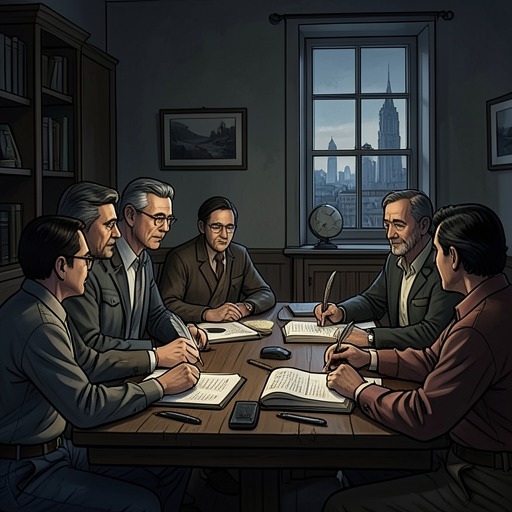
The slips entered a collective process at the Scriptorium. By the time Minor was sending quotations, Murray and his team had moved to Oxford. The Oxford Scriptorium received more than a thousand slips a day, and its initial 1,029 pigeonholes provided storage for the accumulating evidence. Workers first checked that quotations were complete and words correctly spelled. They then alphabetized the catchwords, separated a word’s uses by part of speech, and arranged the quotations for each use chronologically. Assistants grouped the evidence into distinctions of meaning and drafted definitions; Murray further reviewed the material, arranged or subdivided it, added etymology and pronunciation, and selected the quotations that best represented a word’s history.
A slip thus passed through several stages before it could appear in print. Its details supported the editors’ ability to compare a word’s uses across periods and shades of meaning. After Murray completed an entry, the finished columns went to the Press, were set in type and returned as galley proofs before being made into pages for printing. The paper records were not the Dictionary itself, but they supplied the dated examples on which its historical descriptions and definitions depended.
Minor’s Work and the Documentary Record
Minor’s packets were part of a collaboration that began through Dictionary work rather than through a dramatic first encounter. Murray later recalled that Minor had proved a very good reader and wrote to him often; at first, Murray assumed he was a retired medical man with time to spare. The address, Broadmoor, Crowthorne, led Murray to suspect that Minor might be a medical officer at the institution. Their correspondence, he explained, concerned the Dictionary and its materials. The slips and letters therefore preserve the practical basis of their association: an editor’s requests and a contributor’s documented reading.
That record also helps distinguish the working history from a later popular story. In 1915, Hayden Church published a sensational account of Murray visiting a fellow scholar and discovering that he was an inmate. Henry Bradley subsequently objected to the article’s factual errors and described its romantic version of Murray’s first interview with Minor as fiction. A letter Murray wrote in 1902 gives a less theatrical sequence: their correspondence began around 1880 or 1881, while their first meeting took place in January 1891. The slips belong to the long period of work that preceded that meeting, and their routine movement between reader and editor offers a more concrete account of the relationship than the invented discovery scene.
Scale and Significance
The finished Oxford English Dictionary gathered an immense number of dated examples: twelve volumes defined 414,825 words and used 1,827,306 illustrative quotations. Minor alone contributed scores of thousands. Those totals show why the small slips mattered. Each had to preserve enough context and source information to be checked and compared, while the collecting and sorting system made individual examples available for a much larger account of English usage.
The slips also make the Dictionary’s material and collaborative character visible. Its history was not only a matter of definitions composed by editors: it depended on readers locating passages, recording them in a standard form, and sending them into a system capable of classifying evidence at scale. Minor’s repeated packets carried that work from his rooms at Broadmoor into Murray’s Oxford operation. Their importance lies both in the quotations incorporated into the Dictionary and in the physical record they leave of how distant reading became shared lexicographical labour.