Oxford Press
The Surgeon of CrowthorneOxford Press’s adoption of the New English Dictionary turned an ambitious but repeatedly stalled lexicographical project into an active publishing enterprise. Its significance lay not simply in providing a publisher: the Press’s Delegates scrutinized the proposed work, negotiated its terms, and received the edited columns that would become the Dictionary, while its printing operation gave those words a durable physical form.
Choosing an editor and a publisher
The search for an editor and a publisher occupied the lexicographical and commercial literary establishments through the final years of the 1870s. Frederick Furnivall, committed to the Dictionary but judged to lack the personal qualities required to lead it, considered James Murray the right editor. Murray had published work on Scottish dialect, undertaken substantial editing of Scottish poetry, and pursued other scholarly projects; after leaving the Chartered Bank of India, he had returned to teaching at Mill Hill School. Furnivall also saw Oxford Press as a promising home for the undertaking: it offered academic distinction, comparatively deep pockets, and a flexible attitude toward the time literary work could require.
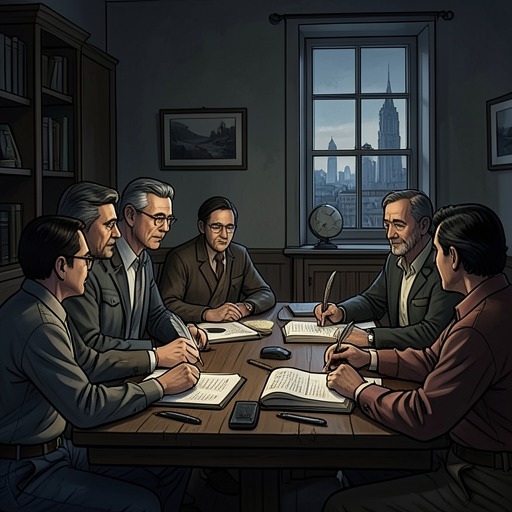
Murray was asked to demonstrate how the proposed dictionary might look. His specimen pages, prepared in late autumn 1877, treated four words: arrow, carouse, castle, and persuade. They went to Oxford Press’s Delegates, who acted as its governing board. Their response was initially discouraging. They wanted stronger evidence that Murray had searched thoroughly for quotations for each word, objected to his presentation of pronunciation, and hesitated over whether the etymological material should be included. The Press was already publishing a separate scholarly etymological dictionary, so the question was not merely editorial but also one of the project’s place within its publishing program.
From resistance to agreement
The prospect of Oxford Press was not the only possibility. As Murray and Frederick Furnivall grew frustrated, they approached Cambridge University Press, whose Syndics rejected the proposal. Meanwhile, lobbying continued in common rooms and London clubs. Oxford Press gradually became more receptive: its Delegates came to consider that the specimen pages could be changed, that Murray might be the right editor, and that the Dictionary could possess both intellectual and commercial appeal.
On 26 April 1878, Murray was invited to Oxford for his first meeting with the Delegates. He expected to be intimidated; they, in turn, had anticipated that they might dismiss him. The meeting reversed those expectations. Murray found that he liked the senior academics, and they quickly took to him. The Delegates decided to proceed, marking the decision with a glass or two of dry sherry. This was a turning point, but not yet a completed agreement: the terms still had to be worked out.
Negotiations over the contract continued for another full year and could be bitter. Murray, described as other-worldly, rarely conducted the arguments in person; his wife Ada did speak up. On 1 March 1879, the parties formally agreed that Murray would edit, on behalf of the Philological Society of London, the New English Dictionary on Historical Principles. The projected scale was daunting: an estimated 7,000 quarto pages in four thick volumes, to be completed in ten years. Even that schedule proved a woeful underestimate, but the work had at last begun in earnest and would not stop.
A publishing project becomes a working system
The agreement required an editorial operation capable of turning an immense body of reading into usable evidence. Murray’s instructions specified how contributors should prepare quotation slips: the catchword went at the upper left, followed by the quotation’s date, author, book, volume, page, and the complete sentence. Readers assigned to important, frequently used books could request preprinted slips; others were to write their own, arrange them alphabetically, and send them to the Scriptorium. The Press’s role in publishing the Dictionary depended on this disciplined paper trail as well as on the editors’ scholarship.
In Oxford, Murray established the Scriptorium as the place where the work would be edited. The iron-and-corrugated-tin building measured fifteen by fifty feet. After a neighbour complained that it spoiled the view, Murray had it set into a three-foot trench; the change made it damp and cold, and the mound of excavated earth caused further offence. The building was disliked by those who worked there, but its arrangements for filing and sorting improved on those at the Mill Hill Scriptorium. By then, quotation slips were arriving at more than a thousand a day, and the Oxford workspace had 1,029 pigeon-holes, compared with the fifty-four at Herbert Coleridge’s earlier arrangement.
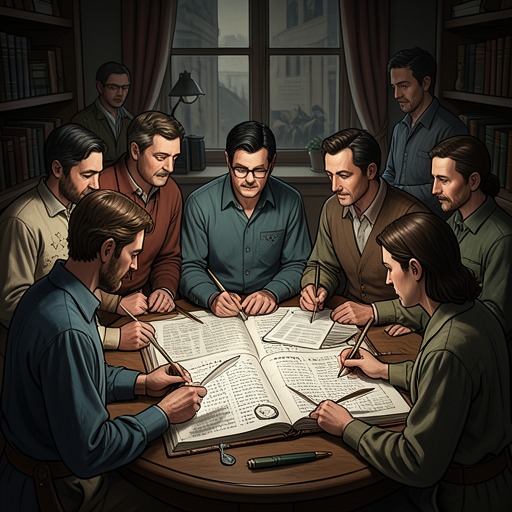
Murray organized the incoming material through successive checks and divisions. A reader checked that a quotation was complete and its words correctly spelled; another worker sorted the slips by catchword; a third separated the recognized parts of speech; and a fourth arranged the quotations chronologically. Assistants then distinguished shades of meaning and began drafting definitions. The process made editorial work collective and sequential: a slip did not become a printed entry by virtue of being gathered, but passed through checking, classification, ordering, and interpretation.
From edited columns to printed pages
Once meanings had been divided and their evidence arranged by date, Murray reviewed and further subdivided the groups, supplied etymology and pronunciation, and selected the strongest quotations. The Press had initially questioned the inclusion of etymology, but ultimately allowed it. Murray’s completed columns went to Oxford Press for typesetting in Clarendon or Old Style, with Greek and other foreign, ancient English, or Anglo-Saxon typefaces used when needed. The composed material returned to the Scriptorium as galley proofs, ready to be made up into pages and forms for the letterpress engines at the stone printing works down Walton Street.
This production chain helps explain the distance between the planned pace and the actual labour. The publishers hoped to issue two parts, or 600 pages of finished Dictionary, each year. Murray tried to complete thirty-three words a day, but a single word such as Approve could take three-quarters of a day. The printed object was therefore the result of a system in which the Press’s expectations, the editors’ decisions, the readers’ slips, and the physical demands of type and printing all met—and sometimes pulled against one another.
The Press’s later disposal of its old printing materials made that process visible again. In the 1980s, a visitor to an Oxford Press warehouse found a disordered pile of metal plates used for the Oxford English Dictionary’s printings, from individual fascicles to the final twelve-volume edition of 1928. The plates had lead fronts and backs of steel and antimony. As the Press adopted computer typesetting and photolithography, the letterpress equipment and handsetting type were being discarded, melted down, or taken away.
One plate survived as a private keepsake and was later used by a hand-printer to make two proofs on fine hand-wove paper, one in Oxford Blue and one in China Red. The plate and the two impressions were framed together. In the book’s closing account, that object hangs above a copy of the Dictionary opened to the page printed from the same piece of metal. The episode gives the Press’s institutional history a material ending: the Dictionary’s making is recalled not only through its words, but through the plates, proofs, and printed volume that connect editorial labour to the finished book.