Philological Society launch of the New English Dictionary project
The Surgeon of CrowthorneThe Philological Society launch of the New English Dictionary project began with a radical change in what a dictionary was expected to do: instead of merely illustrating a word’s meaning, it would document the history of that meaning through evidence gathered from texts. The undertaking was too large for an individual editor, so its defining method was collective labor—volunteers reading across periods, recording dated examples, and building an archive from which the dictionary could be made. The Society’s adoption of the plan in 1858 set the project in motion, though its scale would take decades to become fully apparent.
From definition to history
Richard Chenevix Trench’s proposal answered a problem of scope as much as one of scholarship. A dictionary that recorded the life of words would need to represent their changing uses, including meanings that had later faded or shifted. That meant reading widely and preserving examples that showed not only what a word meant, but when and how its meanings had developed. The aspiration was monumental, and conventional expectations made it seem impracticable.
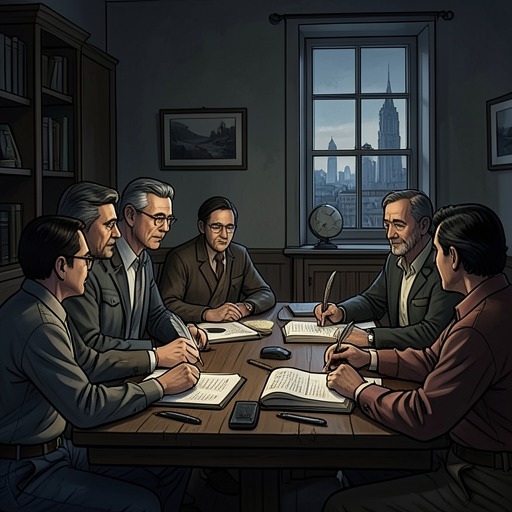
Trench argued that no single person could read all the relevant English literature, newspapers, magazines, and journals. The work, he said, required the “combined action of many”: a large body of unpaid amateur readers. The suggestion made the proposed dictionary a collaborative enterprise from its conception. It also carried a democratic implication. Rather than fixing English through rules imposed by a small authority, the project would assemble evidence of how people had actually used words, across time and in varied contexts.
The Society did not move directly from that idea to a finished plan. Six months before Trench’s speech, it had already formed an Unregistered Words Committee, bringing Trench together with Frederick Furnivall and Herbert Coleridge. Its initial aim was a supplement collecting words absent from existing dictionaries. But searches produced so many discoveries that the supplement threatened to exceed the scale of the books it was meant to supplement. The Society consequently shifted toward a wholly new dictionary. It formally adopted the plan on 7 January 1858, the date commonly treated as the project’s beginning on paper.
Organizing readers and evidence
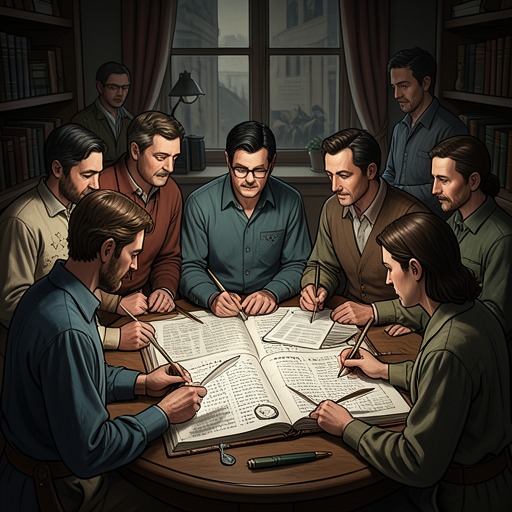
Frederick Furnivall’s circular invited volunteers to choose among three broad periods: 1250 to 1526; 1526 to 1674; and 1674 to the present. The divisions reflected the belief that English had developed through distinguishable historical phases. Readers offered to work on particular books, made word-lists as they read, and could then search more specifically for words the editorial team wanted investigated.
The method depended on making each example identifiable and useful. A reader wrote the target word at the top of a paper slip, followed by the date, author, title, volume, and page of the source, then copied the sentence showing the word in use. This recorded not just an isolated definition, but an instance that editors could place in a chronology of meanings. The individual slip was small; the system depended on thousands of such pieces of evidence being accurately described, collected, and sorted.
Herbert Coleridge’s first practical task was to design storage for the expected submissions: a stack of oak-board pigeon-holes, nine across and six high, intended to hold 60,000 to 100,000 slips. He expected the first volume within two years. Both estimates exposed how little the Society yet understood about the undertaking. More than six million slips eventually arrived, while the first saleable section took roughly ten times as long as Coleridge had forecast. The volunteers’ success in finding material enlarged the task itself; the project’s archive became far greater than its early organizers had anticipated.
From paper plan to sustained enterprise
Even after the Society adopted the proposal, activity remained sporadic for years. Almost a quarter of a century after Trench’s speech, James Murray was appointed editor on 1 March 1879, under an agreement that projected a dictionary of about 7,000 quarto pages in four volumes, to be completed in ten years. That forecast, too, underestimated the work. Murray’s appointment marked the point at which the enterprise began properly and continued without stopping.
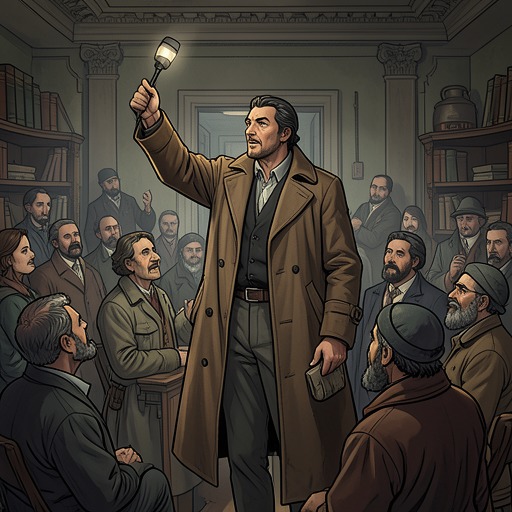
Within days, Murray arranged for a corrugated-iron shed at Mill Hill School to serve as the Scriptorium and issued a four-page appeal for more volunteer readers. It asked the English-speaking and English-reading public in Great Britain, America, and the British Colonies to continue the work by reading and extracting books that remained unexamined. The appeal circulated through magazines and newspapers, bookshops, news-stands, and libraries; some librarians distributed it as a bookmark, while wooden cases allowed visitors to take and read copies. The project’s expansion therefore relied not only on an editorial plan, but on the practical circulation of a printed invitation.
One copy reached William Chester Minor at Broadmoor in the early 1880s. His subsequent work illustrates how the original volunteer method could be extended: rather than simply sending quotations as he encountered them, he built indexed word-lists and could respond when the editors requested particular terms. His first letter offered that capacity to the Dictionary team. When readers were asked for evidence on the word “art,” eighteen replies came in; Minor sent twenty-seven quotations, far more than the one or two sentences offered by most respondents. The launch’s lasting consequence was thus not a single speech or committee decision, but a system able to connect dispersed reading, precise records, editorial requests, and a work of unprecedented scale.
Significance and limits of the beginning
The project’s democratic premise did not make its execution effortless or immediate. The Society’s early supplement scheme had to give way to a new dictionary; volunteer enthusiasm generated an unmanageable volume of evidence; and the formal plan preceded sustained editorial work by many years. The gap between ambition and capacity is part of the event’s history. The dictionary became possible through collaboration, but collaboration required filing systems, editorial labor, repeated appeals, and a willingness to revise expectations as the evidence accumulated.
The launch also established a method whose results could outlast the circumstances of any one contributor. A dated quotation preserved the word in use; accumulated with others, it could reveal shifts in meaning that a prescriptive rule or bare definition would miss. From Trench’s proposal to the Society’s adoption, and from Furnivall’s reader circular to Murray’s renewed appeal, the project turned the historical record of English into a shared undertaking. Its immense archive was the material consequence of that decision to ask many readers, rather than one authority, to gather the language’s history.