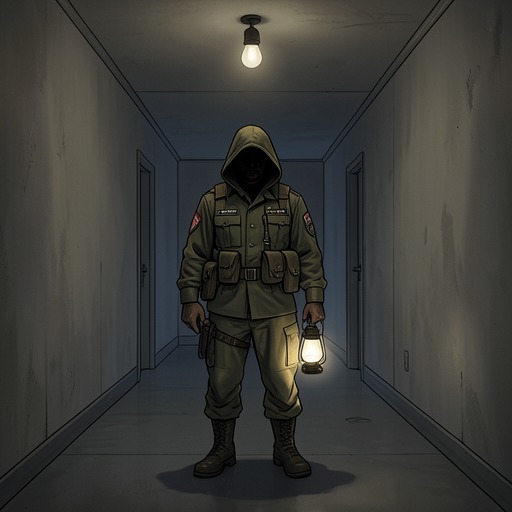
Post-traumatic stress disorder
The Surgeon of CrowthornePost-traumatic stress disorder is considered in the account of William Chester Minor as a possible way to understand how extreme experience might interact with an underlying vulnerability, not as a diagnosis established for him. The narrative asks whether the Battle of the Wilderness helped bring his illness into view, but distinguishes that possibility from the evidence of a condition that persisted throughout his life and from the changing psychiatric terms later applied to his case.
A question of cause
The account presents the origin of severe mental illness as unresolved. It asks whether the scenes Minor encountered at the Battle of the Wilderness could have triggered his later behavior, and whether his branding of an Irishman might have contributed to the crime he committed eight years afterward. These are posed as possibilities, not as a proven chain of cause and effect: the text leaves open whether a particular event initiated the illness or merely intensified its expression.
A broader explanation might combine predisposition and experience. The narrative raises the possibility of an inherited vulnerability, noting that two of Minor’s relations had died by suicide, although the circumstances are uncertain. It also describes him as a painter, flautist, and collector of old books, and wonders whether his gentle temperament made the violence he witnessed especially difficult to bear. Neither family history nor temperament is treated as conclusive evidence; together, they frame trauma as one possible influence among several.
Symptoms and changing diagnoses
The account places the onset of unmistakable difficulty before the London crime. During the summer of 1868, after reportedly spending too long in the Florida sun, Minor complained of severe headaches and vertigo. He was sent under escort to New York for examination. By September, doctors considered him seriously unwell, and Surgeon Hammond’s report of 3 September described monomania and classified him as delusional. The report did not identify the subject of the supposed monomania, so it documents a grave concern without explaining its content.
The language used to describe Minor’s condition changed over time. At St Elizabeths Hospital, on 8 November 1918, his psychiatrist Dr Davidian recorded a diagnosis of dementia praecox, paranoid form. The narrative explains that this term referred to an early decline in a person’s grasp of reality and distinguishes it from senile dementia, associated with old age. It also places the terminology in the history of psychiatry: Emil Kraepelin had published the classification in 1899, partly to distinguish dementia praecox from manic-depressive psychosis. These later labels show how medical understanding shifted; they do not establish that Minor had PTSD.
What the comparison with PTSD can and cannot explain
The account invokes post-traumatic stress disorder to consider the lasting effects of exposure to appalling events. It contrasts cases in which symptoms ease over time with Minor’s unremitting distress, which continued across his life. On that basis, it cautions against treating PTSD as a complete explanation for his illness. The scenes in Virginia may, the narrative suggests, have prompted more ruinous manifestations to emerge, while something else was also profoundly wrong; the underlying cause remains uncertain.
This distinction matters because the narrative resists a simple conversion of chronology into diagnosis. A battlefield experience preceding conspicuous symptoms may support a question about trauma, but it cannot by itself settle whether trauma caused the illness, aggravated a pre-existing susceptibility, or coincided with its emergence. The account accordingly presents several possibilities—genetic predisposition, temperament, and overwhelming external stress—without claiming that any one is decisive.
Confinement, treatment, and the limits of hindsight
The narrative also considers whether Minor’s long confinement at Broadmoor might have left him unimproved, and whether a more compassionate and enlightened regime could have mitigated his distress or helped him recover. This is framed as a counterfactual possibility rather than a demonstrated outcome. The comparison with present-day care underscores how different treatment might be, while recognizing that modern explanations and therapies cannot be applied retrospectively as though they settled his case.
Minor’s history therefore serves less as proof of a trauma diagnosis than as a record of the limits of certainty. The account connects a possible traumatic precipitant to a prolonged illness, traces the changing medical language used to describe it, and keeps the distinction between a plausible influence and an established cause in view. Its central claim is measured: what happened in Virginia may have mattered, but the evidence presented does not show that post-traumatic stress disorder alone explains Minor’s lifelong condition.