The 1897 Great Dictionary Dinner
The Surgeon of CrowthorneThe 1897 Great Dictionary Dinner was an Oxford celebration of James Murray and the growing achievement of the New English Dictionary, staged at a moment when the project seemed certain to reach completion. It brought editors, publishers, scholars, printers, and volunteers together in an elaborate public tribute. Its later significance came partly from a conspicuous absence: William Chester Minor, one of the Dictionary’s most prolific contributors, was invited but did not attend. A popular account turned that absence into the occasion for Murray’s supposed discovery that Minor was an inmate of Broadmoor; correspondence uncovered later shows that their first meeting had taken place six years earlier.
Occasion and purpose
The dinner took place on Tuesday, 12 October 1897, during Queen Victoria’s Diamond Jubilee year. The Dictionary’s progress had accelerated after its difficult early period. Its published fascicles had advanced from Anta–Battening in 1885, through Battentlie–Bozzom in 1887, to Bra–Byzen in 1888. By 1896, the third volume, covering the troublesome letter C, had been completed and dedicated to the Queen with her approval. Royal recognition gave the enterprise an aura of permanence: it seemed increasingly unlikely that a project so publicly endorsed would be abandoned.
With the work advancing and its future more secure, Oxford decided to honour Murray. The university’s new Vice-Chancellor arranged a large dinner in Murray’s name, presenting the occasion as recognition not only of an editor but of a collective scholarly undertaking. The Times described the Dictionary as an effort on a scale rarely attempted by a university or a printing press and treated its eventual completion as a source of institutional glory. The dinner thus celebrated progress already made while expressing confidence in the work still to come; it was not a celebration of a finished Dictionary.
The evening at Queen’s College
The gathering was held in the great hall of Queen’s College. Its ceremonial setting included the college tradition of summoning diners with a silver trumpet, and the tables were dressed with flowers, silver, and crystal. The menu ranged from turtle soup and turbot with lobster sauce to roast partridges, Queen Mab pudding, and strawberry ice, alongside richer dishes with French names. Wines included Amontillado, Maraschino, Château-d’Yquem, and Champagne. Guests wore white tie, academic robes, and medals; after a loyal toast to the Queen, cigars accompanied the speeches.
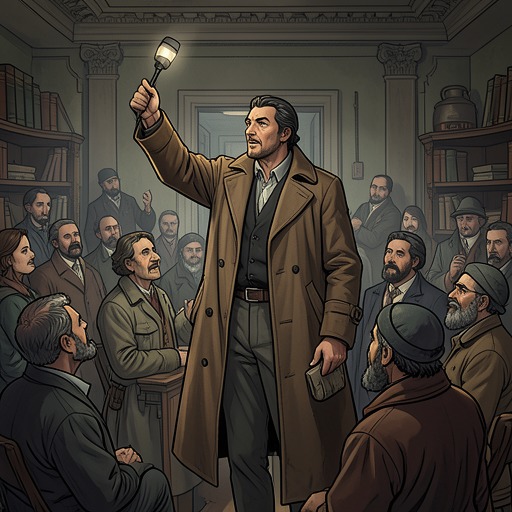
There were fourteen speeches. Murray surveyed the history of dictionary-making, while the head of the Oxford University Press spoke of the project as a national duty. Frederick Furnivall, characteristically lively, used his speech to criticize Oxford’s attitude toward admitting women. The formal programme combined tribute to the Dictionary’s intellectual ambition with arguments about the institutions and social values around it. The dinner’s scale and ceremony made the work visible as a public achievement, rather than merely the accumulated labour of editors and readers.
The company represented that labour broadly. Present were the Dictionary’s editors, delegates of the Press, printers, members of the Philological Society, and some of its most energetic staff and volunteers. Among the named guests were F. T. Elworthy, the Reverend W. E. Smith, Lord Aldenham, Russell Martineau, and Monsieur F. J. Amours. Their presence made the celebration a gathering of the network that sustained the Dictionary, not simply a dinner for university dignitaries.
Minor’s absence and the question it left
Minor had been invited, but he was not among the guests. His absence seemed particularly puzzling because he lived at Crowthorne, about an hour away by train, and his letters were known for their courtesy. Unlike Fitzedward Hall, whose reclusive and difficult character was familiar to those present, Minor was not understood by the company as a notorious misanthrope. His contributions, however, were central to the Dictionary’s work: Murray praised his regular supply of quotations, sent week by week for words being prepared for press.
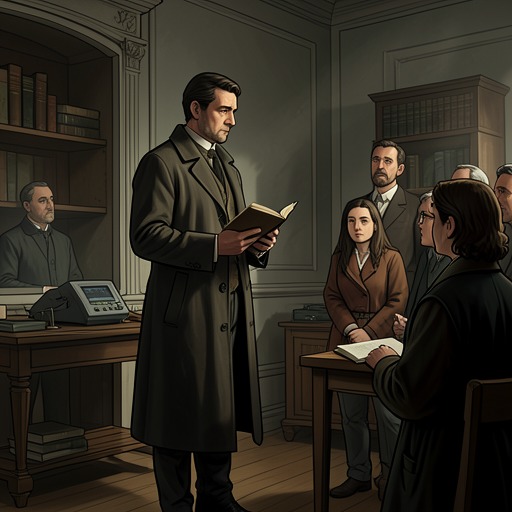
Those at the dinner knew Hall’s reason for staying away, or believed they did. Minor’s absence left a different kind of question. In the received version of events, Murray was perplexed and resolved to visit his contributor, leading to a dramatic revelation at Broadmoor. That story gave the dinner a second life as a scene of discovery: the eminent editor setting out to meet a fellow scholar, only to learn that the man behind the quotations was an asylum inmate who had committed murder and was considered insane. But this was not the circumstance in which the two men first met.
The later account and the actual meeting
The familiar dinner story was popularized by the American journalist Hayden Church in 1915, first in the Sunday Star and then in the Strand. In its sensational form, it joined Minor’s work for the Dictionary to his confinement at Broadmoor and cast Murray’s visit as a startling encounter. The account proved compelling and was repeated by later writers, helping to make the dinner seem like the beginning of their personal relationship. Its narrative force should not be mistaken for an accurate chronology.
A letter Murray wrote in 1902 to Francis Brown gives a different sequence. Murray recalled that Minor had begun writing to him around 1880 or 1881 and that he initially assumed his correspondent was a retired medical man with time to read. After learning that Minor’s address, Broadmoor, was that of an asylum, Murray sought permission to visit. Their first meeting took place in January 1891, over lunch, six years before the dinner. The meeting began a long personal friendship: the men saw each other regularly for almost twenty years, bound by mutual respect and a shared passion for words. The 1897 gathering therefore did not initiate their acquaintance. Its importance lies instead in how an absent contributor and an elaborate celebration were later recast as the opening scene of a memorable, but chronologically mistaken, story.