William Chester Minor—George Merrett: murder and its aftermath
The Surgeon of CrowthorneWilliam Chester Minor—George Merrett: murder and its aftermath is a relationship defined by an irreversible act and its long, unequal consequences. Minor’s contribution to the Oxford English Dictionary became a lasting part of his public story; George Merrett, the working man he killed, was left with little visible memorial. The account holds both facts together, tracing not only the crime but also the losses borne by Merrett’s family and the limited efforts at remembrance that followed.
The killing and its human cost
Shortly after two o’clock on 17 February 1872, three revolver shots—possibly four—rang out in Lambeth. The sound brought young constable Henry Tarrant running toward Belvedere Road. The book later identifies the shooting there as the event that ended Merrett’s life. It was a sudden act of violence in a district where gunfire was considered unusual, but its consequences extended well beyond that night.
Merrett was an innocent working-class man, the son of a farmer from Wiltshire who had come to London to earn a living. He left a pregnant wife, Eliza Merrett, and six young children. The family had already been living in poverty; his death made their circumstances more precarious and turned an ordinary effort to build a life in the city into a lasting bereavement. The book’s account resists allowing the better-known story of Minor’s later scholarship to eclipse the person killed or the family left behind.
Merrett belonged to the Ancient Order of Foresters, a friendly society that offered working people cooperative financial support at a time when comparable assistance was not otherwise available. On the night he died, he had been relieving a fellow member at work. The society responded with a substantial funeral: its band led a half-mile procession, followed by members, the hearse and mourning coaches, and then brewery workers and members of the public. Eliza rode in the leading carriage with her youngest child. The procession passed the place on Belvedere Road where Merrett had been killed before continuing from Lambeth to Tooting Cemetery.
Trial and the account of Minor’s illness
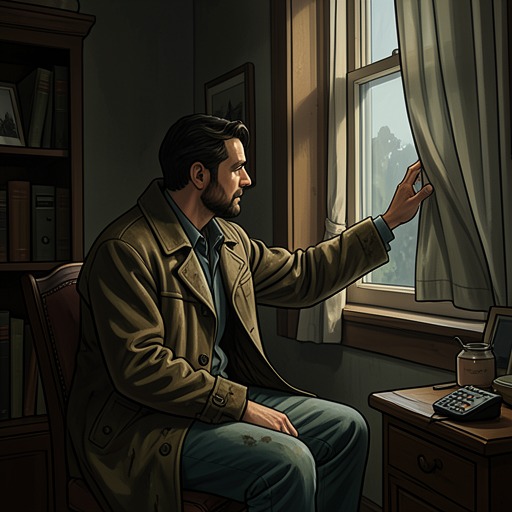
Minor was charged with Merrett’s murder and found not guilty on the grounds of insanity. At his early-April trial at Kingston Assizes, witnesses made the extent of his illness plain to the court. Police testified that he had previously complained of men entering his room at night to poison him. He believed the supposed persecutors were Irish militants and feared that they intended to murder him and disguise his death as suicide. These claims place the killing within the context of a persistent persecutory fear, without diminishing the reality of Merrett’s death or the harm to his family.
The record made when Minor was admitted to Broadmoor on 17 April 1872 described him as a surgeon of superior education and recorded both his belief that he had been persecuted for years and his fear of poisoning. It also formally classified him as dangerous to others. The legal finding and the institutional record explain how the authorities understood Minor’s condition; they do not undo the consequences for the man he killed. The relation therefore remains difficult to reduce either to a story of criminal responsibility alone or to an account of illness detached from its victim.
Remorse, support, and contact with Eliza
In lucid periods, Minor was contrite about what he had done and appalled by its consequences. Some years after the murder, he wrote to Eliza through the American Embassy in London, explaining his sorrow and offering help, including financial assistance for her or the children. His stepmother, Judith Minor, had already contributed to the family’s support. Minor’s letter turned remorse into a concrete offer, though no payment could restore Merrett or reverse the disruption of his family’s life.
Eliza accepted financial help and asked whether she could visit Minor. After the Home Office considered the unprecedented request with Broadmoor’s superintendent, it approved an experimental supervised visit. Eliza travelled from Lambeth to the hospital in late 1879 and met the man who had killed her husband seven years earlier. The visit did not erase the distance between perpetrator and bereaved family; it established a continuing, closely supervised connection. A later account records that Minor gave a large part of his income to support Merrett’s widow and that she visited him regularly.
The family’s later history underscores that restitution was partial. Eliza never recovered from the shock of the murder; she took to drink and later died of liver failure. One son, George, used money from Minor’s stepmother to travel to Monaco, won a considerable sum, and remained there before dying in poverty in the south of France. Another son, Frederick, died by suicide in London; the reasons were never explained. These outcomes belong to the wider aftermath rather than to a simple chain of effects that can be assigned to one cause, but they show how the family’s story continued long after the shooting.
Unequal remembrance
The public response to the murder initially made Merrett’s loss visible. Funds were collected for Eliza and her children by Americans, Lambeth clergy, and local entertainments; his funeral drew a large procession. Yet the attention did not become durable remembrance. Merrett’s grave at Tooting Cemetery, which may once have had a marker, is now represented by a small patch of discoloured grass. Eliza has no grave. Their absence from the commemorative landscape contrasts sharply with the attention later bestowed on Minor and the Dictionary.
Minor, meanwhile, was buried in the family plot at Evergreen Cemetery in New Haven. His small reddish-sandstone gravestone bears only his name. The cemetery’s high chain-link fence and its position near a poor neighbourhood sharpen the account’s contrast between scholarly achievement and obscurity: even a major contributor to the Oxford English Dictionary could die largely forgotten. The Dictionary itself, with twelve volumes, 414,825 defined words, and more than 1.8 million illustrative quotations, offers a lasting memorial to Minor’s labour. It offers no comparable sign that Merrett was worthy of memory.
The book makes that imbalance central to the relation between the two men. Minor’s work is described as singular and admirable, but it began from circumstances that included the murder of Merrett. The final emphasis falls not on turning the killing into a prelude to literary achievement, but on the victim whose name and grave received so little public recognition. The account is offered as a small testament to Merrett, restoring him to a story in which the murderer’s fame might otherwise have occupied nearly all the space.