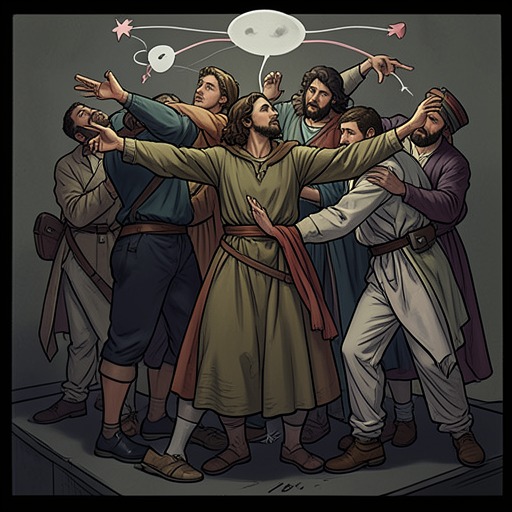
Fifth Commandment
The SwarmThe Fifth Commandment is more than a prohibition against killing: in the crisis prompted by the Yrr, it becomes a measure of whether humanity’s religious laws can claim authority over life beyond humanity. The Yrr break it continually for biological reasons, and that fact turns a familiar commandment into a challenge to doctrines that had placed humankind at the center of God’s plan.
The Commandment and the Yrr
The conflict begins with a distinction between human moral obligation and the Yrr’s way of life. The Yrr do not live within God’s tenets; their biology means they violate the Fifth Commandment all the time. The passage does not present this as a single transgression or a choice to defy a known rule. It is a persistent consequence of what the Yrr are, making the commandment’s reach—and the assumption that divine law governs all intelligent life—uncertain.
That difference also disrupts a comforting division between human dominion on Earth and other species’ dominion elsewhere. If the Yrr are another intelligent species on the same planet, their existence is not easily fitted into a theology in which humanity alone was created as God’s chosen people. Their continual violation of the commandment forces the question of whether the rule is universal, whether the Yrr are answerable to it, and what their presence says about the authority attributed to it.
A Doctrinal Crisis
The argument considers what it would mean to accept the Yrr as a second, equal race on Earth. Under that premise, they would either have had to experience the Passion or live according to God’s laws. If neither applied, they would have sinned without redemption; the expected consequence, in the passage’s reasoning, would be God’s wrath. Their apparent existence outside this scheme leaves religious belief confronting a problem that cannot be resolved simply by asserting human superiority.
The passage sets out three possible explanations: God does not exist, God is not in control, or God approves of the Yrr. Each unsettles a different foundation of faith. The first denies God’s existence; the second denies divine sovereignty; the third suggests that humanity’s claim to be chosen was a delusion. The Fifth Commandment thus sits at the center of a crisis extending beyond the morality of killing: the Yrr make the older account of who God chose, and how divine judgment works, difficult to sustain.
Religious Responses and the Limits of Reconciliation
The upheaval reaches Christianity, Judaism, and Islam, whose adherents are trying to define and interpret what has happened while the event shakes the foundations of their faith. The passage connects this religious destabilization to the broader collapse of human confidence, including economies that had relied more heavily on belief in God than people understood. By contrast, Buddhism and Hinduism attract growing numbers because their teachings have long accepted human coexistence with other forms of life. Esoteric practices expand, new religious movements emerge, and traditional tribal religions flourish.
Mormonism proves the most resilient among the older sects because its conception of God allows for many different worlds. Yet even that framework cannot explain why God would have raised two children in the same nursery. The image compresses the dilemma into a question of shared origin: accommodating multiple worlds does not account for two intelligent peoples apparently brought together on one Earth, with radically different relations to the commandment.
The Commandment as Accusation
A Catholic bishop’s voyage with a delegation from Rome gives the crisis a public and ironic form. The delegation sprinkles holy water over the waves and orders the devil to depart, treating the enemy as something that can be identified and expelled. But the passage turns the accusation back on humanity: the species that has scorned God’s principles and defiled creation is now acting as prosecutor on the Creator’s behalf, as though it could preach the Gospel to its own Maker and ask to be spared.
In that reversal, the Fifth Commandment is not merely evidence against the Yrr. It also exposes the instability of humanity’s claim to moral and religious privilege: people invoke divine authority against a species that does not follow their law while confronting their own failure to honor the principles they profess. The commandment’s crisis therefore concerns both the Yrr’s difference and the human presumption that the moral order must confirm humanity’s favored place.