Finn Skaugen
The SwarmFinn Skaugen is a member of Statoil’s executive committee and a representative of its management board, based at the company’s headquarters in Stavanger. As the threat from hydrate-eating worms and unstable methane deposits grows, he becomes a consequential intermediary between field research, corporate management, and government. He presses for information to be gathered and shared, supports pausing a seabed project until its risks are better understood, and ultimately changes the project’s leadership. His conduct is neither simple corporate caution nor disinterested scientific stewardship: the crisis requires disclosure, while the company also faces the danger of being blamed for withholding evidence.
Position and First Involvement
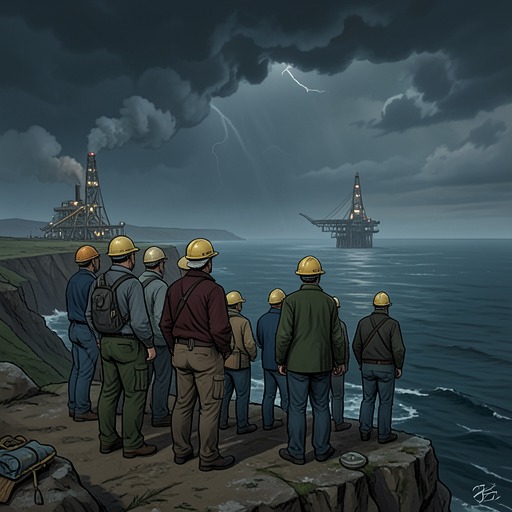
Skaugen first appears at a meeting about Statoil’s proposed subsea project, accompanying Thor Hvistendahl and Clifford Stone. He has come from Stavanger as an executive committee member representing the management board. His manner is comparatively approachable, but his position gives his questions practical weight: the discussion is not only about what the scientists know, but what the company should do with uncertain evidence.
When Sigur Johanson asks that GEOMAR Centre inspect the marked exploration area, with Statoil’s backing, Skaugen responds by asking whether the researchers intend to send someone. Johanson says they will send a research vessel, the RV Sonne. The exchange marks Skaugen as a participant willing to bring outside scientific scrutiny into the project rather than confining the findings to Statoil’s own team.
At the subsequent decision point, Skaugen frames the problem as one of risk under uncertainty. The worms cannot yet be explained or incorporated into the company’s usual calculations, and he asks Johanson for a recommendation without asking him to make the decision on Statoil’s behalf. Johanson’s answer is conditional: proceed eventually, but wait for GEOMAR’s tests and a green light, because the hydrate-eating worms may threaten slope stability and future boreholes. Skaugen thanks him. The exchange makes scientific assessment a basis for delaying the schedule, even though Stone has argued against allowing the worms to become an obstacle to construction.
Gathering Evidence and Escalating Disclosure
Skaugen does not treat the initial meeting as the end of the inquiry. He contacts other exploration teams and oil companies around the world to ask whether they have found similar organisms. Tina Lund tells Johanson that Skaugen suspects teams in Asia may know at least as much as the Norwegian researchers. This search broadens the issue beyond a local anomaly: comparisons across companies and regions might establish whether the worms are isolated or part of a wider pattern.
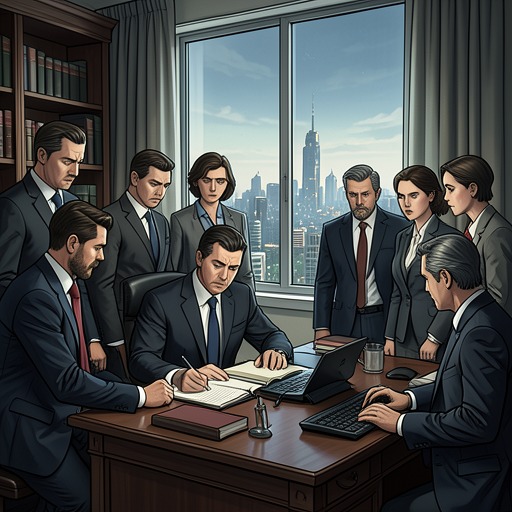
When he later flies in from Stavanger, Skaugen asks for a detailed account of the findings and works to collate the results. At the meeting, he announces that he has spoken with the board and made recommendations, after which the Norwegian government has been informed. The disclosure covers more than the worms: it includes methane-deposit dissociation, the possibility of an impending methane disaster, the danger of a slope collapse, and the deep-sea robot’s footage of an unknown organism.
Skaugen’s appeal is explicitly ethical as well as procedural. He argues that the oil industry would disgrace itself by withholding information when lives might depend on it, and says that Johanson’s earlier judgment had been right. He has also spoken for an hour with the scientific board of the Japan National Oil Corporation. His pointed hypothetical about a company suppressing warnings to win a race for methane extraction places the possibility of a cover-up before the room without presenting it as an established finding about the Japanese company. He then reports that the company has found a similar worm species off Japan’s coast, while its director says the discovery occurred only in the preceding three days. The timing is presented as an extraordinary coincidence, sharpening the pressure for disclosure and comparison.
The Change in Project Leadership
Stone challenges the significance of the evidence, insisting that there are no firm results. Skaugen turns the question back on him: can Stone classify the worm? When Stone cannot, Skaugen releases him from his duties for the moment and says Tina Lund will take his place. The decision is an immediate shift in authority, not merely a request for further research. It follows Stone’s inability to resolve the organism scientifically and Skaugen’s conclusion that the project cannot proceed as though the uncertainty did not exist.
The narrative also gives Stone’s version of what is at stake in the reversal. Stone had pushed the prototype through testing, recommended construction, and gained budget and jurisdiction; he had wanted to be first to launch a successful prototype. He had previously treated the worm reports and methane readings as insufficient reason to delay the work. From Stone’s perspective, Skaugen’s disclosure has set a chain of corporate pressure in motion: other firms are being contacted, each firm presses the next, and the prospect of public environmental disaster makes silence increasingly dangerous. Stone sees Skaugen as having betrayed him and casts his own omissions as service to the company. This account is Stone’s resentful interpretation, but it clarifies why Skaugen’s actions are experienced within Statoil as both a response to danger and a redistribution of responsibility.
Johanson’s New Role and Skaugen’s Ambivalence
Skaugen asks Johanson whether he can still be counted on, explaining that accidents and anomalies elsewhere have made people nervous and that oil companies may become convenient scapegoats. The warning reveals the corporate stakes alongside the scientific ones: Statoil must avoid mistakes, but it must also be prepared for a crisis that could bring suspicion upon the industry. Johanson agrees to remain involved.
Skaugen then tells him that Statoil has approached the Norwegian University of Science and Technology about a leave of absence and has put his name forward to the government. The proposed research post would have a Statoil budget and the support he needs. Skaugen argues that, apart from the GEOMAR researchers, Johanson is better informed than anyone and that accepting would serve the public interest. Johanson feels anger at having the decision effectively arranged for him, but says he cannot refuse. Skaugen acknowledges that the company has bulldozed him into the role, expresses gratitude and respect, and offers to make amends once the crisis is resolved. His warmth does not erase the pressure; it makes the mixture of personal appreciation and institutional necessity explicit.
Johanson later asks Lund why Skaugen publicly removed Stone and involved him. Lund describes Skaugen as a man of integrity who tires of people turning a blind eye, but also as softhearted enough to give Stone another chance if she asked. In a later exchange, Johanson tells Lund that Stone’s reprieve was Skaugen’s decision, not a result of her advice. The possibility of accountability and the possibility of leniency therefore coexist in Skaugen’s conduct: he removes Stone when the evidence cannot be classified, yet does not make the removal irrevocable.
Narrative Role
Skaugen’s importance lies in the decisions that connect scientific uncertainty to institutional action. He sponsors external examination, seeks comparable findings from other companies, reports the danger to the Norwegian government, and changes who directs the project. These measures do not make him a scientist or establish that he can settle what the worms mean. Instead, they show how the crisis advances through acts of coordination and disclosure before its causes are fully known.
His actions also resist a clean division between public duty and corporate interest. Skaugen argues that vital information must not be withheld, while acknowledging that Statoil could become a scapegoat and that Johanson’s expertise is needed to protect the public interest. The company’s decision to alert government and involve scientists is therefore both a response to potentially catastrophic danger and a move away from the secrecy that could make the company culpable. Skaugen’s character is defined by that tense overlap: integrity is expressed through action, but exercised from within an organization whose schedule, reputation, and responsibility are all at risk.