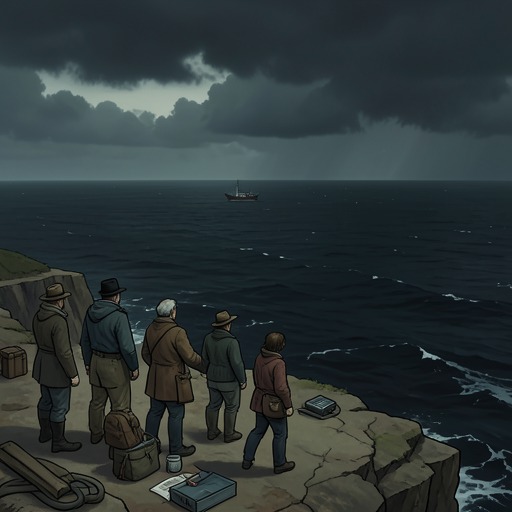
First Underwater Message to the Yrr
The SwarmThe First Underwater Message to the Yrr begins humanity’s attempt to move from interpreting strange ocean signals to addressing their suspected source. Planned by Samantha Crowe and her colleagues as the first stage of a contact strategy, it uses a sound wave tuned to the frequency range associated with Scratch. The act is both a technical experiment and a high-stakes appeal: the team can send a signal into the depths, but cannot know whether the Yrr will recognize it as communication.
Background and purpose
The contact plan had taken shape over several weeks, with help from Murray Shankar, Judith Li, Leon Anawak, and members of NASA. Crowe drew on the small number of earlier attempts at contact, while adapting their logic to a setting where the familiar tools of space communication would not work. In space, radio waves can carry large amounts of data, and light travels quickly without cables or wires. Underwater, water molecules absorb short-wave energy; long-wave signals would require enormous antennas; and light is useful only over short distances. Sound remained the practical medium, but its reflections could make a message overlap with itself and become unintelligible.
This was not simply a matter of choosing a frequency and broadcasting. The transmission had to be designed for a medium that interfered with its own signals. The team’s proposal to use a specialized modem drew on marine mammals, whose changing calls can evade echo and interference. Leon Anawak explained that the relevant technique involved continuous modulation of frequency and pitch: what people might call singing was, in this context, a way to make acoustic communication more reliable and increase the amount of information it could carry. The planned modem could transmit thirty kilobytes over three kilometres, enough for high-resolution images. The first message, however, would be a smaller and more basic test of whether dialogue was possible at all.
A language built from mathematics
Crowe’s choice of mathematics rested on the idea that the laws of physics are expressed mathematically, making mathematics a possible common language for intelligent beings subject to the same physical conditions. Rather than asking the Yrr to solve a puzzle for its own sake, the team intended to express thoughts in mathematical form. The initial exchange was to consist of two sums. Its purpose was to establish the existence of the Yrr as a communicating presence and gauge whether a dialogue could begin.
Crowe situated the proposal against the earlier Arecibo message, sent by SETI in 1974 as 1,679 binary pulses. The number could be organized into 73 columns of 23 characters, since 1,679 is the product of those two prime numbers; rendered as black-and-white blocks, the pulses formed a pattern. The example showed how a message could carry clues to its own structure, rather than depending on a shared spoken language. Yet the Arecibo signal would take 26,000 years to reach its destination, and a reply would require another 26,000 years. The underwater attempt promised a much faster exchange, while facing the more immediate uncertainty of whether its recipients would interpret the signal as intended.
The first transmission
Late that afternoon, the team sent the first sound wave into the depths. Murray Shankar selected a frequency matching the spectrum of the unidentified sounds that his colleagues in SOSUS had named Scratch. That choice connected the new communication directly to the signals that had prompted the investigation: instead of sending an arbitrary tone, the team shaped its first call around a sound already associated with the Yrr.
The modem modulated the signal, but reflection introduced distortion. Crowe and Shankar worked in the CIC, adjusting the modulations until the distortion was gone. An hour after the broadcast, Crowe believed that any creature capable of detecting acoustic signals could receive it. Reception, however, was not comprehension. The team had no way to establish whether the Yrr would recognize the signal as deliberate, identify its mathematical structure, or answer. The act of sending therefore produced no immediate certainty; it created a test whose outcome depended on an intelligence beyond human observation.
Stakes and significance
For Crowe, the broadcast brought the long-imagined prospect of contact close enough to feel real. Her elation was accompanied by fear, because the mission was not an abstract exercise like Arecibo or Project Phoenix. The team understood itself to be acting amid a catastrophe that might destroy humanity, and the responsibility for preventing it rested on their decisions. The first message makes that burden concrete: a carefully engineered signal is sent, but neither the intention behind it nor the hoped-for response can be verified at the moment of transmission.
The event also gives the ocean a role beyond that of a setting. Elsewhere, the continental shelf is described as familiar territory beside depths that remain an unknown universe; in polar waters, descent can strip away ordinary visual and gravitational cues. Against that larger picture of limited human perception, the message is a modest instrument sent through an immense, difficult medium. Its precision—the selected frequency, the corrected distortion, the mathematical design—does not abolish uncertainty. It marks the beginning of contact as a disciplined attempt to reach beyond what the human team can yet see or understand.