Hypermutating DNA
The SwarmHypermutating DNA is the proposed learning system of the Yrr: a way for single cells to register information through DNA changes, share it across a collective, and preserve it through cell division. The idea overturns the assumption that intelligence requires a large, stable brain. In this account, genetic inheritance is not merely the transmission of a biological blueprint; it is the transmission of experience, making each Yrr cell part of an evolving, distributed memory.
From an apparent impossibility to a model
Before considering the Yrr, Karen Weaver is working against the prevailing limits placed on intelligent life. Researchers had reasoned that intelligence required a minimum neural capacity: individual neurons were not intelligent by themselves, and a brain needed a critical mass of cells. This reasoning made intelligent single-cell organisms seem impossible. The question is therefore not simply whether a large number of cells can be compared to a brain, but how separate cells could learn, communicate, and become a higher-order entity.
The problem takes concrete form in the blue cloud filmed by the URA near Vancouver Island, which appeared to consist of billions of cells. The researchers can imagine those cells as a body or a brain in aggregate, but numbers alone do not account for thought. They still need a process by which the cells share information and make it useful. Weaver begins programming a computer to connect mental capacity with single-cell organisms, turning the biological puzzle into a testable model rather than treating the comparison as an answer in itself.
A known bacterial behavior offers a limited analogy. Sue Oliviera describes how Myxococcus xanthus cells emit a chemical starvation signal; as the signal grows stronger, the swarm gathers and forms a visible fruiting body. The example demonstrates that single cells can communicate chemically and alter their collective behavior. It does not establish that such cells think. For Weaver and Leon Anawak, the unresolved step is how signaling might support learning and cognition rather than aggregation alone.
Building a learning collective in the computer
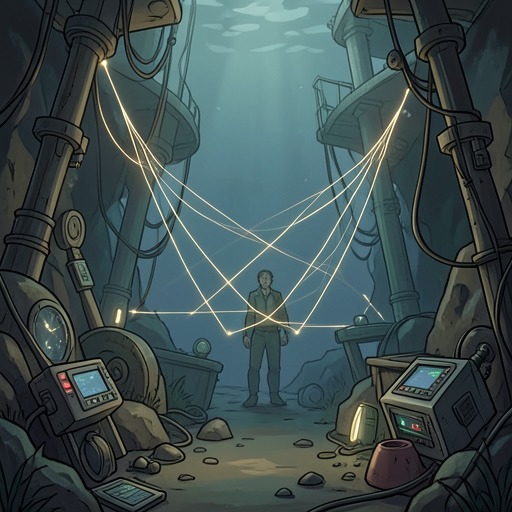
Weaver and Anawak program virtual amoebas with electronic DNA that is allowed to mutate. Their initial effort to divide an electronic brain into its smallest programmable units and assemble the units into a thinking whole does not work. The model begins to function only when its individual cells can learn. The researchers use a scent, following the chemical-signal idea, and give the cells the ability to move in three-dimensional space. They also reproduce conditions such as pressure, currents, and friction so that the simulation operates more like a deep-sea habitat than an abstract collection of units.
The model addresses how Yrr cells might identify other members of their collective. Pheromones account for part of the communication, but the researchers propose that variable sections of DNA also act as recognition codes. Yrr amplicons differ in small, hypervariable sections. On their hypothesis, a cell changes its DNA after coming into being, and those changing sections mark which collective it belongs to. Cells with matching codes can recognize one another, while smaller collectives can join larger ones.
The simulated collectives also acquire and retain a learned response. Anawak describes training one group to evade a shark attack while leaving another group without that information. After the groups combine, the resulting collective avoids the attack; when it is divided into smaller groups again, each retains the response. The scenario makes aggregation more than a meeting of cells: it allows experience acquired within one part of a collective to influence the behavior of the whole and persist after the whole separates.
The model's limits sharpen the importance of the real phenomenon. Learning through hypervariable DNA is theoretically possible in the simulation, but it proceeds too slowly to account for the speed of the Yrr mass that attacked the Independence's well deck. Weaver therefore expands the model: rather than allowing only small DNA segments to learn, she makes the entire strand capable of learning. This change greatly accelerates cognition. The researchers infer that the Yrr act with the speed of advanced parallel processors, although their conclusions remain based on a small number of trials.
How mutation preserves and changes information
Sigur Johanson's later analysis supplies a more detailed account of the proposed mechanism. The Yrr genome contains numerous clusters of genes associated with particular functions, including the production of substances and the coding of receptors. The cells repair their DNA, but the repair system does not simply scan the whole genome uniformly. It responds to signals, and repair inhibitors protect the clusters from the enzymes that would otherwise correct changes there.
This arrangement separates preservation from variation. Core genetic information remains protected, while other sequences can continue to mutate. The genome is therefore neither wholly unstable nor fixed: some information is retained while other material remains open to change. Johanson characterizes each Yrr as an evolving brain, because mutation is not only a source of biological variation in this account; it is part of the mechanism through which a cell can respond and learn.
Communication links the process across cells. A ligand from one cell reaches a receptor in another and initiates a chemical cascade toward the nucleus. The genome mutates in response, and the signal is passed on to surrounding cells. The sequence is described as almost instantaneous. This proposal connects molecular events inside a cell to collective thought: signals initiate genomic change, altered cells transmit information onward, and the collective can respond at a scale and speed that no single cell could achieve alone.
Johanson leaves open whether the system is genuinely new. The biochemical arrangement may be unfamiliar to human science, he suggests, but could have existed for millions of years, perhaps alongside life from its earliest stages. It would represent an evolutionary system running in parallel with the one that produced human intelligence, rather than a later or more advanced version of the same path.
Genetic memory and collective history
The most consequential implication is that Yrr cells pass acquired information to their descendants. When one cell divides, it duplicates its genome along with the information stored in it. A new cell therefore inherits more than abstract instructions: it receives information described as real experience, as if it had been present when the earlier cell encountered the event. Johanson imagines that the Yrr may have gained consciousness as early as the beginning of the Jurassic era and accumulated knowledge ever since. The date is presented as a proposed timescale, not an independently established fact.
This form of memory differs fundamentally from human cultural transmission. Humans depend on words, written accounts, and images to preserve what earlier generations have learned; each new person begins without direct access to those experiences. The Yrr, by contrast, are imagined as carrying collective memory in their inherited genomes. Their history does not need to be reconstructed from records that can be lost or misunderstood. Each generation adds to a living store of information available to the next.
Johanson describes the consequence as continuous selection: collectives compare, modify, and refine responses, learn from mistakes, and act on the results. Information accumulated across generations can support strategies that would take humans years to devise. Destroying one collective would not necessarily erase this knowledge; Johanson argues that eliminating it could require eliminating every last Yrr cell, an undertaking made more daunting by uncertainty about the extent of their cellular networks. The proposed memory system thus helps explain both their adaptive power and why their collective knowledge cannot be treated as a vulnerable archive held in one place.
Mind without the individual brain
The concept also changes what counts as a thinking subject. Anawak cautions against attributing human-style individual consciousness to single cells. He instead describes them as creative sensors: each cell converts experience into information that can enter the collective. A possible thought gains consideration if the impulse behind it is strong enough across enough cells; competing possibilities are weighed, and the one best suited to persist survives. Weaver likens this process to natural selection operating through thought.
Intelligence, on this account, belongs neither wholly to an isolated cell nor to a centralized brain. It emerges through distributed sensing, signaling, mutation, aggregation, and inherited memory. The cells can contribute information without possessing consciousness in the human sense, while the collective can learn and act as a larger entity. Hypermutating DNA is the bridge between those levels: it makes change available to individual cells, communication available to the group, and accumulated experience available across generations.
That model also unsettles the human distinction between mind and body. The Yrr's capacity to think is inseparable from their living material, chemical signals, and cellular organization; their bodies are not containers for a separate intelligence. The idea does not prove that the Yrr's behavior can be reduced to the computer model, and the researchers acknowledge that their trials are limited. Instead, it supplies a coherent explanation for how a cellular collective might learn at all—and makes human assumptions about the necessary size, location, and lifespan of a mind appear contingent rather than universal.