Independence
The SwarmThe Independence is the central setting for the Greenland Sea mission to communicate with the Yrr, and its destruction turns that effort into a struggle for survival. The carrier brings together scientific inquiry, military command, and experimental procedures in a tightly divided shipboard world. When a series of explosions and failures overwhelms its systems, those same compartments become barriers to evacuation, and the vessel sinks with people still trapped below.
Mission and Setting
The Independence is stationed in the Greenland Sea during the effort to establish contact with the Yrr. On 15 August, Samantha Crowe argues for sending a second, more complex message: an account of humanity’s evolution and culture, intended to give the Yrr reasons to reconsider their campaign. Jack Vanderbilt is initially reluctant, but Crowe persuades him that communicating what humans are may be their remaining chance. Judith Li frames the proposal as an appeal to shared values. The ship is therefore not merely a military platform; it is the place where humans try to make themselves understood to an intelligence they fear they cannot yet comprehend.
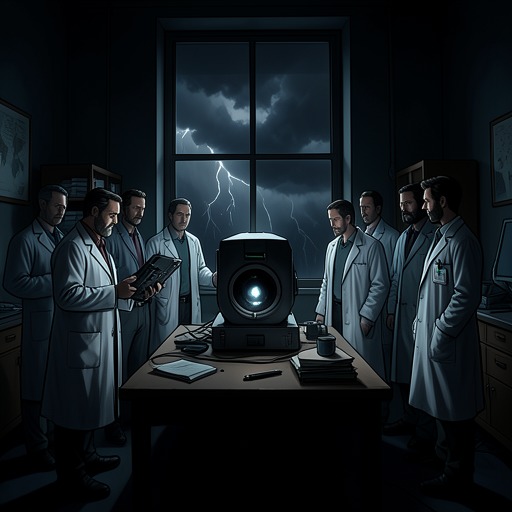
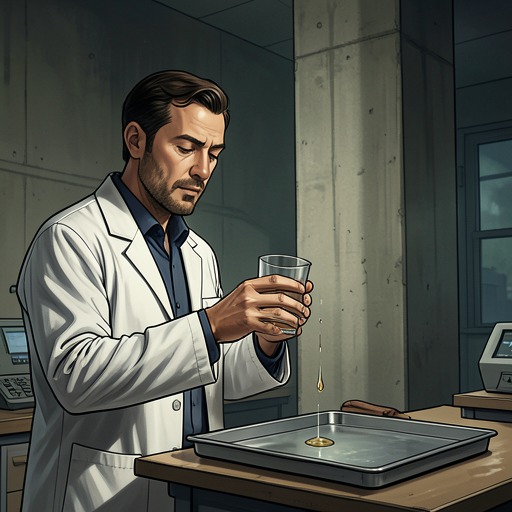
That work proceeds alongside hazardous research. Sigur Johanson finds the preparations unsettled: the crew is arranging for a luminous jelly to be transferred to a deep-sea chamber under Mick Rubin’s supervision. The tank has been emptied and decontaminated, while crabs carrying Pfiesteria have been placed in liquid nitrogen. Sigur Johanson and Sue Oliviera plan to begin phase tests once the jelly is in the tank. At the same time, Samantha Crowe and Murray Shankar are deciphering the second Scratch message. The carrier thus holds several different kinds of encounter with the Yrr at once: attempted dialogue, biological investigation, and preparations to contain dangerous material.
The Ship’s Working Spaces
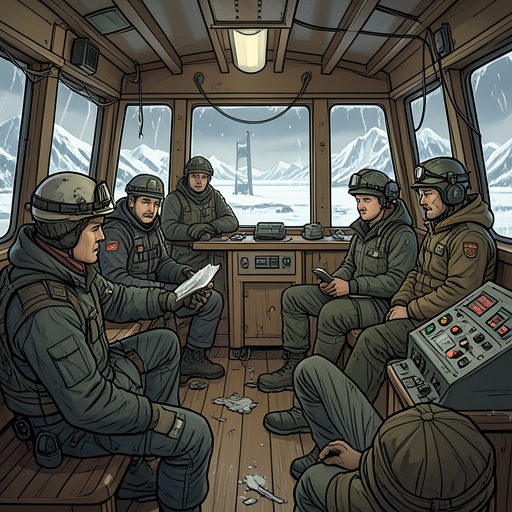
The Independence’s spaces define how its people move through the crisis. Its combat information center, or CIC, is a command and monitoring hub: Judith Li watches the well deck’s emergency unfold there and calls for sound as soldiers fire into the water and Luther Roscovitz is left hanging above the scene. The well deck itself, with its jetty and sluice, is a key operational area. Earlier, the damaged Deepflight floats there with its pods open, held by a single chain to the rail overhead. The failed submersible and its position at the water’s edge make the deck a hazardous threshold between the ship and the sea.
Other spaces become crucial as the emergency spreads. The laboratory lies above vehicle stowage, while the hangar connects to the vehicle ramp leading down toward the well deck. After an explosion rocks the ship, Leon Anawak, already struggling with a knee injured in the earlier seaplane crash and worsened when Jack Vanderbilt kicked him, has to find a route to the well deck through the hangar and ramp. Thick smoke is coming through the elevator gateways, and he hears someone calling for help. The ship’s layout turns movement into a problem of access: a familiar destination may remain physically close while the routes to it are blocked or dangerous.
Damage and Failed Systems
The first major blast tears open the Independence amidships, where the ammunition magazines and engine room are located. The resulting crater is about twenty metres long. Water surges through the breach, and the flooding threatens people who survived the initial explosion. The situation presents a stark choice: keeping the torrent from overwhelming the rest of the carrier requires sealing off the flooded lower compartments, even though people remain in the ship’s catacombs.
On the bridge, Craig Buchanan stays calm and tracks the accumulating failures. The loss of the ammunition magazines is survivable in itself, but damage to the engine room sets off a chain reaction involving the hydraulic system and fuel-pumping stations, producing further explosions. The Independence draws electricity from two gas turbines and six diesel generators; the generators fail in rapid succession. Meanwhile, flooding in forward cargo compartments makes the carrier settle bow-first. Buchanan understands that sinking is no longer in doubt. He estimates that water is about to enter vehicle stowage below the laboratory and may also reach troop berthing. The ship has about 180 people aboard, mostly on upper levels, rather than the 3,000 marines it would carry during a normal operation. That difference narrows the scale of the evacuation but does not make the damaged vessel safe.
A loose torpedo adds another danger beneath the flight deck. Released when a submersible explodes, it has not detonated and lies in the flooding water after being driven into a munitions magazine. It is lodged in a metal cage that has partly broken free of its position. As the carrier tilts, the cage shifts by small increments; its supports buckle, the magazine wall begins to fracture, and an attachment bolt is pulled loose. The episode makes the ship’s changing angle more than a visible sign of damage: it sets heavy objects in motion within already compromised compartments.
Destruction and Aftermath
The final destruction is concentrated at the well deck. A torpedo launched by Sigur Johanson strikes a steel wall less than three metres from its tube and explodes. The pressure wave drives the Deepflight backward into the sluice. As it spins in the water, a second torpedo launches; its explosion engulfs the submersible and its two passengers. Debris penetrates decks and bulkheads and breaches ballast tanks at the stern. Water pours into the space that had been the well-deck basin, and the stern drops as the Independence begins to sink rapidly.
The carrier’s end is also rendered through the view of those who get away. Leon Anawak steers a Zodiac through high waves, slows to make the crossing safer, and turns back to look. The Independence’s island still rises above the slate-grey sea, but the flight deck is nearly submerged and only burning wreckage remains visible. Samantha Crowe, pale and shaking, reaches him and leans on his jacket because of her injured leg. Their brief return of attention to the ship fixes the scale of what has happened: the Independence, which had carried the attempt at dialogue and the machinery of military response, is now a damaged silhouette in the sea.
Narrative Significance
The ship’s destruction brings its competing purposes into collision. Scientists try to study and communicate with the Yrr while military personnel secure the vessel and prepare for further danger; neither work can be separated from the physical spaces in which it occurs. The CIC receives the disorder of the well deck, the hangar and vehicle ramp offer an uncertain route through smoke, and flooding turns the lower compartments into places that may have to be abandoned. The carrier’s architecture therefore does more than provide a backdrop: it gives the crisis its sequence of blocked routes, failing systems, and difficult choices.
The Independence also frames a reversal in the mission. The ship is meant to serve as a base from which humans can pursue contact, yet its weapons, experimental cargo, and damaged machinery become part of the catastrophe. Its sinking does not resolve the attempt to understand the Yrr; it leaves the survivors confronting the loss of the vessel on which that attempt depended. In the final image, the dark smoke and the nearly submerged flight deck replace the carrier’s former role as a controlled platform for human action.