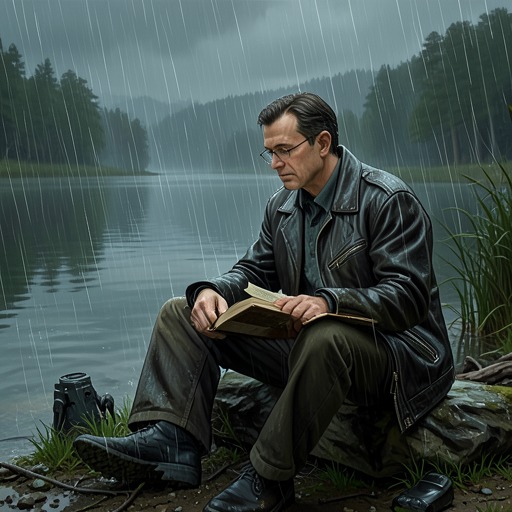
Johanson's memory loss and recovery
The SwarmJohanson’s memory loss and recovery turn an unexplained mental wound into evidence of deliberate concealment. As memories return in fragments, he reconstructs how he was made to forget a secret laboratory above the one where he works—and realizes that his research team has been used as part of a charade.
Symptoms and the laboratory work
Johanson’s recollections surface while he is exhausted at the control desk during a late-night laboratory session. Oliviera is synthesizing batches of Yrr pheromone in the containment facility. The collective is scarcely visible: amoebas cloud the water, while the jelly has disaggregated and its glow has vanished. The team plans to add the synthetic chemical to the tank in the hope of drawing the Yrr back together for further tests. Even as he watches the monitors, Johanson considers trying one of Crowe’s messages to see whether the collective responds.
His difficulty concentrating is not, he recognizes, ordinary fatigue. His head throbs because of the memories trapped inside it. The pain has worsened since the morning meeting, when a remark by Li set off what he experiences as an internal slide projector. A few words expand until they crowd out other thought; as he dozes at the desk, their repetition carries him toward sleep. His physical exhaustion and the returning memories overlap, but the text distinguishes the ache in his head from the long lab session that might otherwise explain it.
Repetition and fragmented recall
The phrase that loops through Johanson’s mind is “Mustn't be too hasty.” Its recurrence is both a fragment of the meeting and the immediate shape his blocked memory takes: the words are available to him, but he cannot yet place their full significance. He wakes briefly to the laboratory lights, closes his eyes, and hears the phrase again. The memory does not arrive as a complete account; repetition holds his attention where explanation is still missing.
The narrative then breaks sharply into darkness and the hangar deck. A grating-metal sound jolts Johanson awake. For a moment he cannot remember where he is; then he feels the vessel’s steel side against his back and sees the brightening sky above the sea. This abrupt change of setting gives the recovered material the force of a disjointed recollection rather than a settled explanation. At this point, the reader sees him struggling to orient himself, but not yet what the episode means.
Recognition of the deception
The turning point comes when Johanson sees a member of Jack Vanderbilt’s team and then Rubin. Johanson is too bewildered to act. He notices the shock in Rubin’s eyes and the way Rubin searches for a way to rescue the situation. That look breaks Johanson’s paralysis: he understands that his work is a charade and that he is being used. The realization extends beyond Johanson himself; he thinks of Oliviera, Leon Anawak, Karen Weaver, and Crowe as also caught up in the deception. His question about whether Rubin is the only person playing more than one part shows that the recognition opens a wider uncertainty rather than resolving every secret.
A flash of white light and a rush of pain follow. The walls and passageway blur, and Johanson sees the ground coming toward him. When the memory falls into place, he is back in the laboratory, where Oliviera is still working in the containment facility. He looks over the control desk, benches, and chamber, then up at the ceiling. The remembered setting and the present room converge in his recognition that another laboratory lies above him, one no one was meant to know about.
What the recovered memory establishes
Johanson reconstructs the missing episode as an act of suppression: Rubin must have knocked him out, he concludes, and someone drugged him to make him forget. The account preserves the distinction between what he now sees and what he infers. The hidden laboratory is the recovered fact that gives the episode its shape; Rubin’s role in knocking him unconscious and the use of drugs are Johanson’s explanation of how the memory was lost.
The recovery immediately changes his understanding of the work around him. The laboratory experiments are no longer simply an attempt to study the Yrr collective: Johanson now recognizes that his work and the work of his colleagues have been folded into a deception, while a concealed facility exists directly above their own. Helplessness and fury replace the paralysis of his first recognition. He clenches his fists and runs up the ramp, turning recovered memory into action. The episode therefore makes remembering consequential: it restores neither a complete history nor certainty about everyone involved, but it gives Johanson enough to identify the concealment and move against it.