Juan Narciso Ucañan
The SwarmJuan Narciso Ucañan is a 28-year-old fisherman from Huanchaco whose disappearance opens the novel’s chain of oceanic anomalies. His story gives the crisis an obscure human face before it becomes a global emergency: while the world later reacts to unexplained disappearances, no one notices that Ucañan has gone. The sea keeps his experience, and his name, out of the first accounts of what is happening.
Identity and Background
Ucañan belongs to a fishing community whose history reaches back more than a thousand years. The Yunga and Moche fished along the Peruvian coast, supplying Chan Chan with fish, and made reed boats from totora harvested in coastal marshes fed by underground springs. Ucañan and the remaining fishermen still use these boats, known as caballitos: light craft three to four metres long, with an upturned prow. Their design makes them practically unsinkable, but using them requires skill and composure. Their continued presence connects Ucañan’s daily work to a tradition that predates the Spanish arrival and to a coastal environment that has changed around it.
At 28, Ucañan is described as one of the last of his kind. His five older brothers have moved to Lima for work and consider his attachment to fishing foolish. They have abandoned the expectation that the fish will return; Ucañan still waits in waters depleted of mackerel and bonito, holding to a livelihood his family has practised across generations. The contrast is not simply between different temperaments. His brothers have left, while he remains with a boat and a fishing practice increasingly out of step with the pressures reshaping the coast.
A livelihood under pressure
Ucañan feels caught between environmental change and accusations of responsibility for it. El Niño has affected Peru for generations, yet he is powerless to prevent it; meanwhile, political attention to overfishing turns toward local fishermen after environmentalists raise the issue. Ucañan has not brought the floating factories or the Japanese and Korean trawlers waiting near the 200-mile boundary to tow away the fish, but he has begun to feel guilty as though he were responsible for the enormous quantities removed from the sea. The fishing crisis becomes personal: forces beyond his control are translated into blame borne by the person still visible on the water.
His family’s decline sharpens that burden. His father, nearly 70, had gone out fishing every day until a few weeks before the story begins. Now bedridden, with blotched skin, a persistent cough and signs of mental deterioration, he can no longer sail. Ucañan clings to the hope that continuing the family tradition might keep his father alive. The hope binds fishing to care and inheritance, even as the surrounding conditions make the tradition harder to sustain. His persistence is therefore neither simple stubbornness nor merely a practical choice: it is also an attempt to remain connected to his father and to a shared past.
The last voyage
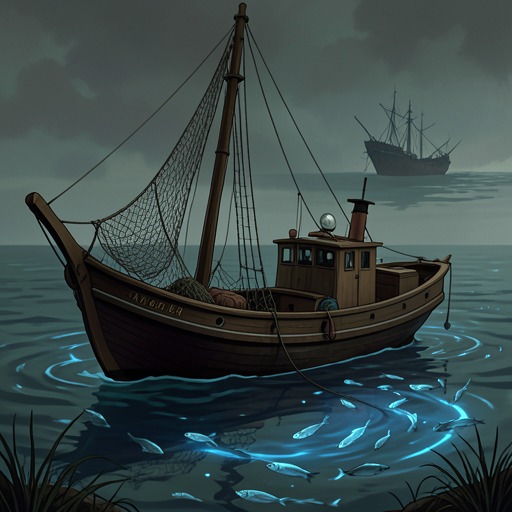
On 14 January, Ucañan sails farther out than he ever has in his caballito. In the morning haze he estimates that he is at least twelve kilometres from Huanchaco, alone on the open sea. He pauses, silently asks St Peter to bring him home safely with a boat full of fish, then lowers his calcal, the net and hooks disappearing below the surface until only its small red buoy remains beside the boat. His routine depends on watching that buoy; the modest marker gives his attention a fixed point in a wide expanse of water.
The fishing ground is familiar. A jagged ridge of fossilised white lava rises almost to the surface, providing shelter for anemones, mussels, crabs and small fish, with larger fish hunting among its hollows. The sharp rocks deter trawlers, while Ucañan’s light reed boat can approach. He relaxes, smiles for the first time that morning and paddles into the current, preparing to spend hours watching the buoy. The scene briefly restores his confidence: he knows these waters, understands the dangers of the reef and believes there is enough here for a daring fisherman.
That assurance breaks when a dense shoal surrounds him. Ucañan fears that the fish are trying to trap him and cut him off from his boat. In terror, he stops thinking about the damaged net, the buoy and even the caballito; he concentrates on breaking through the mass and reaching the surface. The shoal parts, and something writhes toward him. The narrative does not identify the thing or show what happens to Ucañan after that approach. It leaves the encounter at the threshold of explanation, with his knowledge confined to an experience no one else has witnessed.
Disappearance and narrative significance
After the encounter, the account returns to the open sea. The wind rises, though the day remains clear and the swell is manageable for a person in a boat. There is no one for miles. Only Ucañan’s caballito, one of the last of its kind, drifts offshore. That final image does not establish the precise circumstances of his fate, but it makes his absence visible: the boat remains where its fisherman should be, separated from the living routine that gave it purpose.
Ucañan’s disappearance is later connected to events that send shockwaves around the globe, yet his name is not mentioned. The novel stresses that his experience was one among many and that parallels became apparent only after the wider pattern emerged. Because Ucañan alone knew what had happened to him, the mystery initially lacked its crucial witness. When he next appears in the public reckoning, he is reduced to a statistic; no one has time to ask where he had been as events enter a graver phase.
His opening story thus establishes a recurring imbalance in the crisis: the people closest to its first signs may be the least able to make those signs count. Ucañan possesses direct knowledge, but his isolation at sea and his marginal place in the world’s attention prevent that knowledge from becoming evidence in time. The drifting reed boat carries both meanings at once: it is the remnant of a threatened fishing culture and the first stark trace of a disturbance that will soon exceed any one person’s account.