Karen Weaver
The SwarmKaren Weaver moves from marine journalism into the heart of an ecological and political emergency. A reporter drawn to difficult environments, she becomes an investigator of the sea’s changing behavior, a collaborator in a theory of nonhuman intelligence, and finally a participant in an attempt at direct contact with the Yrr. Her story gives the crisis a distinctive human measure: the work of observing, testing, and interpreting continues even when the ocean makes familiar explanations—and familiar limits—unreliable.
Identity and Work
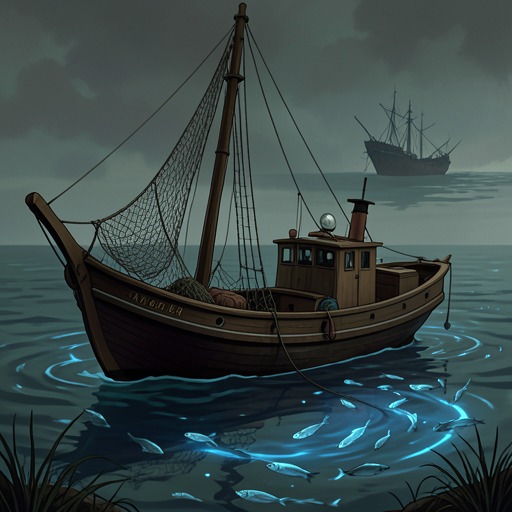
Weaver specializes in marine-related journalism and has chosen work that takes her to inhospitable places. She is comfortable pursuing extremes, in contrast to scientists such as Lukas Bauer, who dislike discomfort but accept it as the price of knowledge. Her career puts her between the research community and the public: aboard a vessel, she asks Bauer to explain the drifting floats because she needs to understand his work before presenting it. When he warns that the findings are unsettling, she presses him rather than treating his research as a convenient story. Her persistence establishes a pattern that lasts through the book: she does not remain a passive recorder when the evidence becomes consequential.
On the Sonne, the limits of her working environment are physical as well as professional. She runs laps on deck because the ship’s three exercise machines are intolerable to her and she needs to keep active; she threads her way past scientists assembling a float and crew members at work. Her attempt to understand the instruments draws her into conversation with Bauer, whose energetic, slightly hunched presence impresses her. Their exchange is not simply an interview. Weaver wants the technical explanation, and Bauer recognizes that her questions are tenacious enough to lead toward the disturbing implications of his results.
Her connection to Bauer’s research continues after she leaves the vessel. She disembarks at Longyearbyen to pursue her own work, and Bauer later reflects on the contrast between her appetite for extremes and his commitment to understanding despite discomfort. When Sigur Johanson contacts her, she has returned to London but cannot reach Bauer or determine what has happened to him and his boat. She offers to meet Johanson, either in London or sooner in the Shetland Islands, leaving open the possibility that their inquiries might help one another. That message links her personal reporting to Johanson’s growing suspicion that the sea is responsible for a wider unraveling.
From Reporting to Crisis Investigation
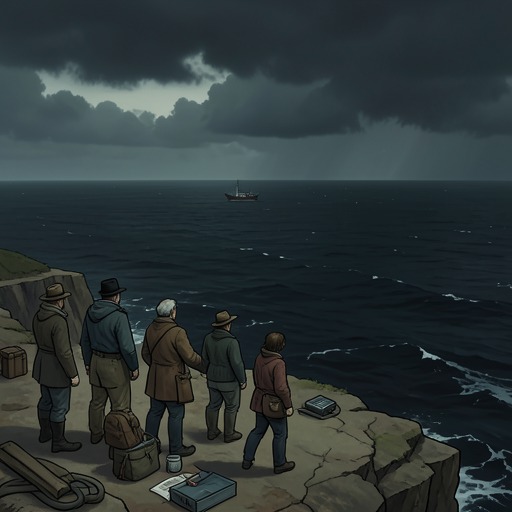
Weaver meets Johanson in the Shetland Islands. Their meeting is interrupted by the Norwegian continental-slope disaster and the resulting tsunami. The scale of the event gives sudden force to the questions she had pursued through interviews and data: the sea is not merely the setting of isolated incidents, but part of a connected system capable of producing catastrophic changes. The tsunami devastates northern European coastlines and ends the offshore oil industry in the region; hundreds of thousands of people die. Weaver survives the upheaval and continues her work amid a crisis that has made the costs of incomplete knowledge impossible to dismiss.
Her investigations increasingly rely on data rather than direct observation. While working with the emergency response, she compares satellite radar scans with multispectral images and notes that Bauer’s drifting profilers have stopped transmitting. She has repeated and checked her calculations, then checked them again: sea level has fallen in the Gulf Stream. In a later discussion she argues that the current has effectively stopped, allowing for the possibility of a weak residual flow but warning that the world should prepare for severe cooling, potentially within decades. Her conclusion is a warning, not a claim that every consequence can be predicted. The evidence points toward a danger whose timing and scale remain uncertain.
The contrast between her certainty about the measurements and uncertainty about what they mean recurs throughout her role. Weaver can state what the satellite data show, but the implications extend beyond what a journalist—or any single specialist—can establish. On the USS Independence, she is among those analyzing satellite information related to the Gulf Stream. Judith Li’s intranet surveillance records Weaver’s activity without her knowledge, including the pages she consults. The episode places her scientific work inside a political environment in which observation is not neutral: the same data can inform research, military decisions, and covert scrutiny.
The Cellular-Collective Hypothesis
Weaver’s most consequential scientific contribution is a thought experiment about how simple organisms might combine into an intelligence. She considers the possibility that the luminous jelly is an aggregate of single-cell organisms, each able to communicate and coordinate changes in shape. If such organisms could take over functions performed by brain cells, she reasons, they might form an artificial brain and even alter the host’s emotions, characteristics, or knowledge. The proposal is explicitly tentative, but it gives a possible mechanism for the unfamiliar abilities the researchers are trying to understand.
To test the logic of collective organization, Weaver obtains a recent artificial brain directly from its inventor, Ray Kurzweil. She first saves a backup, then dismantles the original into electronic components, breaking the connections that had made the system a functioning whole. The resulting units are scattered across her computer without anything to bind them together. The exercise turns an abstract question into a concrete problem: how could separate elements come together again as a thinking system?
Weaver’s answer depends on learning. In the virtual model, the amoebas receive electronic DNA capable of continual mutation. Each cell acts as an autonomous, reprogrammable unit; experience changes its genetic structure, and when mutated cells aggregate, they transmit information to one another. A lesson acquired by one cell can therefore become part of the collective’s knowledge. Weaver and her collaborators find that the units do not re-form a functioning neural network until they can learn. She relates this model to the biological possibility that mutation could serve as a learning process, and to the use of a scent in their experiment. Her work does not prove that the Yrr operate in this way; it gives the team a framework for thinking about intelligence that is distributed across cells rather than housed in a single brain.
This inquiry requires her to suspend and reconsider established accounts of intelligent life. The narration describes her as trying both to set aside existing evolutionary research and to confirm its findings. The apparent contradiction is productive: she is not simply rejecting human knowledge, but testing whether its categories can explain a form of intelligence unlike the individual, brain-centered model on which those categories depend.
Resistance and Relationships
Weaver’s ability to turn an interpretation into action becomes crucial when she discovers the secret laboratory and the plan to use a radioactive isotope with a manufactured Yrr pheromone. She confronts Mick Rubin about the hidden lab and Johanson’s incapacitation, then insists that Rubin explain what is being done there. When the plan is made clear, she pushes him toward the laboratory and states that the toxin will not be deployed. Her intervention marks a decisive break with the assumption that contact or conflict can be managed through a weapon. The script, as she puts it, has changed: the immediate task is to stop the poison from going forward.
Her personal relationships also shift as the crisis develops. Johanson first regards her as a confidante, but comes to understand that she is not a substitute for Tina Lund. The two get along, yet their connection has not become an intimate partnership. By the time they are together on the ship, he suspects that Weaver and Leon Anawak may be better suited to one another. After Anawak returns from Nunavut, he and Weaver speak more openly about themselves; she sees greater confidence in him than in the dejected man she had encountered earlier. Their connection grows through conversation and shared danger rather than a long-established romance.
When the USS Independence is lost, Weaver and Anawak have little time for declarations. She takes his face in her hands, kisses him, and then enters the pilot’s pod of the Deepflight. The gesture gives their relationship a clear emotional turn, but the act that follows is equally important: she leaves to carry out the descent herself.
Descent and Contact
Weaver’s Deepflight journey takes her down through the blue polar water toward the unknown depths of the Greenland Sea. The descent is described as a passage into an inner space where the distinction between rising and falling becomes difficult to sense and familiar human perceptions lose their authority. The submersible is functioning properly, and the path is clear of orcas and the Yrr. Small fish, detritus, and krill pass through its lights as Weaver continues toward the sea floor. The scene recasts the ocean not as an empty void but as a world whose scale and conditions unsettle the assumptions carried from land.
The novel identifies the decisive development with the declaration that the queen makes contact. Soon after the Independence sinks, attacks cease; SOSUS arrays register Scratch signals audible across the ocean, whales return to their ordinary routines, and the worms and other dangerous organisms disappear. The oceanic pump begins to recover, while the methane hydrates appear to stabilize. The signals coincide with Weaver’s encounter with the queen, but the ending preserves a limit to what she knows: she cannot say what she saw at the bottom of the Greenland Sea. Her idea may have worked, yet the encounter is not translated into a complete human account.
Weaver’s arc thus moves from explaining scientific equipment for an audience to becoming an agent in an encounter that resists explanation. Her importance lies not in mastering the Yrr or making the ocean legible, but in combining persistent observation with a willingness to revise the terms of the question. She helps imagine intelligence as a shared, mutable process; rejects an effort to answer the crisis with a toxin; and enters the deep in search of contact. The final uncertainty is not a failure of her investigation so much as a reminder that contact does not guarantee comprehension.