Kinngait
The SwarmKinngait, known also as Cape Dorset, is a community on southwestern Baffin Island whose Arctic landscape and Inuit history shape Leon Anawak’s return to his birthplace after nineteen years away. The place is more than a destination: it holds the memories and family ties he had tried to leave behind, while its history makes clear that belonging can survive even when a way of life has been profoundly disrupted.
Setting and landscape
In the present, Kinngait is described as the capital of Inuit art, with a population of about 1,200. Its half-joking, half-admiring comparison to New York evokes the town’s modern public identity, but the narrative also sets that identity against a much older geography and personal memory. For Leon, the approach by plane is a threshold: as he crosses Hudson Strait toward Nunavut, the tundra, snowfields, and ice floes mark his return to a world he had sworn never to revisit. When he reaches Kinngait, he feels at home and is reluctant to leave the plane.
The older name, Kinngait, means high mountain in the Inuit tongue. The community lies in the Sikusiilaq region, whose name refers to a place where sea ice does not form. Temperate currents keep the water around Foxe Peninsula, at the southwestern end of Baffin Island, from freezing even in the harshest winter. The account links the location’s names to close observation of local conditions: the landscape is not an empty Arctic backdrop but a place understood through the particular behavior of its water and ice.
Near Kinngait, Mallikjuaq Island is a nature reserve containing traces of several periods of human presence and local history. The narrative mentions nineteenth-century fox traps, ruins of ancient Thule culture, burial sites associated with many legends, and a lake where Leon once camped. He remembers stone stands for kayaks and recalls having loved the island. These details make the landscape a storehouse of use, history, and recollection rather than a mere scenic view; his recognition of it brings back both attachment to the place and the circumstances that drove him away.
Leon Anawak’s return
Leon’s journey brings him first to Iqaluit, Nunavut’s capital, and then by Piper to Kinngait. The arrival transforms a geographical return into a family one. Ijitsoq Akesuk, Leon’s uncle, runs to greet him after the plane lands. The reunion is affectionate, but it is shadowed by the fact that no one had bidden Leon farewell when he left nineteen years earlier. The narrative observes that Inuit have many words for welcome but none for farewell, making the return feel less like a simple reversal of departure than a meeting with a separation that was never properly marked.
The death of Leon’s father draws him into the community’s funeral rites. Before the short ceremony, he has to shake hands with everyone; people he has never seen embrace him. A priest reads from the Bible and prays, and the coffin is lowered into a shallow grave, covered with blue plastic and stones. The crosses in the graveyard stand askew in the hard ground. Ijitsoq gives Leon a small wooden box with a glass lid, holding faded artificial flowers, cigarettes, and a metal-capped bear’s tooth. At his uncle’s urging, Leon carries it to the grave and sets it beside the cross. The ceremony places him among the community even as his own feelings remain distant from the dead man.
Leon declines Ijitsoq’s offer to see his father one last time. He has long felt that the relationship had ended before the burial, and at the graveside he tries to picture the person in the coffin without being able to make the death feel real. He wants to leave and thinks of home as Vancouver or Tofino, but recognizes that this answer does not resolve where home is. Kinngait thus becomes the setting for a crisis of belonging: the funeral does not erase his estrangement, but it makes the question of his connection to family and homeland unavoidable.
Displacement and cultural change
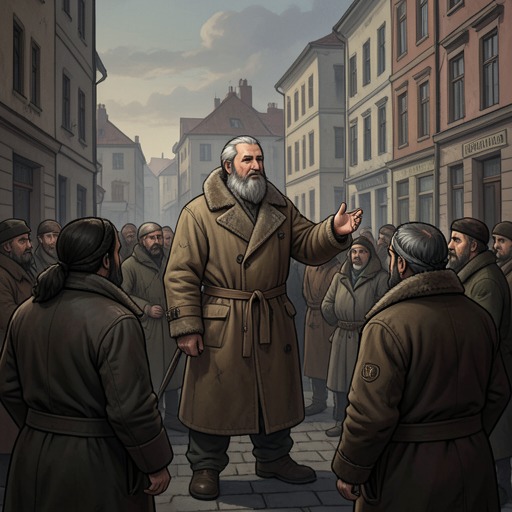
The family’s history is set within the broader disruption of Inuit life in Canada. Ijitsoq recounts that government relocation during the Cold War forced nomadic Inuit from their traditional territory in the southern Arctic to Resolute Bay and Grise Fjord, far to the north. Officials presented relocation as a measure to improve hunting and survival, but Ijitsoq says the new settlements were far from caribou trails and summer breeding grounds. People were transported without their tents, kayaks, canoes, or sleds, and required to wear numbered tags. He says that he, Leon’s parents, and many others were relocated; Leon’s father campaigned with the community for compensation, an effort that broke his spirit.
Ijitsoq connects this displacement to a longer history of change. In the 1920s, white trappers arrived with guns, and seal and caribou populations were depleted. Inuit communities were plunged into poverty; infectious diseases spread, and people left the land for settlements. By the end of the 1950s, Ijitsoq says, Inuit were dying from starvation and disease while the government did nothing. Military construction then brought secret radar stations onto traditional hunting grounds, and Inuit were moved still farther north. These account-wide histories illuminate what is at stake when Leon returns to Kinngait: the loss is not only personal distance from relatives but also the forced alteration of the relationships among community, territory, and subsistence.
The broader damage to cultural continuity appears in the account of Indigenous knowledge and oral tradition. The Indian Act of 1885 encouraged people to leave their homelands and send children to residential schools for integration into white society, breaking the transmission of knowledge between generations. Reparations could not restore what had been lost, and fewer people knew the old lore. The narrative does not present Kinngait as untouched by that history; rather, Leon’s search for understanding brings him into contact with elders and with the difficulty of recovering knowledge after its transmission has been interrupted.
Community, memory, and belonging
After decades of campaigning and court action, Nunavut was established in 1999 as Inuit territory governed by Inuit. Ijitsoq presents this as a meaningful change: no one can now tell the Inuit what to do or force them to move. Yet political self-government does not restore the former nomadic way of life, which he says is lost forever. The community is adapting to a bounded territory and a modern civil government, while also reviving practices such as dog-sledding, teaching young people to build igloos, and showing them how to kindle fires with flints. Ijitsoq welcomes this renewal without claiming it can stop time.
His account also resists reducing the community to loss. He describes new forms of movement through the Internet, where young people communicate with friends in other countries and tell them about Nunavut. At the same time, he speaks of a profound trauma and of continued suicides among Inuit. His insistence that the living should not have to sacrifice their hopes to the dead gives the past a difficult, ongoing place in the present: remembrance matters, but it cannot become a demand that the next generation remain fixed in grief.
Kinngait gathers these strands of the novel’s treatment of place: specific currents and ice, the remembered island, a communal burial, family return, and the consequences of displacement. Leon’s homecoming does not offer a simple restoration of what he left. Instead, the location makes visible the tension between inherited connection and changed circumstances, and allows his idea of home to become a question shaped by both personal memory and collective history.