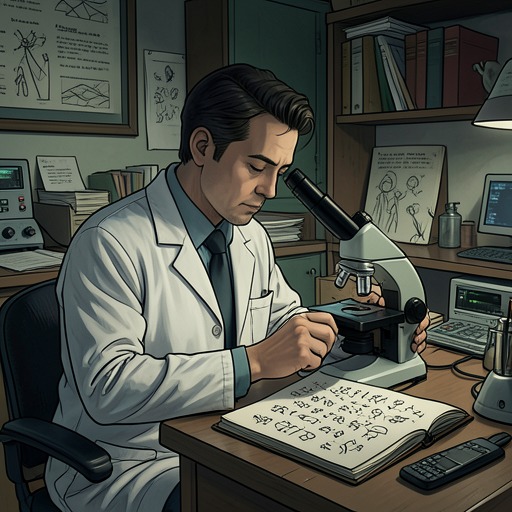
Knut Olsen
The SwarmKnut Olsen is a biologist at NTNU with particular knowledge of jellyfish, coral and sea anemones. He becomes an important source for Sigur Johanson as reports of marine anomalies accumulate: Olsen can place unusual outbreaks against the background of species, seasons and ecological disruption. His work also puts him in a position to collect information that official channels leave incomplete. When the tsunami strikes Trondheim, however, the distant crisis becomes personal. Olsen’s concern narrows to whether his wife and four children can get out alive.
Identity and Scientific Background
Olsen is introduced through a telephone call from Johanson, who remembers him as a fellow biologist at NTNU and someone well informed about jellyfish and related marine life. Olsen answers despite the late hour; his children are still awake because it is his daughter Marie’s fifth birthday. The brief domestic detail establishes the family life that later becomes central to his story, while the call places him within Johanson’s scientific network.
His expertise is practical as well as taxonomic. Olsen knows that Australian box jellyfish spawn in river mouths north of Rockhampton, that the reported death toll is likely higher than the public figure, and that the animals can kill quickly in shallow water. He distinguishes Australian seasonality, from October through May, from the less predictable periods when jellyfish trouble European swimmers. By supplying this context, he makes clear that a high number of incidents alone does not establish a new phenomenon; their scale and circumstances have to be compared with what is normally expected.
Investigating the Jellyfish Anomalies
Olsen nonetheless judges the emerging reports anomalous. He recalls that in 2000 he was called to investigate a jellyfish plague in the Gulf of Mexico. The animals invaded spawning grounds in Louisiana, Mississippi and Alabama, where they consumed fish eggs, larvae and plankton that fish depended on. Olsen identifies the jellyfish as an Australian species from the Pacific that did not belong in those waters. The episode gives him a concrete example of how an introduced organism can disrupt a food chain and reduce fish yields, rather than merely create a nuisance for swimmers.
He also recalls a separate invasion in the Black Sea. Comb jellies had been carried there in a cargo vessel’s ballast water during the 1980s; by the time the affected countries raised the alarm, the population had reached a reported density of eight thousand animals per square metre. Olsen uses these cases to explain why biological invasions matter: an organism moved beyond its native range can multiply and damage an ecosystem before a response can catch up. The examples lend historical depth to his present concern, but do not by themselves explain why the current outbreaks are occurring.
Olsen considers the recent deaths and outbreaks more than a routine cycle. Johanson cautiously asks whether the pattern could be cyclical, and Olsen maintains that it is an anomaly, while allowing that its appearance might be mistaken for a cycle. Johanson does not tell him about the worms he has encountered. He considers the information outside Olsen’s business and worries that Olsen talks too freely, while also recognizing that disclosure could upset Statoil if the story reached the press. Their exchange therefore has two kinds of restraint: Olsen refuses to treat the jellyfish reports as ordinary, but Johanson withholds evidence that might connect them to a wider investigation.
Gathering News and Meeting an Information Blockade
As the research at sea continues, Johanson uses satellite communications to ask institutes, scientists and other expeditions whether they have found the worms. Among the few informative replies is an email from Olsen. It reports that jellyfish are swarming along the coasts of South America and Australia, while news accounts claim they are concentrating on populated areas. Olsen relays that claim with skepticism rather than presenting it as an established explanation. His message also mentions a collision involving container ships near Japan, continuing disappearances of boats, recorded distress calls and rumors that whales in British Columbia are hunting people. He distinguishes those reports from confirmed details: information about British Columbia remains uncertain, and he warns that not everything circulating in the news is true.
When Johanson later visits him in Trondheim, Olsen has pursued the reports through material he has gathered online. He tells Johanson that beaches in Central and South America have been closed and that jellyfish are clogging fishermen’s nets. In Costa Rica, Chile and Peru, Portuguese men-of-war are appearing in large swarms alongside a second, very small animal with exceptionally long, toxic tentacles. Reports first identified the small species as box jellyfish, but Olsen says that identification is now in doubt and that it may be a different, possibly new, species. His account preserves the uncertainty instead of turning an early guess into a settled finding.
The search for explanations runs into a shortage of reliable information. Olsen has found little about the ship collisions and tanker incidents, and says that a news embargo has descended once reports of the events begin to surface. He observes that there are too many jellyfish and, more broadly, too much happening at once. He does not claim that all the incidents are connected: officials may blame El Niño or global warming, or turn toward invasion biology, but none of those possibilities yet supplies a demonstrated cause. For Johanson, Olsen’s collected reports enlarge the pattern; their gaps also show how difficult it is to establish that pattern while information is being withheld.
The Tsunami in Trondheim
The catastrophe brings Olsen’s scientific world into direct contact with his family life. Trondheim’s position at the end of a long fjord seems to offer protection, but the tsunami crosses the harbour and floods part of the old town. Olsen’s wooden house, one road above Johanson’s on Kirkegata Street, withstands the first assault, though its furniture and crockery are thrown about and the floor begins to sag. With the children frightened, Olsen sends his wife to take them toward the back rooms. He goes to the front windows to see what has happened, without knowing whether the house or the surrounding city is safe.
The first surge appears to have stopped, but the retreat is another part of the disaster. Olsen sees the water rushing back toward the fjord, and the floor gives way beneath him as the front of the house breaks apart. He is left clinging to a branch outside while the family’s home remains precariously in place. Seeing his wife at the edge of the damaged house, he finds a way to shift his grip and lower himself onto the branch. The episode turns on a reversal: the apparent pause that might have suggested safety is followed by a renewed danger, and survival depends on Olsen and his family staying together through it.
After the water has receded, Olsen helps his wife and children leave. They take money, credit cards, passports and a few sentimental belongings in two backpacks; their car is gone, so they set out on foot, walking away from Trondheim along the other side of the river. Olsen later cannot explain with certainty why he had proposed going to higher ground. He wonders whether an old film or article had informed the decision, or whether it came from intuition. Whatever its source, fleeing saved the family’s lives.
Narrative Role and Significance
Olsen links scientific interpretation, informal reporting and the human consequences of the crisis. His accounts of ballast-water invasions and disrupted food chains show why unusual marine populations cannot be understood as isolated spectacles. His later reports make visible the simultaneous spread of jellyfish, ship incidents and rumors, while his acknowledgment of missing information keeps the distinction between evidence and speculation intact. The gap between what he can collect and what can be confirmed becomes part of the crisis itself.
The Trondheim sequence gives that work a sharply different scale. Earlier, Olsen evaluates danger through species, habitats, seasons and effects on fisheries; during the tsunami, those categories give way to the immediate tasks of sheltering his children, finding his wife and leaving a damaged home. He survives not through scientific control of the ocean but through a decision to move his family to higher ground and the uncertain resourcefulness required when that ground is threatened. His arc connects the book’s marine emergency to its domestic cost without making him a solver of the larger mystery: he is a knowledgeable witness whose expertise helps establish the anomalies, and a father whose survival story shows what those anomalies ultimately put at risk.