Long Island
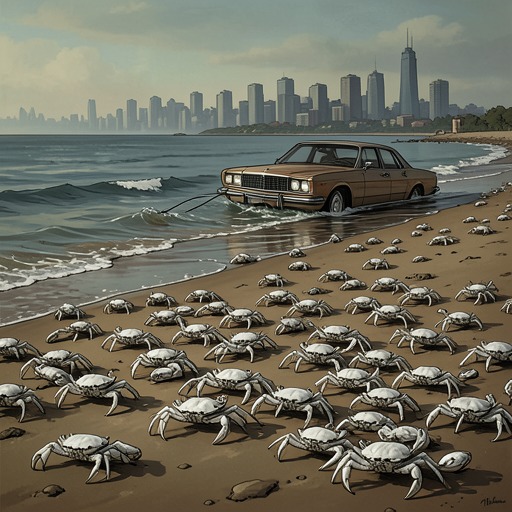
The SwarmLong Island is presented as a densely inhabited, prosperous coast whose beaches and resort towns become the first visible stage of a larger marine emergency. Near Montauk, a vast tide of white crabs advances out of the sea and across the shore, turning a familiar holiday landscape into a threat that cannot be contained at the water’s edge. Reports from the island help bring the crisis into the view of military intelligence and contribute to the isolation of New York and its surroundings.
A wealthy and familiar coastline
The novel introduces Long Island through its appeal to visitors. Sandy beaches and numerous fish restaurants make the region a fashionable destination, while affluent New Yorkers come there on holiday. East Hampton is described as an exclusive, pristine town effectively colonized by wealthy industrialists, beyond the means of much of its working population. The area’s prosperity and leisure culture establish a sharp contrast with what follows: a coast normally associated with recreation becomes a route of approach for an immense animal incursion.
Montauk, at the island’s eastern tip, anchors the crisis. A newly married couple is spending a honeymoon on Long Island when the coastal emergency reaches them. The island narrows at this end, with a road running parallel to the coast. That geography makes the threat difficult to ignore: the crabs arrive across the beach, reach the parking area, and then appear advancing over the bluff toward the road and the town. The couple escape by motorbike toward Southampton, but the journey offers no assurance that the danger is confined to one beach.
The invasion at Montauk
The first alarm is uncertain. A fishing boat radios for help near Montauk, apparently after an accident involving a sperm whale, but contact ends almost immediately. Because false alarms have become common, the report cannot initially be verified. Intelligence personnel at Buckley Field direct a KH-12 reconnaissance satellite toward the relevant stretch of coast, turning Long Island into a focus of remote observation at the very moment when conditions on the ground remain unclear.
At Montauk, the invasion becomes unmistakable. The crabs are not a small group confined to the shore: hundreds of thousands are reported rising from the sea, and the beach appears to seethe with them. They overrun the rocky ground and parking area, and their advance continues across the coast. The couple’s escape toward Southampton provides a moving view of the scale of the event; as they approach the town, a sea of white crabs is seen spilling over the bluff toward the road. The crisis is therefore not just a frightening encounter at one point on the beach. Its movement along the island raises the question of how far the invasion extends.
The satellite search follows that question geographically. From Montauk, the KH-12 scans westward through East Hampton and Southampton, then on toward Mastic Beach and Patchogue. Surveillance expands the incident from a local report into a coastal emergency whose reach must be assessed across several communities. Long Island’s sequence of towns becomes, in effect, a search path: the authorities need to know whether the invasion is isolated or spreading along the inhabited shore.
From coastal alarm to emergency rule
The reports from Long Island alter the scale of the response. At a meeting with Sigur Johanson, Judith Li presents the possibility that billions of white crabs are rising from the sea along the island’s coast. New York and the surrounding area are to be placed under martial law, with Salomon Peak already there to begin putting measures in place. The island is thus not merely the setting of an alarming animal encounter; it is the source of evidence used to justify a wider emergency response.
The government’s treatment of the crisis develops from uncertainty toward containment. Earlier, Li had publicly urged restraint, warning against speculation and violence toward animals while the causes of attacks remained unknown. As the crisis escalates, however, she reports that New York has been isolated and that confirmed crab sightings in Washington require the city to be quarantined as well. Troops with flamethrowers are ordered around key coastal cities, and an antitoxin is under development. These measures extend well beyond Long Island, but the crab reports from its shore form part of the progression from observation to lockdown and militarized defense.
The shoreline as a limit of knowledge
Long Island’s narrative significance lies in the collision between an intensely familiar human landscape and a sea that resists human control. Beaches, roads, resorts, and towns make the coast seem legible and accessible; the satellite can trace a route across settlements, and officials can draw boundaries around threatened cities. Yet the initial distress call is brief, the cause of the emergency is uncertain, and remote surveillance can establish where crabs are appearing without explaining why. The coast is visible, but visibility does not amount to mastery.
That tension belongs to the novel’s broader portrayal of the ocean as an environment whose depths and movements exceed ordinary human perception. Long Island gives that problem a concrete, inhabited edge. The invasion does not remain in an abstract deep-sea realm: it reaches the beaches and roads of a wealthy holiday region, and its consequences travel into national policy. The island marks the point where an obscure marine anomaly becomes an immediate public and political emergency.