Mick Rubin, mollusk biologist
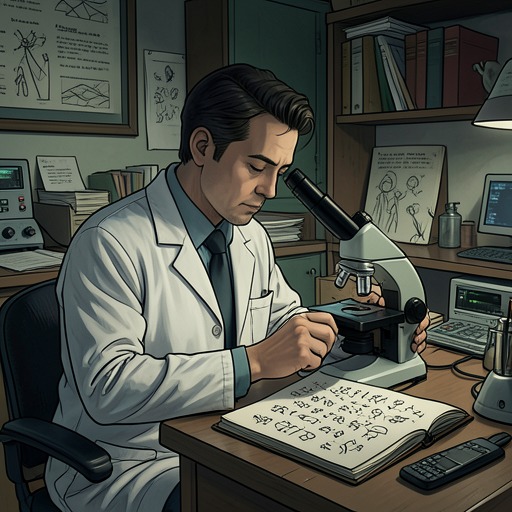
The SwarmMick Rubin, mollusk biologist, helps connect the crisis’s broad ecological warnings to the close examination of individual sea creatures. At the emergency centre and in the containment facility, he asks practical questions, assesses unfamiliar animals within the limits of his expertise, and contributes a crucial identification: the strange crabs are vent crabs associated with deep-sea hydrothermal vents.
Identity and Scientific Outlook
Rubin is from Manchester, England, and is identified as a biologist specializing in mollusks. His expertise does not make him omniscient: when asked to assess an unfamiliar crab, he acknowledges that he does not know the species. Instead, his observations distinguish what he can judge from what requires further investigation. That restraint matters in a story where many apparently local anomalies may be parts of a larger, still poorly understood disturbance.
In a discussion of subsea development, Rubin weighs the economic attraction of underwater production against the danger of treating optimistic projections as reliable forecasts. He recognizes that subsea plants can reach otherwise inaccessible oil reserves and that methane is promoted as a cleaner fuel. His concern is with the gap between an ideal scenario and actual conditions: companies may choose the most favourable outcome from a range of possibilities because it lets them proceed despite limited knowledge of the environment they are entering. The warning gives his scientific outlook a practical and political dimension. The problem is not simply that people lack data; institutions may act as though uncertainty has already been settled.
At the Emergency Centre
At Chateau Whistler, Rubin is among the specialists gathered as the ecological emergency is organized under military leadership. Judith Li explains that the centre’s work must remain secret and that participants may leave, but may not discuss their work with others. Rubin raises a direct question about whether the restriction also means that he cannot leave the hotel. Li clarifies the distinction: he is free to go, but cannot disclose his work.
The exchange places Rubin at the boundary between emergency coordination and personal choice. He does not make a speech against the secrecy policy, and the evidence does not establish whether he signs the declaration or what he ultimately decides. What the scene does show is that he asks about the concrete terms governing the specialists’ participation before the briefing continues. His question gives the confidentiality rule a practical consequence: remaining in the work group carries an obligation of silence, even though departure remains possible.
Rubin’s response to the toxic-algae report is similarly direct. When the discussion turns to the deadly Pfiesteria outbreak and the possibility that the algae came from human activity, he quietly asks where they originated. Roche answers that polluted waters enriched by agricultural and industrial waste helped create conditions in which the organisms flourished. Rubin’s question marks him as a listener seeking causal explanation, not merely a specialist reacting to the scale of the disaster. The answer also resonates with his earlier concern about industries entering complex marine environments while relying on assumptions that may fail in practice.
The Containment Facility
After crabs arrive at the institute, Rubin meets Johanson in the biohazard containment facility. He greets him with a handshake and a strained, animated laugh, then asks to hear about the worms Johanson has been studying. The encounter brings the two lines of investigation together: Rubin’s mollusk expertise and Johanson’s work on anomalous deep-sea organisms now meet amid a new specimen requiring examination.
Rubin initially judges the crab’s behaviour to appear normal, while acknowledging that he is unfamiliar with its species. Johanson disagrees with the first impression, distinguishing apparently normal movement from a possible failure of the animal’s senses: rather than responding defensively to the spatula, the crab repeatedly attempts to flee the work surface. The difference between their assessments is productive rather than a contest of authority. Rubin offers a cautious preliminary observation; Johanson proposes a specific behavioural abnormality that might explain why ordinary movement does not amount to ordinary behaviour.
The identification follows from attention to the animal’s anatomy and habitat. Johanson reasons that the crabs’ lack of eyes suggests an existence in darkness and narrows the possibilities to a deep-sea species. Rubin recognizes the likely group as vent crabs and identifies their habitat as deep-sea hydrothermal vents, which he describes as volcanic oases of life. His contribution turns an unexplained animal into evidence of a connection with the deep ocean. The discovery does not, by itself, explain how the crabs reached the facility or establish the cause of their altered context; it supplies a meaningful taxonomic and ecological lead without pretending to solve the larger mystery.
Role in the Crisis
Rubin’s role is defined less by a single revelation than by the way he handles partial knowledge. He asks where a threat came from, tests the limits of what can be inferred from behaviour, and recognizes a deep-sea animal when its defining features become clear. In the committee scene, he also asks what secrecy means in practice. Across these settings, his questions keep abstract crisis language attached to observable conditions: the terms of participation, the source of a bloom, the crab’s response to a tool, and the dark habitat implied by its anatomy.
The contrast between his specialties and the scale of events is significant. A mollusk biologist cannot independently explain a global ecological emergency, and Rubin does not claim to. His usefulness lies in bringing disciplinary knowledge to an unfolding investigation while acknowledging its limits. The vent-crab identification widens the inquiry toward the deep sea; his earlier warning about industrial optimism shows why such environments should not be treated as blank spaces available for exploitation. Together, these moments make him a figure of careful expertise in a crisis repeatedly shaped by the costs of acting before the consequences are understood.