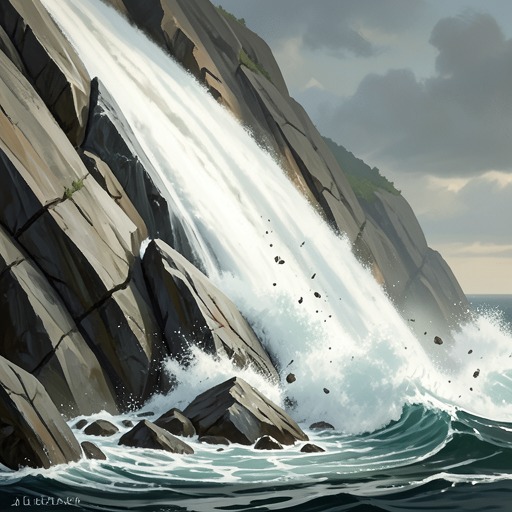
North Sea tsunami aftermath
The SwarmThe North Sea tsunami aftermath turns a submarine geological disaster into a crisis that reaches far beyond the coast: the wave devastates Norwegian cities and the region’s industrial infrastructure, while the seabed collapse cuts a major transatlantic cable and leaves an already strained Europe facing mass displacement, disease, and shortages. The disaster is at once a visible wall of water and a less visible unravelling of the systems that connect coastal populations to energy, trade, and one another.
The setting and the slide
The scale of the catastrophe depends on the character of the North Sea. The continental shelf is the submerged continuation of the continental plate, generally no more than two hundred metres deep; beyond it, the seabed falls or slopes toward the ocean floor. The shallow waters around the British Isles and Scandinavia merge into the North Sea, a busy maritime region whose waters average between twenty and 150 metres deep. Its apparently familiar geography conceals the vulnerability of a broad continental margin.
When the shelf and slope slide into deeper water, the descending mass draws the sea level down over a vast area. Water rises around it and surges outward in a wave that spreads across the ocean. Near the slide, over several thousand square kilometres, the wave is exceptionally flat and reaches scarcely a metre above the surface, so it passes unnoticed amid a storm. Its decisive change comes when it encounters the shallow shelf. The disaster’s origin is therefore largely hidden from the people in its path: the sea does not announce the full scale of the event where it begins.
Coastlines caught without warning
Norway’s exposure is not simply a matter of its long coast. Many of its major cities lie at sea level, and small, flat archipelagos stand between the open water and the mainland. Stavanger, the centre of the Norwegian oil industry and a major commercial and shipping hub, is especially vulnerable: a line of low islands lies north of its port, connected to the mainland by bridges. The Norwegian government alerts local authorities shortly before the wave arrives, and warnings go out through radio, television, and the web. There is too little time to evacuate the city.
The response is hampered by a broader absence of preparation. Pacific countries have an established tsunami warning system, but Europe, the Mediterranean, and the Atlantic do not have a comparable network in the account given at the emergency briefing. People in Norway have little public familiarity with tsunamis, and Stavanger’s final minutes are consequently marked by confusion. The wave reaches the city before residents can flee; at its full height of thirty metres, it destroys bridges and overwhelms the harbour defences. The old town and historic buildings are among the losses. The scene makes clear that a warning sent is not necessarily a warning that leaves time to act.
A regional disaster becomes a humanitarian crisis
At a briefing in Chateau Whistler, Sal Peak places the North Sea disaster beside earlier tsunamis: the Aegean event of 479 BC, the 1755 Lisbon disaster, the waves following Krakatoa’s 1883 eruption, and the 1933 tsunami at Sanriku. Even these historical comparisons, he argues, do not match the scale of the recent catastrophe. Two hundred and forty million people live in the North Sea states, most near the coast. Initial estimates put the death toll at two or three million, with at least as many people injured or homeless.
The economic damage is inseparable from the human emergency. Ports central to international trade have been badly damaged or destroyed, and a region that produced about 450,000 barrels of oil a day has lost its entire oil industry within hours. Half of Europe’s oil reserves lie off Norway, with a substantial share off Britain, and the North Sea is also an important source of natural gas. The scale of these losses makes recovery a question not only of rebuilding individual cities, but of how a densely connected industrial region can function when its ports and energy supplies are disrupted.
The later account of conditions across Europe extends the aftermath into a humanitarian breakdown. Parts of the continent are under martial law, while aid organizations cannot meet the need for tents and food. Disease and infection compound the crisis, and damage to coastal power-station cooling systems brings nuclear emergencies in Norway and England. Peak’s list moves from ports and energy to food, medical care, electricity, and public order: the tsunami’s consequences are measured by the systems that fail after the water has passed, as well as by the immediate destruction.
The seabed reaches the information network
The slope collapse also interrupts infrastructure that is physically remote from the devastated coastline. An email sent by Erwin Suess from Kiel travels through TAT 14, a transatlantic fibre-optic cable buried beneath the seabed. The cable is cut where the avalanche of mud and rock crosses its route; its torn ends are left hundreds of kilometres apart. The message cannot reach Gerhard Bohrmann at Chateau Whistler, where he is waiting for data on worm-colony growth and estimates of possible invasions elsewhere.
A week after the disaster, transatlantic Internet traffic is at a standstill. Phone calls can be made only by satellite, if they can be made at all. The interruption exposes the dependence of everyday communication on a comparatively unseen network under the ocean: the global village, in the novel’s account, is made of cables as well as computers and telephones. The disconnection also delays the circulation of scientific findings at the moment when researchers are trying to understand the scale and causes of the crisis.
An unresolved cause and a wider pattern
The emergency briefing treats the worms on the Norwegian continental slope as a striking mutation and identifies their interaction with bacteria as part of the destabilization of methane hydrates. Yet Sal Peak stresses that this does not adequately explain a catastrophe of such magnitude. Sigur Johanson and the researchers at the GEOMAR Centre likewise believe that the full account is missing a factor. The tsunami, in this formulation, is the most visible part of a larger problem, not a complete explanation of it.
That uncertainty places the aftermath within the novel’s broader chain of oceanic and social disruptions without making every later crisis a direct result of the North Sea slide. The broken cable gives the seabed collapse a global reach; the losses of ports, energy production, and homes reveal how closely regional vulnerability is tied to international systems. The aftermath therefore marks two kinds of exposure at once: coastal communities face a hazard they were scarcely prepared to recognize, while distant populations discover that the networks they rely on can be severed by events beneath the sea.