Pfiesteria homicida
The SwarmPfiesteria homicida is the novel’s most dangerous form of a toxic single-celled alga: a rapidly changing organism that turns contaminated water and apparently ordinary crustaceans into vehicles for a lethal epidemic. Its arrival reveals how an ecological hazard can cross from polluted waters into cities and how difficult it becomes to contain once it has entered the water supply. The account links its emergence not to an inexplicable natural plague but to conditions created by human industry.
Identity and changing forms
Salomon Peak identifies the Central European pathogen as closely related to Pfiesteria piscicida, a known toxic dinoflagellate, but not the same organism. Pfiesteria piscicida had previously caused severe harm along the east coast of the United States, especially in North Carolina, where it killed billions of fish and affected fishermen and researchers. The new strain is presented as more toxic; Bernard Roche names it Pfiesteria homicida, distinguishing it from the fish-eating relative with a name that evokes its danger to people.
Pfiesteria is difficult to classify by appearance because its form can change within minutes. The organism may grow to ten times its former size, enclose itself in a cyst, or change from a harmless single-celled state into a highly toxic zoospore. The presentation describes twenty-four possible forms, each associated with different characteristics. Electron-microscope images show shapes ranging from star-like amoebas and bristled spheres to forms with twisted tentacles. These variations make a single visual description inadequate: the organism’s danger lies partly in its capacity to alter what it is and what it can do.
The epidemic and its routes of spread
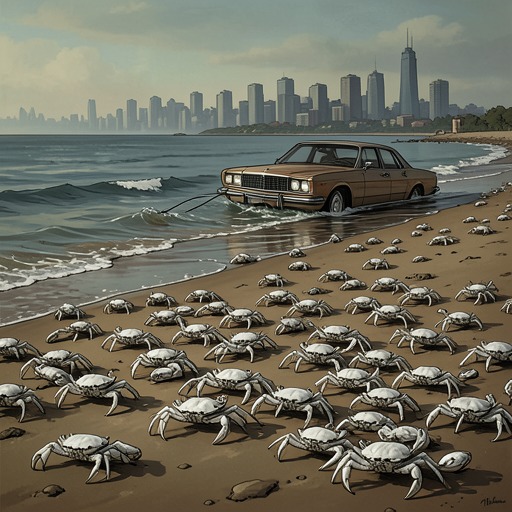
In the novel’s outbreak, Pfiesteria homicida reaches Central Europe through crustaceans resembling lobsters. The animals are caught alive, but their flesh has been replaced by a jelly-like material containing colonies of the algae. Peak describes them as a kind of Trojan horse: the outwardly familiar crustacean conceals the actual carrier. The European Union responds by prohibiting the catching and export of lobsters. At the time of Peak’s briefing, sickness and deaths have been reported in France, Spain, Belgium, Holland, and Germany; the latest available count is fourteen thousand fatalities. American lobsters are still considered genuine, though officials are considering a wider ban on crustacean sales.
The infestation becomes especially difficult to control after the algae enter the water supply. According to the briefing, they reproduce in cycles of explosive growth, seep into soil, and leave behind toxins that resist filtration. Cleaning pipes and tanks does not reliably remove the threat: the organisms appear elsewhere and continue to spread their toxin. Attempts to destroy them with heat, acid, and chemicals risk replacing one danger with another. The crisis therefore exceeds the reach of a single cleanup operation, because the contamination persists across connected water and infrastructure.
Effects and limits of containment
The novel distinguishes the effects of the new strain from those associated with Pfiesteria piscicida. The earlier species is described as affecting the nervous system; Pfiesteria homicida attacks it more aggressively, causing paralysis within hours, followed by coma and death. Only a small number of people appear immune. Roche hopes to identify the genetic basis of that immunity, but he has not yet deciphered the toxin’s structure, and the epidemic is spreading faster than the research can answer it.
The account also recalls the health consequences associated with earlier contact with Pfiesteria piscicida. Fishermen developed persistent health problems, while researchers experienced memory loss and other long-term effects. Howard Glasgow’s case illustrates how exposure can go unnoticed: after a laboratory ventilation error directed toxin-laden air into his office, his health deteriorated over six months, and his memory and ability to function were profoundly affected. Other researchers later developed respiratory illnesses. These earlier cases do not establish that every effect is identical for Pfiesteria homicida, but they show why the new outbreak is treated as a danger extending beyond direct contact with contaminated water.
Industrial origins and narrative significance
Roche attributes the conditions behind the outbreak to nutrient pollution. He explains that animal waste washed from fields and carried through rivers supplies phosphates and nitrates that encourage Pfiesteria growth; industrial outlets and organic matter in sewers offer further favorable environments. His account connects the epidemic to agricultural and industrial practices rather than presenting the algae as a threat wholly separate from human activity. In this view, people may not have invented the organism, but they have helped create the conditions in which it can flourish and become more dangerous.
Pfiesteria homicida thus gives the novel’s ecological crisis a specific, material mechanism: a shifting microorganism, transported in concealed form, sustained by polluted environments, and difficult to remove once it reaches public water systems. The contrast with the familiar lobster is central to the threat’s unfolding. What appears to be a recognizable food animal becomes a carrier, while water—ordinarily treated as a dependable public resource—becomes a pathway for continued exposure. The creature’s menace comes not only from its toxicity but from the gap between its changing biological forms and the human systems attempting to recognize, trace, and contain it.