Samantha Crowe
The SwarmSamantha Crowe begins by listening for intelligence across the distances of space and ends by helping humanity attempt contact with an intelligence already living in the ocean. A SETI researcher whose work has prepared her to ask whether anyone is out there, she becomes a central architect of the effort to communicate with the Yrr. Her importance lies not only in bringing a method to first contact, but in insisting that humans distinguish technical ability from conscious understanding—and resist assuming that another intelligence must share human values.
Identity and First Meeting
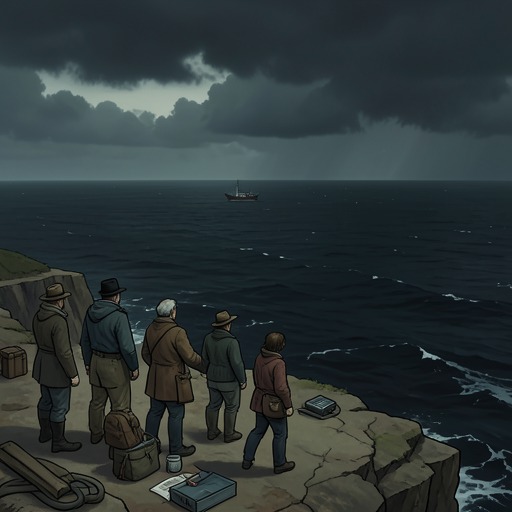
Crowe enters the story in Clayoquot Sound, where she meets Leon Anawak and introduces herself as Sam. Their first conversation takes place over dinner after a friendly exchange on a rocky promontory. The setting makes a quiet contrast with the work that has brought Anawak there: the restaurant overlooks the bay and islands, but there are no whales to watch. Crowe’s easy manner gives way to a more unusual subject when she explains that her work is to ask whether anyone else exists beyond humanity.
She works for SETI, specifically Project Phoenix, and listens for signals from space. The search is constrained by the distance their technology can reach—about two hundred light-years—but its scale has already been enormous: during the mid-1990s, the project analyzed sixty billion signals and reduced them to thirty-seven that could not be matched to natural phenomena. None had yielded a confirmed response. Crowe’s work therefore rests in the space between methodical scrutiny and hope: a signal might be noise, but it might also be evidence that another intelligence has attempted to say hello.
A Shared Search for Meaning
Anawak and Crowe recognize a kinship between their work. He studies whales; she listens for extraterrestrial signals. Both are attending to possible forms of intelligence beyond the human, and both are driven by more than professional curiosity. Their exchange gives their parallel inquiries a personal dimension: each wants to know what the existence of other intelligent beings might mean for humanity. Crowe frames that desire as a search for meaning, not merely a hunt for proof.
The encounter establishes a relationship of warmth and mutual regard without making it the centre of either character’s work. When they part after a drink, Crowe hopes Anawak will find the whales he is looking for. He promises to let her know, and she tells him that the whales are fortunate to have him as a friend. Her compliment recognizes his care for them, while the exchange leaves open a line of connection between their distinct investigations.
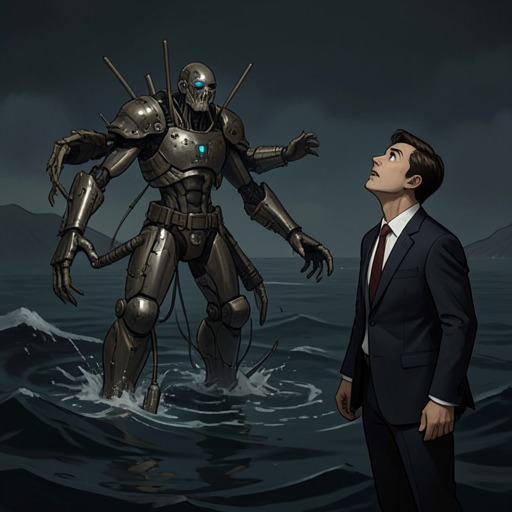
Crowe later appears to Anawak in a scene set amid ice and dark water. He recognizes her as the SETI researcher and tells her that he has found his aliens: contact has finally been made. In this vision-like encounter, Crowe points him toward the water and suggests that the beings there want to meet him. The scene turns their earlier conversation inside out. The question she once pursued among distant signals now confronts Anawak in the ocean, and the search for other minds becomes a demand to approach them rather than simply observe them from afar.
The Contact Mission
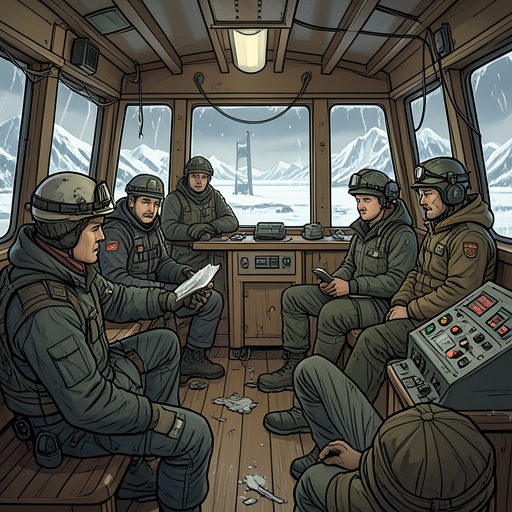
On 12 August, Crowe arrives by helicopter aboard the USS Independence in the Greenland Sea. The ship is to be her home for the coming weeks, and her assignment is to conduct a conversation. The scale and military character of the vessel contrast with the purpose she has been given: the mission is not simply another research expedition, but an attempt to open negotiations with beings whom humanity has so far encountered through ecological catastrophe and conflict.
At the team’s welcome meeting, Judith Li explains that the human response has failed to address the underlying threat. Attempts to counter particular effects—among them toxic algae, worm colonies, whale attacks, methane buildup, and the prospect of a halted Gulf Stream—have not revealed the cause. Li presents the mission as an effort to make contact and seek a peaceful resolution. Crowe’s experience with SETI makes her both a specialist and a realist: unlike a search across the vast known universe, the team has reason to believe the beings exist and a rough idea where they live. She also argues that contact has already occurred in an unintended form, because human activity has entered their habitat for decades and brought destruction with it. On her account, the Yrr’s war is not an inexplicable first move but a response within a relationship humans have already begun.
Crowe helped develop the contact strategy with Murray Shankar, Judith Li, Leon Anawak, and NASA personnel. She explains why familiar methods of long-distance communication will not work underwater. Short-wave signals are absorbed by water; long-wave signals would require enormous antennae; and light is useful only across limited underwater distances. Sound remains the viable medium, but echoes and interference could make a message unintelligible. The team therefore plans to use a special modem based on a technique associated with marine mammals, which sing in ways that overcome interference. The proposed conversation is shaped by the medium itself: communication with an ocean-dwelling intelligence must begin in a form the ocean can carry.
Intelligence, Consciousness, and Ethical Caution
Crowe resists the assumption that superior mathematics or physics automatically proves consciousness. A being—or even a machine—might perform impressive tasks without understanding their meaning. In a discussion that invokes artificial intelligence and the possibility of a machine civilization, she asks the team to separate observable capability from inward awareness. Her position does not dismiss the Yrr’s evident skill; it treats that skill as evidence requiring further interpretation, rather than as a guarantee that the Yrr think or feel as humans do.
This distinction structures the three stages she proposes. First, the team must establish whether anything is present beneath the sea. Second, it must determine whether dialogue is possible. Third, it must test whether the Yrr respond consciously to messages, rather than merely exhibiting intelligence or learned capacity. Only after there is reason to believe that they can conceptualize and understand does Crowe consider it meaningful to debate their values. Even then, she warns against expecting those values to resemble human ones.
Her caution also shapes the proposed mathematical challenge. Crowe argues that if the Yrr have collective agency and have chosen to fight, appeals to empathy or sentimental identification may not change their conduct. The team must make communication more compelling than violence, so she suggests challenging them with mathematics—an approach grounded in the Yrr’s demonstrated command of physics and mathematics. The plan is not a claim that mathematical achievement proves moral feeling; it is a way to invite a response that could help reveal what kind of intelligence the team faces. Crowe’s method therefore links first contact to intellectual humility: human beings must discover what the Yrr can understand before deciding what they are.
Crisis, Survival, and Narrative Role
During the crisis aboard the USS Independence, Anawak hears Crowe’s voice in a smoke-darkened hangar and calls out to her, but receives no answer. Later, as he reaches the deck elevator, he calls her name again. Crowe appears and leaps toward him; the impact sends them sliding down the slope together. The episode brings their earlier intellectual connection into immediate physical danger: the scientist who once pointed Anawak toward the beings in the water is now beside him in an escape whose outcome is uncertain at the moment it unfolds.
The epilogue identifies its final section as being drawn from Crowe’s diaries and dates the entry 15 August. Its opening, that nothing is as it used to be, establishes that she has survived to write in the aftermath. The diary also gives her a final narrative function beyond the contact mission: she becomes a witness who can record the altered world after the shipboard struggle.
Crowe’s arc carries the book’s first-contact question from distant observation to direct encounter. At dinner, she describes a search for signals that might mean someone is out there; aboard the ship, she must help determine whether the beings already in humanity’s world can answer, understand, and be understood. Her most consequential contribution is methodological as much as scientific. By separating intelligence from consciousness and consciousness from shared morality, she denies the human team the comfort of easy categories. Contact, in her account, begins not with the presumption that the other side is human-like, but with the disciplined willingness to find out.