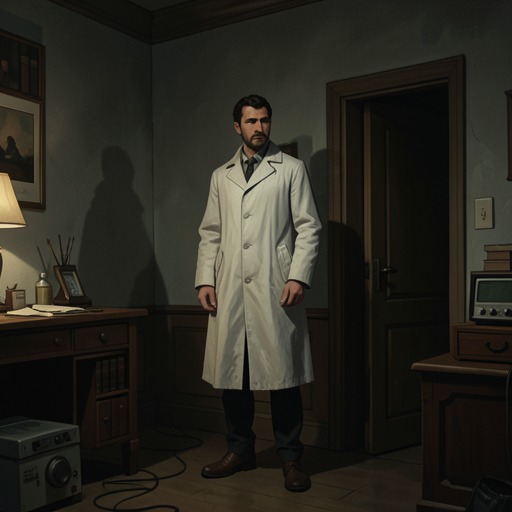
Sigur Johanson’s amnesia
The SwarmSigur Johanson’s amnesia turns a head injury into a struggle over what can be remembered—and who wants the memory kept buried. After being found on the hangar deck of the ship, he wakes in the sickbay with no recollection of what happened there. His memory begins to return in fragments, but the later revelation that he was given a mind-erasing drug makes the gap more than an accident: it is also something others have deliberately tried to preserve.
The gap after the hangar deck
Johanson wakes to the ship’s loudspeakers announcing eight hundred hours, with an almighty headache and no sense of how he came to be in the sickbay. The familiar setting of Trondheim has vanished from his immediate world: there is no steeple or ochre-coloured house, only a windowless, sterile room and empty beds. The headache is not the after-effect of church bells, as he first imagines, but a physical condition that accompanies his disorientation.
His clothes from the previous night are still on him. His down jacket and sweater lie on the next bed, and his shoes have been placed neatly on the floor. Sid Angeli, head of the medical unit, explains that Johanson was found on the hangar deck in the middle of the night. The ship’s video surveillance made it possible to find him; Angeli thinks he slipped and hit his head on one of the struts. The injury accounts for his soreness, but not for the blank stretch in his recollection.
The missing time has an identifiable edge. Johanson remembers being on the hangar deck with Sue Oliviera, then returning there by himself. He cannot remember why he went back or what happened next. An empty bottle nearby supports the shipboard explanation that he had been drinking wine with Oliviera, and Angeli warns that a wet, dark helicopter carrier is dangerous, especially for someone wandering alone after drinking. That practical account makes the gap seem like the aftermath of a fall, while leaving the crucial final moments entirely unavailable to Johanson.
Fragments and competing explanations
The next day, as Johanson and Oliviera make their way to the lab, his headache is improving but the memory loss remains conspicuous: he describes a blank in his memory as large as the hangar bay. Mick Rubin offers a competing explanation for his own absence the previous night, saying that he had been incapacitated by a migraine and had not been able to get out of bed. Oliviera answers with a look that makes clear she is not simply accepting his account. Her response matters because Johanson’s missing recollection concerns more than the circumstances of his fall: he may have seen Rubin.
The possible memory returns not as a complete scene but as an interrupted process. Johanson experiences his mind like a broken projector, repeatedly trying to place a slide that will not settle. At the lab door, Oliviera reminds him that, while the two of them were drinking wine and waiting for the sequencer, he had insisted he saw Rubin the previous night. Johanson cannot initially recall having said so. Then fragments come into focus: the glass of wine, their conversation, and the impression that he had seen something. The repeated clicks mark an approach to recognition without supplying a full account of what he witnessed.
The distinction between remembering an event and recovering its meaning remains important. Johanson does not, in these fragments, retrieve a clear explanation of what occurred after his solitary return to the hangar deck. Instead, the recollection of Rubin arrives through Oliviera’s prompting and connects the forgotten night to an earlier conversation. His uncertainty leaves the memory vulnerable to both an ordinary explanation—the blow to his head—and a more troubling possibility: that what he might remember is something someone else does not want him to remember.
Deliberate erasure
The later account of the drug changes the status of Johanson’s amnesia. Sal Peak says that ten millilitres were injected, with a larger dose avoided because it would have left Johanson too impaired; the group still needs his brain. The drug is intended to work like an eraser on the mind, but its effect is not guaranteed. The conversation identifies an intervention beyond the apparent accident, without establishing that the drug alone caused Johanson’s original blank or specifying exactly what he had seen.
The uncertainty is built into the drug’s limits. Peak warns that a word, a colour, or a smell could act as a trigger and allow Johanson to remember precisely what happened. Jack Vanderbilt agrees that no drug can suppress a memory entirely and notes how little is understood about the brain’s workings. Judith Li therefore calls for Johanson to remain under observation and asks Mick Rubin how much longer they will need him. Erasure is treated not as a finished operation but as an unstable condition requiring continued surveillance.
Memory as a contested state
Johanson’s amnesia develops in layers: the physical aftermath of a fall, a gap in memory around his second visit to the hangar deck, the partial return of a recollection involving Rubin, and the deliberate attempt to suppress memory with a drug. The evidence does not settle how much of the gap comes from the blow and how much from the drug. That uncertainty itself is consequential: Johanson cannot use his own recollection to distinguish accident from interference, while those who injected him know enough to fear its return.
The broken-projector image gives the condition its narrative shape. A memory is not simply present or absent; it catches, clicks, and almost falls into place. The possible trigger may be as small as a word, colour, or smell, while the memory at stake may expose what happened during a night Johanson cannot reconstruct. His recovery remains incomplete in these scenes, and the threat of recall remains active. The amnesia is therefore both a bodily vulnerability and a means of controlling access to knowledge—one that the very act of trying to erase it cannot make fully secure.