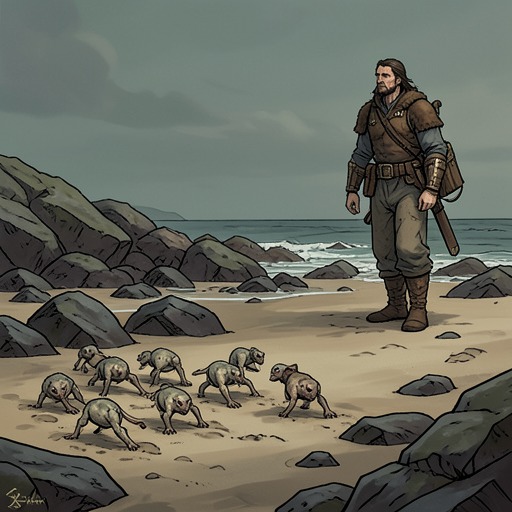
The yrr are memory
The Swarm“The yrr are memory” condenses the novel’s account of a nonhuman intelligence whose past is not stored outside the organism but carried forward through cellular life. The expression challenges the human assumption that memory belongs to individual minds: for the Yrr, inherited experience links generations into a collective capable of learning and acting across spans of time beyond human reach.
From cell signals to collective thought
The idea takes shape against the question of how single-celled organisms might form a thinking whole. Leon Anawak objects that pressure waves could explain communication among fish, but not among single cells; some force, he reasons, must draw the cells together. Sue Oliviera offers a biological comparison: Myxococcus xanthus cells release a chemical starvation signal, whose growing intensity eventually brings a swarm together into a visible multicellular fruiting body. The example makes chemical coordination imaginable without establishing that a cellular aggregate can think.
That gap remains troubling after the blue cloud filmed by the URA dive robot near Vancouver Island is understood to consist of billions of cells. Karen Weaver considers whether such a mass could be intelligent, how it might learn, and how its cells could communicate. She programs a computer to connect mental capacity with single-cell organisms, while the surrounding researchers remain skeptical that cells without self-awareness or creativity could constitute a mind.
A model that learns
Weaver and Anawak later describe a virtual experiment that turns the question into a working model. They program virtual amoebas with electronic DNA that continues to mutate: in their simulation, the DNA learns. The system recovers the neural-network computer they had previously failed to reconstruct from its smallest programmable units, suggesting that learning at the level of the cells is what allows the larger network to function.
The simulation also gives its cells movement through three-dimensional space and conditions resembling the deep sea, including pressure, currents, and friction. Chemical scent supplies one means of recognition; variable sections in the Yrr’s DNA provide another, marking which collective a cell belongs to. The model offers a way to connect cellular communication, group boundaries, and cognition, though it remains an explanation the characters have constructed rather than direct proof of every step in Yrr thought.
Memory carried in the genome
Johanson identifies hypermutating DNA as the crucial difference between the Yrr and humanity. He proposes that the Yrr became conscious in the early Jurassic and have accumulated knowledge ever since. Human cultures preserve experience in words, written records, and pictures, but each person is born without the lived memories of earlier generations. Yrr cells, by contrast, duplicate their genomes when they divide; the information encoded there passes into new cells along with the genetic material.
In Johanson’s account, this inheritance is more than the transmission of abstract facts. New cells receive experience as though they had been present when it occurred, giving the collective a memory that persists beyond any individual cell. Its intelligence can compare past outcomes, refine strategies, learn from errors, and retain innovations. Johanson warns that defeating this accumulated knowledge would mean destroying entire collectives—and perhaps every last cell—while their networks may extend for hundreds of kilometres. Li, rather than dismissing the Yrr as merely cold-blooded, recognizes the speed and force of a system that can draw on its own history.
Time as a living inheritance
The expression returns in Weaver’s thoughts during a dive in the Greenland Sea. As ideas tumble through her mind, an internal objection insists that the world has no memory and that memory belongs to people; the answering thought asserts that the Yrr remember everything. Her dizziness and check of the oxygen supply leave the passage poised between intellectual insight and a disorienting mental experience, rather than presenting the exchange as an ordinary conversation.
The thoughts then recast time itself. Humans are described as bounded by a short horizon, prone to forget disasters and unable to share the world’s memory. The Yrr, in contrast, carry geological time in their genomes: the joining of oceanic plates with the land that became North America, Greenland’s separation from Europe, the formation of Atlantic topography, and the sinking of ridges that allowed Arctic and Atlantic waters to circulate. In this image, the genome is both archive and route through deep time. “The yrr are memory” thus names not only a mechanism of biological inheritance but a different scale of consciousness, in which the past remains active within the living collective.