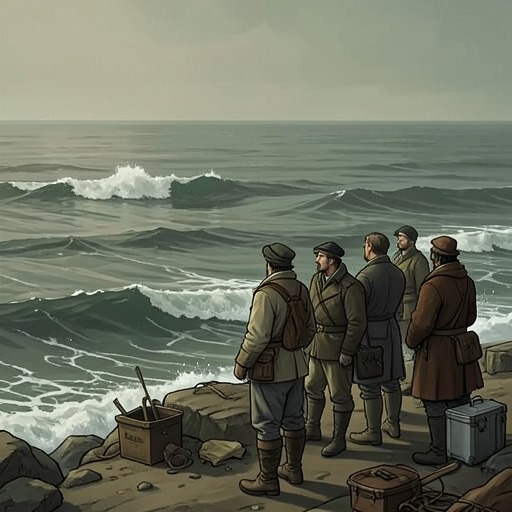
They've shown us how it really is
The Swarm“They've shown us how it really is” is the book’s final interpretive turn: the Yrr have not remade the world so much as made its underlying conditions impossible to ignore. Spoken a year after the vessel sank, the expression redirects attention from what humanity believes it has learned about the Yrr to what the encounter has revealed about human dependence, ignorance, and responsibility. Its force lies in that reversal. The crisis may be unprecedented, but the world it discloses was already there.
A headline turned inside out
A year after the sinking, a newspaper declares, “The yrr have changed the world forever.” The closing reflection pauses over that confident formulation rather than simply accepting it. Its answer—“The yrr haven't changed the world. They've shown us how it really is.”—recasts the crisis as revelation, not creation. The difference matters: if the Yrr have altered the world, humanity might imagine the upheaval as an external interruption, something that could eventually be put behind it. If they have shown how it really is, then the old human picture of the world was already incomplete.
That reframing gathers the novel’s ecological concerns into a final, compressed claim. The surrounding reflection describes nature not as a hierarchy of separate things but as a web of connections that sustains life. Humanity’s damage to biodiversity therefore reaches beyond the loss of individual species: it damages a complex system that people cannot fully explain or replace. The Yrr’s intervention makes that dependence newly legible. The expression does not claim that humanity now understands the whole system; it marks the unsettling recognition that human beings were never outside it.
Knowledge that remains incomplete
The ending refuses to treat survival or contact as mastery. Humanity knows virtually nothing about the Yrr, despite believing it understands their biochemical composition. Even that apparent knowledge is questioned: identifying a composition is not necessarily the same as understanding the beings themselves. The Yrr have not been seen since the encounter, while their signals continue to echo through the oceans in forms not intended for human ears. Their presence is perceptible, but their communication remains beyond human comprehension.
The closing reflection dwells on the gap between detecting a signal and understanding its source. It raises unresolved problems about how a mass of jelly produces and receives sound, and places those problems among millions of questions that human beings cannot answer by observation alone. The questions are not presented as a mystery the novel has solved; they establish the burden that remains. The onus lies with humanity. In that context, the title expression is not a declaration that the Yrr have explained reality. They have exposed how little human knowledge can claim, and how much work remains before contact could become understanding.
The turn toward humanity
The proposed response is self-examination rather than further certainty about the Yrr. Humanity, the reflection suggests, may need to enter a new phase of evolution by reconciling its inherited nature with its development as a civilized species. The challenge is not merely to acquire more information about an unfamiliar intelligence, but to question the human habits that have made nature seem separable, subordinate, or expendable. The encounter turns the search for another mind back toward the people conducting it.
That reversal also gives the closing passage an ethical edge. If human well-being may depend on the existence of other animal species, then biodiversity is not a decorative abundance surrounding human life. It belongs to the conditions that make human life and even human psychological health possible. The reflection warns that a damaged planet could impoverish future generations in ways that cannot be confidently measured in advance. Against the temptation to divide nature into dispensable parts, the expression insists on connection: what humanity damages in the wider web may be a condition of its own survival.
A conclusion that remains open
The expression closes the novel without converting its remaining uncertainty into a neat resolution. The Yrr’s biochemical nature may be partly understood, but their motives and signals remain obscure; their influence on humanity has been decisive, but their future judgment is not known. The reflection acknowledges that humanity has already overstepped and may have narrowly avoided exclusion from the web of life. It also urges people to make any further decision as straightforward as possible, while recognizing that the Yrr will not be deceived in the same way again. Hope therefore appears not as a guarantee of reconciliation but as the possibility that humanity might change how it sees its place in the world.
The final remarks bring that large-scale argument back to ordinary continuity. The narrator observes that nothing is as it was, yet the habit of smoking has not stopped; the last reflection wonders whether everyone needs some kind of continuity. This small persistence does not cancel the upheaval. It gives the ending a human scale: changed understanding coexists with habits and needs that endure. The expression’s final significance is similarly double. The Yrr have altered humanity’s sense of reality, but the reality they reveal is one humanity must still learn to inhabit—and one it can endanger again if it mistakes partial knowledge for mastery.