U.S. Intelligence Community
The SwarmThe U.S. Intelligence Community is depicted not as a single command but as a broad, interlocking network of agencies and technical systems. As the oceanic crisis becomes a problem of national and international security, its personnel and surveillance capabilities converge at Chateau Whistler, while the breakdown of undersea communications reveals the limits of a system accustomed to moving information at global scale.
Structure and Presence at Chateau Whistler
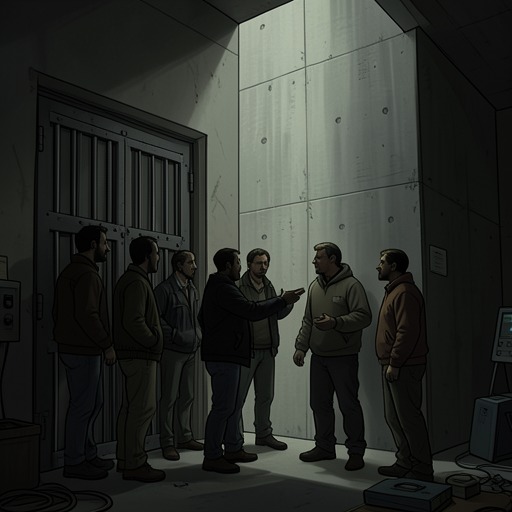
Chateau Whistler is transformed from a luxury hotel into the Allied Emergency Committee’s crisis centre. Among the hundreds of delegates there, more than half have some connection to the U.S. Intelligence Community, and most of that group work for the U.S. Central Intelligence Agency, which quickly turns the hotel into its command centre. The U.S. National Security Agency occupies the fourth floor with an entire department; employees of the Pentagon and the Canadian Security Intelligence Service take over the fifth. The building also houses British, German, French, Swedish, and Finnish representatives, making it a strikingly concentrated gathering of intelligence organizations.
The gathering is described as a historic convergence of agencies, but also as a muddle of people and data. That distinction matters: the community’s influence comes from the connections among its component organizations and their information systems, not from a clearly presented unified structure. The hotel’s conversion into a command centre gives this dispersed network a temporary physical centre, even as the international composition of the meeting makes its work dependent on cooperation across national lines.
Surveillance and Information Processing
The account gives the U.S. Intelligence Community an extensive technical reach. At Buckley Field, two intelligence agents work in an underground station belonging to the U.S. National Reconnaissance Office, which coordinates satellite espionage for the U.S. Air Force. The station has close ties to the U.S. National Security Agency, whose remit includes interception and cryptology. Analysts receive real-time data from Keyhole, Lacrosse, and other reconnaissance systems, evaluate it, and forward information to relevant authorities.
This satellite apparatus is part of a wider monitoring network. Keyhole satellites can operate in infrared, photograph the Earth from low orbit, and, after the attacks began off Vancouver Island, some are brought down to a lower altitude. Alongside Lacrosse, they form a reconnaissance system described as exceptionally capable. ECHELON extends surveillance across international communications, drawing on satellite, radio, and fibre-optic traffic. The community’s apparent power therefore rests on both observation from orbit and the interception of information as it moves through terrestrial and undersea networks.
Crisis Management and Secrecy
The intelligence presence at Chateau Whistler is tied to an emergency response that combines scientific investigation with military and security coordination. The centre is positioned near the British Columbian coast, where several of the unfolding anomalies have been observed, and within reach of research facilities including the laboratory in Nanaimo. The hotel’s closure, military helicopter traffic, and lack of an official explanation help keep the committee’s work insulated from public scrutiny.
At the meeting, Judith Li tells the assembled delegates that they must not discuss their work, even with family or close friends, and that they will be asked to sign a declaration of silence. The stated rationale is to prevent panic and allow the committee to work; the arrangement also makes secrecy part of the crisis centre’s operating conditions. The book thus presents intelligence work not only as gathering information, but as controlling who may share it and when. That control sits uneasily beside the committee’s need to combine findings from scientists, military personnel, and international agencies.
Infrastructure and Limits
The intelligence network’s reach does not make it independent of the infrastructure it monitors. A message from Kiel to Gerhard Bohrmann at Chateau Whistler travels through the transatlantic TAT 14 cable, a fibre-optic route capable of carrying enormous volumes of traffic. When an undersea avalanche destroys the seabed and severs the cable, the message never arrives. One week after the northern European disaster, transatlantic Internet traffic has stopped, and ordinary telephone calls depend on satellite connections, if those work at all.
The contrast is pointed: military satellites continue to function, but they cannot simply replace the capacity of the damaged fibre-optic bridge. Crisis teams attempt to create autonomous networks, yet the Internet keeps collapsing, and the shortage is one of capacity rather than technical knowledge. Elsewhere, the novel shows how hidden infrastructure can turn a local failure into a wider emergency: New York’s unmapped tunnels and water pipes carry contaminated runoff into the city’s water system, while marine life attached to a ship’s speed log can mislead navigation instruments. In this world, information systems and physical networks are not neutral backdrops. They are links in the chain through which the crisis is detected, misunderstood, transmitted, or amplified.