Yrr Queen
The SwarmThe Yrr Queen is the immense, apparently intelligent presence at the center of the Yrr aggregation encountered by Karen Weaver. A vast white, moonlike being whose shifting patterns seem to calculate and communicate, it gives physical form to the Yrr’s collective intelligence. Its approach brings Weaver close to a new understanding of nonhuman life, but the encounter is also a perilous experiment: the Yrr must interpret the pheromone signal issuing from Mick Rubin’s corpse, and the Queen’s response remains unreadable to the humans watching it.
Identity and Appearance
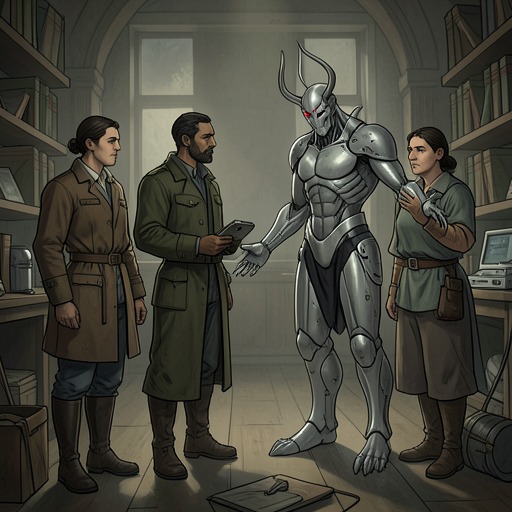
The Queen first emerges not as a familiar animal or a personlike ruler, but as the source of the tentacles hanging beneath the blue dome above Weaver. Its almost perfectly round body is described as large as the moon. Grey shadows move beneath its white surface, forming symmetrical configurations that vanish quickly; lines and dots flash in combinations that appear to Weaver like a cryptic code. The changing patterns suggest a mind at work, not merely a luminous surface. She imagines a living computer processing calculations of extraordinary complexity, then recognizes that the thought may belong not only to this single body: the Queen seems to think for the surrounding mass of jelly and the blue expanse itself.
The description preserves a tension between an individual figure and a distributed intelligence. The Queen has a distinct, recognizable presence, and Weaver identifies her as a particular being; at the same time, her apparent thinking encompasses the aggregation around her. She is less a monarch issuing commands to separate subjects than a visible focal point through which a much larger intelligence seems to act. Her white bioluminescence can invite sacred interpretation, and Weaver has to resist slipping into prayer, but the narrative insists that the light is biological: it is produced by stimulated Yrr cells, not a manifestation of God. The Queen’s otherness is not made easier by turning it into a human religious image.
The Encounter with Karen Weaver
The Queen’s appearance changes the terms of Weaver’s encounter with the Yrr. Earlier, the human debate had circled around whether a single-celled organism could become intelligent and whether cellular organization amounted to consciousness or only an elaborate mimicry. The Yrr had also appeared as a monstrous, tentacled force capable of breaching the USS Independence. Against those disturbing images, the Queen’s patterned light presents a different kind of evidence: Weaver concludes that she is witnessing unmistakably developed intelligence that is not human. The recognition does not make the scene safe or familiar. It makes its significance harder to deny.
As the Queen descends, the beauty of its light gives way to physical danger. Mick Rubin’s body, drawn out of the wreckage and compressed by the immense water pressure, releases the chemical injected into him. The Yrr react immediately; aggregation begins, then abruptly ends. The Queen descends toward the Deepflight, many times larger than the submersible. Its tentacles reel Rubin in, drawing his mummified torso, wrapped in jelly, into the light. The Queen then closes around the boat, engulfing it and absorbing it into what Weaver understands as its thoughts. The depths are no longer dark, but that radiance offers no refuge: Weaver’s fear returns, and she knows that starting the propeller cannot force the resilient jelly to retreat. The boat is lifted, leaving the encounter suspended in threat rather than resolved in conversation.
Rubin’s Signal and the Problem of Recognition
Rubin’s pheromone signal creates the encounter’s central communicative paradox. The chemical originates at the site of injections into his corpse, and the Yrr respond instinctively to it. Yet Rubin is not a Yrr collective. His body tells the Yrr that he belongs to the enemy species they have resolved to eliminate, while the message carried by the chemical urges aggregation. The Yrr have never before received such a pheromone-based message from anything other than themselves. Weaver therefore understands the event as a possible crisis of identification: the collective is being asked to accept as Yrr a body that, in every other respect, signifies its enemy.
For a brief moment the signal appears to produce aggregation, but the process ends abruptly, and the Queen’s understanding cannot be confirmed. Weaver wonders whether the Queen has seen through the deception—whether it can distinguish Rubin from a true collective, despite the message. The scene offers no answer. Its suspense comes from the mismatch between the signal and the organism transmitting it, and from the humans’ inability to know what the Queen makes of that mismatch. The Queen’s physical nearness does not make its thoughts transparent; its luminous patterns suggest complexity without providing a readable translation.
Collective Life and the Queen’s Significance
Weaver’s reasoning about Yrr life makes the Queen’s response especially consequential. She believes that the Yrr do not kill one another. Diseased or defective cells are expelled from the collective and die, but this is not understood as combat between independent beings: the cells form one body. Even collectives with individual queens belong, in Weaver’s account, to one vast being with one vast memory. That encompassing intelligence can make mistakes, yet does not experience moral blame as humans do; it permits individual ideas without granting preference to any single cell. There can be neither internal wars nor punishments in the human sense, only the distinction between normal and diseased cells.
Rubin’s disguise therefore places the Queen at the boundary of a system with no familiar model for betrayal, enemy status, or individual guilt. The humans are not merely trying to fool a creature; they are testing whether a collective that treats its members as parts of one being can be made to mistake an outsider for one of its own. The Queen is significant both as the most concentrated image of Yrr intelligence and as the presence before which that experiment becomes real. Its appearance gives Weaver a powerful reason to accept the existence of nonhuman intelligence, while its silence leaves open whether contact has begun, failed, or become something more dangerous. The boat’s capture and lifting end the available scene without revealing the Queen’s judgment.