
The Uses of Red and White
The SympathizerThe novel repeatedly uses red and white to connect political ideals and private memories with blood, purity, grief, and coercion.
increasing Bearing strength in each event
 decreasing
Bearing strength in each eventdecreasingThe Red Envelope

The Red Envelope
Exclusion at a Holiday
The narrator receives fewer gifts than his cousins because relatives regard him as only half-blooded. A missing red envelope makes his outsider status visible during a family celebration.
A New Interpretation
Man later tells him that the red envelope symbolizes the blood used to single him out. The narrator begins to associate red with revolution rather than luck alone.
The color becomes a personal memory that turns into a political sign, carrying pain and possibility at once.
The Blood-Brother Scar

The Blood-Brother Scar
A Mark of Chosen Kinship
The narrator, Man, and Bon cut their palms and mingle blood as an oath. The resulting scar becomes a private sign of loyalty stronger than the family ties that exclude the narrator.
A Promise Under Strain
The mark remains visible through war, exile, and the later mission. Its meaning is tested whenever one friend must conceal information or make a dangerous choice for another.
The scar turns red from an image of exclusion into an emblem of chosen responsibility.
White Rooms and White Screens

White Rooms and White Screens
A Room Made for Disorientation
The Watchman is held in a white room where walls, furniture, clothing, and light suppress ordinary markers of time and space. The blankness is a technique, not neutrality.
A Screen for Violence
The interrogation room is also called a movie theater when foreigners visit. The same space can appear harmless or violent depending on who is allowed to look.
White becomes a color of official cleanliness that conceals the coercion taking place inside it.
The White Ao Dai

The White Ao Dai
A Symbol of Modesty
Lana wears the white ao dai as a schoolgirl under her mother’s supervision. Western observers turn the clothing into an exotic image of Vietnamese femininity.
Purity and Mourning
The narrator later sees Lana in dreams wearing white and recognizes that the color can signify both innocence and death. His desire is entangled with the distance between the girl he remembers and the woman she has become.
White carries cultural meanings that cannot be reduced to the gaze of outsiders or the narrator’s own fantasies.
A Nation Painted Red
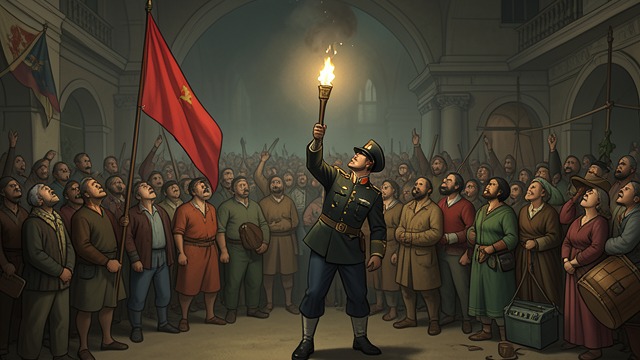
A Nation Painted Red
Revolutionary Color
The narrator returns to a country governed in the name of revolution. Its symbols and slogans promise that sacrifice has produced independence.
A Color Turned Complicated
The narrator sees that red can mark collective hope and the violence used to enforce political conformity. Its meaning changes with the authority that displays it and the people who are made to obey.
The color does not settle the revolution’s moral status; it makes the struggle over meaning visible.
During the narrator’s childhood Lunar New Year
During the narrator’s lycée years
During the narrator’s Special Branch work
During Lana’s adolescence and later dreams
During the narrator’s return to Vietnam
