
The Commandant’s Pedagogy
The SympathizerThe Commandant’s relationship with the narrator exposes the tension between claimed revolutionary education and the coercion used to produce political conformity.
increasing Bearing strength in each event
 decreasing
Bearing strength in each eventdecreasingThe Special Case

The Special Case
A Guest, Not a Prisoner
The Commandant insists that the narrator is a special case rather than an ordinary prisoner. He presents isolation as a necessary quarantine for a man contaminated by foreign ideas.
Care as Control
The narrator is permitted to write and exercise briefly, but his movement and contact are restricted. The language of treatment hides the fact that he cannot leave.
The Commandant’s vocabulary makes coercion sound like concern, establishing the terms under which the narrator’s confession will be judged.
Style as a Political Test

Style as a Political Test
A Demanded Voice
The Commandant criticizes the narrator’s confession for being too indirect, literary, and influenced by Western culture. He wants language that is simple, collective, and politically clear.
Content Is Not Enough
The narrator has confessed to numerous acts, but The Commandant insists that the form of the writing reveals his resistance. Even truthful words can fail the test if they do not sound like the approved confession.
The exchange shows that reeducation governs not just beliefs but the style in which a person is allowed to express them.
A Defense of the Camp
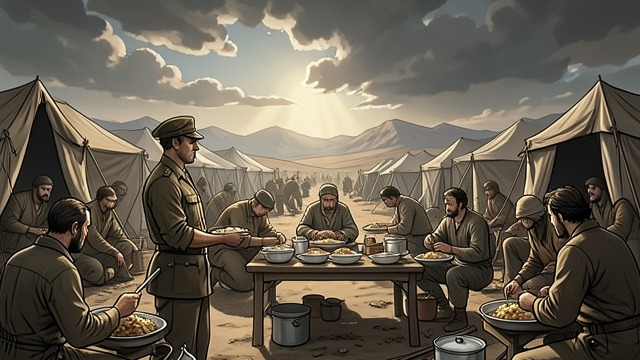
A Defense of the Camp
Comparison with Wartime Harm
The Commandant argues that prisoners receive food, sunlight, and work, unlike people harmed by bombing or forced into earlier camps. He sees their complaints as evidence that they still need reeducation.
Suffering as Justification
His comparisons recognize real wartime devastation but also use other people’s suffering to dismiss present prisoners’ pain. The political account makes compassion conditional on accepting a hierarchy of victims.
The Commandant’s reasoning is not without truth, but its truth becomes an instrument for denying individual experience.
A Lesson in Self-Criticism

A Lesson in Self-Criticism
The Body as Classroom
The narrator is subjected to sleep deprivation and intense sensory pressure while being questioned. The Commandant and Commissar describe the process as education rather than punishment.
The Cost of Conformity
The narrator is expected to discover the correct conclusion himself, even though the conditions are designed to break his capacity to resist. The distinction between learning and coercion becomes increasingly difficult to sustain.
The scene reveals a system in which the student is held responsible for reaching an answer that the authorities have already decided he must find.
An Unresolved Teacher

An Unresolved Teacher
Acknowledgment and Criticism
The narrator thanks the Commandant for his criticism and recognizes that some of it has been truthful. The Commandant nevertheless continues to doubt the narrator’s political suitability.
Education Without Agreement
The narrator leaves the camp with a more complex understanding of the revolution but not the uncomplicated ideological conversion the Commandant sought. He retains both gratitude and resentment.
Their relationship ends without a final reconciliation, preserving the difference between learning from an authority and accepting its right to control a life.
At the beginning of the narrator’s camp confinement
During the first year of confession writing
During the Commandant’s weekly meetings
During the final examination
After the narrator’s recovery
