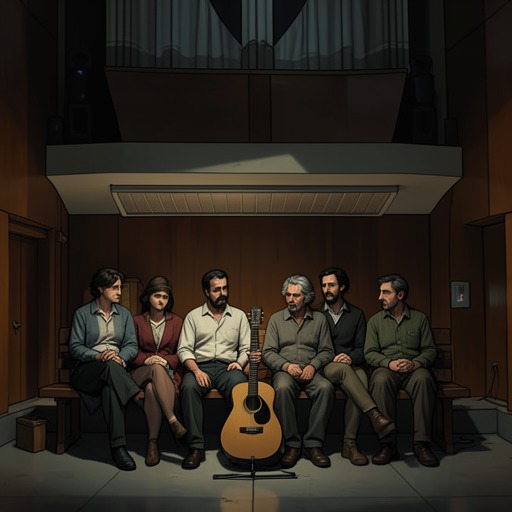
“City of Sadness”
The Sympathizer“City of Sadness” is performed at Fantasia, a gathering of Vietnamese exiles in Los Angeles, and becomes a musical emblem of the community’s portable attachment to Saigon. Its emotional force lies in a double movement: the song transports its listeners back toward the lost city, even as the scene asks whether sadness is something they have chosen or learned to live with because exile left them no alternative.
Performance at Fantasia
A singer in a bolero jacket performs a heartache-soaked version of Pham Duy’s “City of Sadness” in the lounge of the Roosevelt Hotel. The hotel, once associated with Hollywood glamour, has become shabby and unfashionable; Fantasia’s rented lounge, by contrast, is buoyant, with exiles dressed in tailored suits and ball gowns. Their polished appearance reflects new wages and a measure of comfort, but the song gives the evening a different center of gravity.
The unnamed narrator sits with Bon and orders cognac, then sends drinks to the grizzled captain and the affectless lieutenant at the bar. As performers take the stage, the gathered exiles are carried in memory across years and miles to the nightclubs of Saigon. In that recalled world, even champagne carries a trace of tears. The song is therefore not just a performance for an audience at a social evening: it helps make the distance between the gathering in Los Angeles and the remembered city emotionally traversable.
Sadness as a shared inheritance
The narrator treats the song’s title as more than a description of one place. Saigon has become a portable city, carried by people who have left it, and sadness is one of the words most readily available to their songs. The scene pauses over whether the exiles have come to hunger for sadness or have simply learned to enjoy what they were forced to endure. That uncertainty gives the performance its ache: music preserves a connection to home, but the connection is inseparable from loss.
The song’s emotional register belongs to a wider pattern in the exiles’ lives. A year after Saigon’s fall, the unnamed narrator writes to an aunt about their scattered community, whose members have been sent to different parts of the United States and depend on networks of correspondence and reunion. Families gather where they can, but attempts to recreate familiar food and custom make the absence of home newly tangible. Against that background, “City of Sadness” sounds both like remembrance and like evidence that remembrance cannot restore what has been lost.
Song, memory, and exile
Fantasia offers a temporary refuge that looks unlike a refugee camp: the exiles have jobs, money for cognac, formal clothes, and a room in which to gather. Yet the music returns them to Saigon, showing how material adjustment and emotional displacement coexist. The scene’s pleasure is real, but it does not cancel grief; indeed, the performance allows the gathering to share that grief without needing to explain it individually.
The surrounding cultural life also gives music a communal role. Nearly every performer and the emcee mention Saigon, while the emcee uses the evening to reflect on the differences and misunderstandings between American and Vietnamese life. The song sits within that public act of remembering, joining entertainment to cultural continuity. Its significance is not that it resolves exile, but that it gives the exiles a common language for carrying the lost city into their new surroundings.
A city carried in song
Elsewhere, the novel makes the refugees’ altered relation to place visible through a hardwood clock carved in the shape of Vietnam, with its dial organized around Saigon. The narrator observes that displacement is defined by time as much as by distance: return may be geographically possible, yet its waiting can stretch without limit. The song’s return to Saigon works in the same tension. Music can bring the city near in memory, but it cannot make the journey home happen.
That tension persists as the unnamed narrator and Bon prepare to leave Vietnam by boat, carrying a manuscript intended to represent themselves against those who would speak for them. The song at Fantasia belongs to an earlier moment in the exile’s chronology, but its central image anticipates this later departure: home remains present through memory, words, and shared cultural forms even when its people are scattered or forced to flee. “City of Sadness” names not simply a mournful place, but the burden and bond created when a community carries that place with it.