“Nothing” and Nothingness
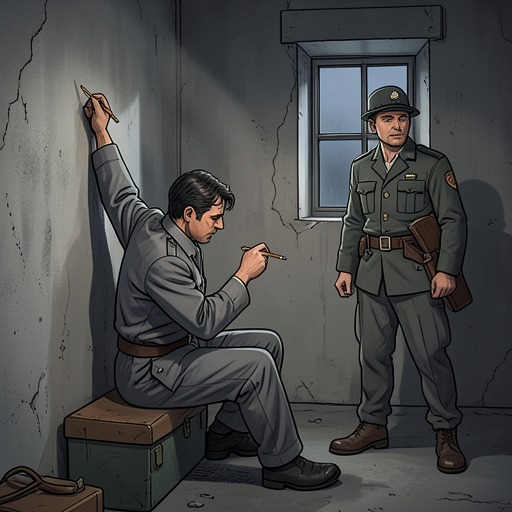
The Sympathizer“Nothing” and Nothingness is both the answer The unnamed narrator must discover to complete his reeducation and a paradox through which he understands himself and his revolution. At first, nothing seems to mean only absence: the blank, negative answer that makes freedom and independence worthless. By the end, that apparent void holds a second meaning. It can expose the emptiness of political slogans, but it can also name what a person wants when every available answer has been imposed by someone else.
The question and its failed answer
During his examination, The unnamed narrator is told that he already knows the answer to a question he must pass to finish reeducation. The question is, “What is more precious than independence and freedom?” He approaches it as a familiar test, confident that he can prove himself by supplying the obvious response. His mind seems to hold a solid answer, but he cannot bring it into focus; he offers the expected declaration that nothing is more precious than independence and freedom.
The response is nearly right, but not right enough. That distinction turns an apparently simple political formula into a trap: repeating its words does not mean understanding what they can mean. The voice asking the question belongs to his friend and comrade, who reminds him that warnings had been sent, but that their messages were watched and the narrator chose to return anyway. The question is therefore bound to the narrator’s own history of divided loyalties. Its answer cannot be memorized like an exam response; he has to reach it through the painful consequences of what he has done and wanted.
Desire, guilt, and the answer he cannot give
The question returns in a scene in which The Commandant and the commissar confront the narrator over his father’s death. The interrogation makes him face a letter to Man in which he had wished his father dead. He protests that he did not mean for his father to be killed, but recognizes that he wrote to a revolutionary friend who knew the force of words and understood his desires. The father was in fact killed by a bullet to the head, and the commissar says that his agent arranged the death. The Commandant considers whether the narrator is inventing the story to save the commissar; the narrator’s expressed wish is treated instead as evidence of what he wanted.
The Commandant’s political judgment further complicates the admission. In his view, the father was a colonizer and a religious spokesman whose faith had helped justify the sacrifice of millions. His death could thus be described as a just sentence rather than murder. That interpretation does not erase the narrator’s guilt or settle what his words caused. It shows how a private desire, a written sentence, and a political verdict can be made to converge without becoming identical.
When the commissar asks the question again, the narrator tries happiness, then love, before admitting that he does not know. At last he says that he wishes he were dead. The crapulent major and Sonny applaud, and the commissar draws his pistol. The answer has shifted from a slogan about what ought to be most precious to the narrator’s discovery of what he wants for himself. That discovery is not a clean liberation: it arrives through despair, after the question has been repeated until borrowed answers fail.
Birth, division, and the word
The narrator’s recognition is joined to a retelling of his birth. In a passage that bends time back to his origin, he imagines his father’s sperm invading his mother’s egg, his cells dividing, and his mother’s steady heartbeat enclosing him before he can see the world. The scene moves through several possible sources of a scream: the agent, his mother, and finally the narrator himself. The word he has been unable to find emerges as the word he screams again and again. Nothing is not merely an abstract solution to an examination; it becomes the utterance attached to his passage from the womb into a world of shadows and unfamiliar voices.
That origin scene makes the answer inseparable from his mixed and divided identity. The narrator sees himself as one person who is also two, and recalls how others have pressed him to choose between his sides. He connects that demand to Vietnam’s partition and to the country’s subjection to competing colonial and Cold War powers. His division is personal, but the account refuses to make it solely a personal failing: he describes a self and a country shaped by forces they did not freely choose. Nothing, in this context, is not a simple escape from identity. It names the impossible demand that he deny one part of himself in order to be accepted as whole.
Reeducation, laughter, and the double meaning
After the answer, the narrator says his reeducation is complete, but understanding first breaks into laughter, sobbing, and self-injury. In the examination room, he explains that nothing was the punch line. The realization makes him laugh so violently that The Commandant comes to investigate, interprets his behavior as madness, and worries about its effect on the camp. The commissar alone understands what the narrator means. The Commandant hears only a negative sense, an absence where nothing is there; the narrator now recognizes the paradox that nothing is also something.
That distinction turns the examination’s repeated question inside out. One version of the slogan asserts the supreme value of independence and freedom; another makes nothing the answer to what could be more precious. The words are nearly the same, yet their meanings pull in opposing directions. The joke depends on holding both meanings at once, rather than allowing an official formula to settle into a single, pious interpretation. The narrator’s laughter is therefore both the sign that the answer has reached him and an act that the authorities cannot comfortably classify. The Commandant calls for the doctor after the narrator beats his fists against his forehead and his head against the wall; the commissar recognizes that the pain belongs to the narrator’s attempt to punish himself for having missed the meaning.
A political slogan turned inside out
The final interpretation extends the paradox from the narrator’s divided self to revolutionary power. He describes the first, inspiring version of the slogan as Ho Chi Minh’s empty suit, no longer worn by its dead originator. The second is that suit turned inside out, with its seams exposed: the same language made to reveal how a revolution founded on freedom can deprive the defeated of freedom. In the narrator’s account, the revolution has moved from the vanguard of political change to a rearguard hoarding power. He places that reversal beside the French and Americans, who also became imperialists after once being revolutionaries. The point is not that these histories are identical, but that each can learn to use grand ideals to excuse domination.
The commissar’s fate gives the concept an intimate counterpart. He has tortured the narrator in the name of reeducation and friendship, yet helps set him free; the narrator recognizes him as a faceless man able to understand the meaning of nothing. The two men clasp hands, their red scars recalling a bond that has survived division. Before the narrator leaves, the commissar returns the battered rucksack and their copy of Asian Communism and the Oriental Mode of Destruction. Nothing thus holds contradiction rather than resolving it: freedom can be promised and withheld, friendship can coexist with torture, and an apparently empty word can disclose both political betrayal and a difficult recognition of the self.