“Two Minds” and the Divided Self
The Sympathizer“Two Minds” and the Divided Self is the unnamed narrator’s account of an identity that cannot be made whole by choosing one side over another. It begins as a personal condition, sharpened by the insults and demands imposed on him, but expands into a way of understanding Vietnam’s imposed divisions and the contradictions of revolution. In the final reeducation scenes, the idea also becomes a basis for recognizing Man: each is divided in a different way, and their friendship makes room for what others insist must be separated.
Identity Under Pressure
The narrator’s divided self is not presented as an abstract puzzle detached from his life. He understands himself as having two minds and two faces, while people around him repeatedly treat that condition as a defect that requires a single answer. During the sleep-deprivation interrogation, fear and exhaustion break his speech into a sequence of rejected identities: he says he is a nobody, then struggles through fragments such as “I am a lie, a keeper, a book” and “I am a fly, a creeper, a gook.” The rapid reversals make the pressure to name himself feel less like self-discovery than a demand imposed on a person whose language and identity are being broken down.
The narrator connects this personal fracture to being called a bastard. The word identifies his mixed parentage as a stigma, but his account refuses the premise that division can be cured by choosing one inherited side. The demand to choose one self against another is, in his view, impossible: it asks him to reject part of himself. The divided identity is therefore both intimate and social. It is felt within the self, but reinforced by other people’s insistence that a person must fit a single category.
A Personal Division Made Political
The narrator extends this logic from his own birth to Vietnam’s history. He recalls a country partitioned into north and south, then describes successive divisions imposed through colonial rule and the competing power of capitalism and communism. In his account, the French divided the country into north, center, and south; great powers then made it part of a Cold War contest. The comparison does not make an individual’s experience identical to a nation’s history. Rather, it shows how a political language of sides can repeat the same coercive demand at different scales: a person, like a country, is expected to belong wholly to one camp.
This historical analogy complicates any simple claim that division was freely chosen. The narrator allows that people may have participated in conflict, but insists that their choices were formed within histories they had not chosen. His own generation, he says, was divided before birth, just as he was divided at birth. The parallel makes his mixed identity more than a private burden: it becomes a way of registering the costs of colonialism, partition, and Cold War alignment without pretending that those forces and personal experience are interchangeable.
Man as Torturer, Friend, and Double
The idea becomes most concrete in the narrator’s relationship with Man. During the interrogation, Man is both the revolutionary comrade who inflicts pain and the friend who claims to do so out of friendship. The narrator fears him and begs for sleep, yet the treatment is also presented as Man’s attempt to make him understand the horrors of history. This collision of care and violence prevents either role from cancelling the other. Man’s friendship does not make the torture harmless, and the torture does not erase the bond between them.
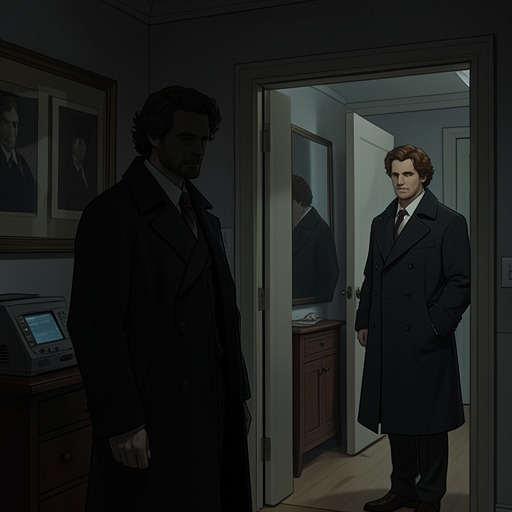
In their later meeting, the narrator recognizes a comparable division in Man. Man is at once the commissar and the old friend, the interrogator and the narrator’s confidant, the person who tortured him and the person who is helping him leave. The narrator does not claim certainty about Man’s intentions; he recognizes that he cannot know whether he is being deceived. Instead, the encounter makes uncertainty part of the relationship. Man’s facelessness and the narrator’s divided identity provide contrasting images of incomplete recognition, while the narrator’s reflection on mirrors questions the assumption that anyone appears most truthful when seen as whole and in focus.
Their shared red scars, described as marks of their brotherhood, give that recognition a physical sign. Before the narrator and Bon depart, Man returns their battered rucksack and their copy of Asian Communism and the Oriental Mode of Destruction, now held together with a rubber band after its binding has torn. He offers the book as a possible means of sending messages. The exchange does not reunite the friends or resolve their circumstances: Man remains in the camp, while the narrator is leaving. It does, however, preserve their connection through a shared mark and an object that can carry communication across separation.
Division, Recognition, and Political Meaning
The narrator’s understanding of divided identity changes from a source of shame and coercion into a means of recognizing contradiction in others. He does not arrive at a simple reconciliation in which the opposing parts disappear. Instead, he challenges the assumption that a self—or a relationship—must be reduced to one legible side. The people who demand a single answer treat division as evidence of monstrosity; the narrator’s encounter with Man shows that such a demand can conceal rather than clarify the truth of a person.
That recognition has a political edge. The narrator connects the revolution’s claim to independence and freedom with its later deprivation of those same goods from defeated compatriots. His divided perspective allows him to register both the liberation promised by revolutionary ideals and the repression carried out in their name. The resulting contradiction is not an excuse for the violence; it is the basis for seeing how ideals and their betrayal can coexist in the same political history. In this sense, two minds are not simply a personal peculiarity. They are the narrator’s way of refusing a forced choice between incompatible truths—and of recognizing that the demand for a single, unambiguous identity can itself be an instrument of power.